Starship HLS: Why Landing on the Moon Needs 15+ Refueling Launches
The short version
Tim Dodd of Everyday Astronaut examines whether Starship HLS is viable for Artemis. He covers its height and landing legs, methalox boil-off, and why a dozen or more tanker launches are needed. Using rocket-equation spreadsheets, he compares alternatives such as drop tanks, a stubby Starship, low lunar orbit and lunar-made oxygen.
Full written account
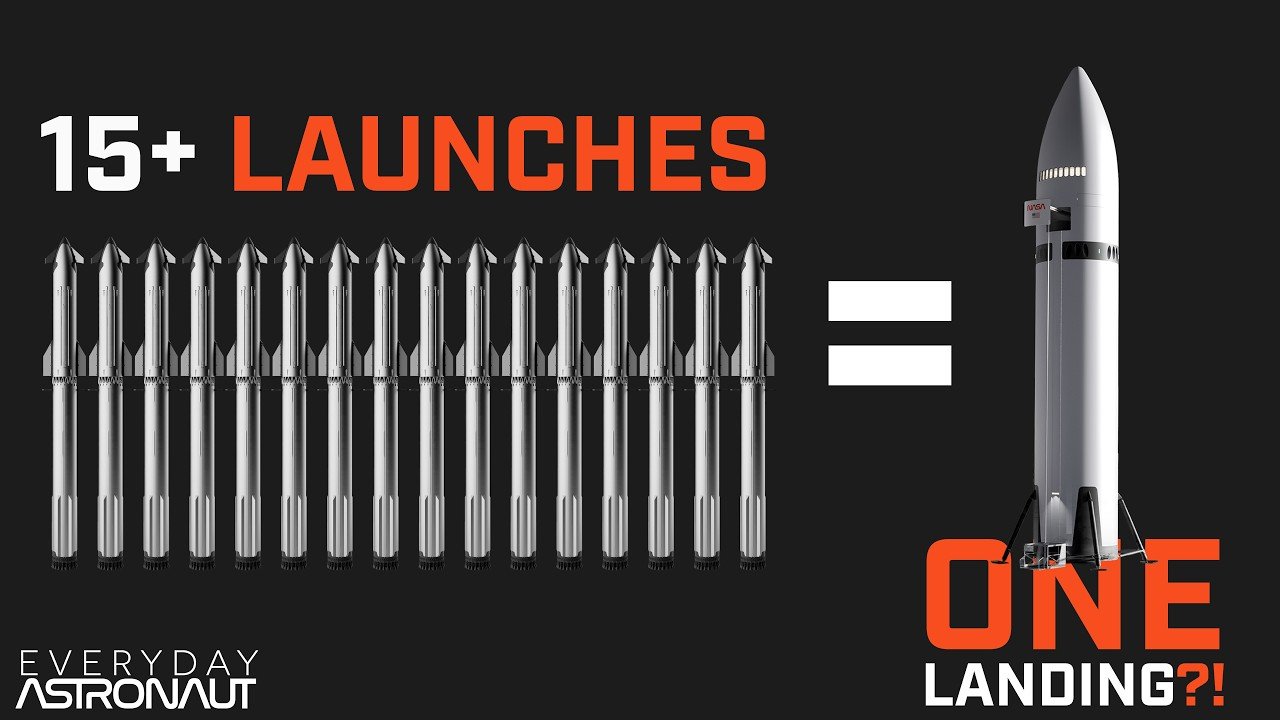
Landing one Starship on the Moon could take 14 or 15 tanker launches just to fill it in low Earth orbit, and that is only the first mission. That figure, worked out by Tim Dodd of Everyday Astronaut in a spreadsheet analysis of the Starship Human Landing System (HLS) for NASA's Artemis program, comes from one driving number: about 1,450 tons of propellant burned to reach low Earth orbit, which must be replaced at roughly 100 tons per Starship tanker. The analysis uses rough estimates, and Dodd says his numbers are not perfect; its purpose is to show which variables matter.
Why the lander is so large
Starship HLS replaces the standard upper stage. The upper stage is 9 m wide, over 50 m tall and over 100 metric tons dry. HLS would have a pressurized crew compartment, two airlocks near the top, an elevator, self-leveling landing legs and pressure-fed landing thrusters near the top of the vehicle. Dodd compares it with the Apollo lunar lander: roughly seven times taller, perhaps 100 times heavier on the Moon and with over 100 times the internal volume.
The Apollo lander that reached the surface weighed about seven or eight tons out of a rocket of almost 3,000 tons, about 0.25% of liftoff mass. Landing something like 500 tons on the Moon means getting about 8% of Starship's takeoff mass there. Using the Saturn V approach would need a rocket of roughly 200,000 tons, all expended. Starship hopes to be fully reusable, so the cost would in theory be mostly propellant.
Delta V and the baseline numbers
Delta V is the change in velocity a vehicle can achieve. It is calculated from exhaust velocity (specific impulse times 9.8) and the natural log of wet mass over dry mass. Because delta V does not scale linearly with propellant, this is the "tyranny of the rocket equation".
The estimates used: HLS dry mass around 120 tons and 1,600 tons of propellant, as on a version 3 Starship. Vacuum Raptors give about 380 s of specific impulse and sea level Raptors about 350 s, averaging 370 s with the sea level engines throttled to 66%. The landing thrusters get about 320 s. Super Heavy is estimated at about 250 tons dry with 3,650 tons of propellant, of which 450 tons is reserved for the boostback and landing burns. It can supply about 2,700 m/s, leaving Starship to provide almost 6,800 m/s to reach orbit.
Height, landing and the elevator
Starship's height-to-width ratio is over 5:1, against about 1:1.3 for the Apollo lander, which was 7 m tall and 9.4 m wide. Dodd notes that two of three recent commercial lunar landers tipped over. Using Kerbal Space Program, he shows that self-leveling legs can handle steep slopes, provided horizontal velocity is removed first. He still says he would prefer wider legs or a shorter HLS.
The landing thrusters sit high so exhaust spreads over a wider area and avoids digging a crater. A Raptor at minimum throttle produces about 1,500 kN, against a little over 45 kN at full throttle for the Apollo descent stage. At least two would run for roll control.
The 40 m cable-driven elevator is a concern, and NASA also expressed concern about the lack of a backup. Dodd suggests a ladder, battery winches or hoists, easier in one-sixth gravity. Landing on its side would put the thrusters only a couple of meters from the surface, make control harder because the center of mass shifts, and add structural loads.
Methalox and boil-off
Hypergolic propellants ignite on contact, but Dodd argues Raptor ignition should become reliable with enough flight data. The bigger issue is boil-off. Methane boils at -161° C and oxygen at -183° C, and losses can be as bad as 1% per day. Remedies include pointing the engines at the Sun, which cuts the exposed area from about 450 to about 64 square meters, multi-layer insulation, solar panels in front of a sunshade to power active cooling, and a vacuum jacket inside the tanks. Intuitive Machines' Nova-C landers already used methalox. Dodd gives reasons for it: commonality with Starship, higher performance than hypergolics, and the toxicity of hypergolics.
Refueling math
A full HLS would hold about 9,654 m/s of delta V. Reaching low Earth orbit may leave roughly 100 to 200 tons, so about 1,450 tons must be replaced. From there, translunar injection (about 3,100 m/s) and the insertion into near rectilinear halo orbit (NRHO, about 400 m/s) would use about 1,070 tons, leaving about 530 tons in NRHO. A landing and return needs about 5,400 m/s at minimum; Dodd aims for 6,000 m/s for margin.
Subsequent missions are costlier. The standard vehicle needs 555 tons delivered at the Moon, which means 1,842 tons loaded into a cislunar depot, or 18 and a half tankers.
Alternatives
- Fewer launches by expending Starship upper stages, which roughly doubles payload, or both stages, which gives almost three times the payload.
- Waiting for Starship to carry 150 to 200 tons per launch.
- Dropping tanks and engines after translunar injection. Ditching the Raptors and using landing thrusters is judged physically impossible because of pressurization; turbo pumps would cut propellant to about 510 tons but add complications.
- A drop tank on top of the crew cabin: about 425 tons per subsequent mission, and about 530 tons left in NRHO, enough for the full first mission. Dodd would pick this for early missions.
- A stubby Starship from the start: 360 tons of propellant and 75 tons dry. Its first mission still needs a refill at the Moon, with about 1,000 tons needed in the depot, roughly as many tankers as the standard design but with two dockings.
Low lunar orbit and lunar oxygen
Targeting low lunar orbit lowers each lander trip to about 4,500 m/s and saves roughly 200 m/s overall. The standard Starship then needs about 325 tons and a depot load of about 1,471 tons, down from 1,842. The benefit disappears if the depot is heavier than the lander. Orion currently cannot reach low lunar orbit.
Oxygen is 78.3% of Starship propellant by mass. If oxygen came from the Moon, only methane would need delivery: 74 tons for the standard vehicle, 630 tons in the depot, perhaps six launches on version 3 or four on version 4. Blue Origin is among those working on turning regolith into oxygen.
Questions this video answers
Why does Starship HLS need so many refueling launches?
The video says it is because the lander is massive, about 500 tons landed on the Moon, so it has to be filled with propellant in low Earth orbit, with Starship's payload of 100 tons per launch.
How many tanker launches does the first mission need?
Roughly 14 or 15 tanker launches to fill it in low Earth orbit for the first mission, based on 1,450 tons of propellant at 100 tons per launch.
Could Starship HLS land without tipping over?
Yes, in theory, with self-leveling landing legs, high-mounted diffuse landing thrusters, and all horizontal velocity removed before touchdown.
What is the main problem with methalox?
Boil-off, which can be as bad as 1% per day. Orienting engines toward the Sun, multi-layer insulation, active cooling and vacuum-jacketed tanks can greatly reduce it.
How could the number of launches be reduced?
The video suggests expending some stages, waiting for larger payloads such as 150 or 200 tons per launch, a drop-tank design, or a stubby Starship, and later making oxygen on the Moon.
Explore related missions
Connected by the topic: Artemis