Inside the ISS: Building, Training and Science in Orbit
The short version
A documentary tour of the International Space Station told partly through ESA astronaut Thomas Pesquet as he prepares for a six-month stay. It covers how the station was built, daily life aboard, astronaut selection and training, medical and plant experiments, and the station's uncertain future.
Full written account
How does a station the size of a football field, assembled in orbit by sixteen nations, keep working, and what do the people aboard actually do there? A documentary following European astronaut Thomas Pesquet through training and his six-month stay answers with the International Space Station's construction, its daily routine and its research.
Building the station
The ISS was assembled entirely in space over 13 years, beginning in 1998. It took no less than 140 space shuttle and rocket launches to carry up the modules and the people who installed them. The first component was the Russian-built central module, launched in 1998. American, Russian, European, Canadian and Japanese space agencies, representing 16 nations, took part. The agreement for the station was signed on January 29, 1998, which the film describes as the transition from competition to cooperation. The station cost 150 billion dollars.
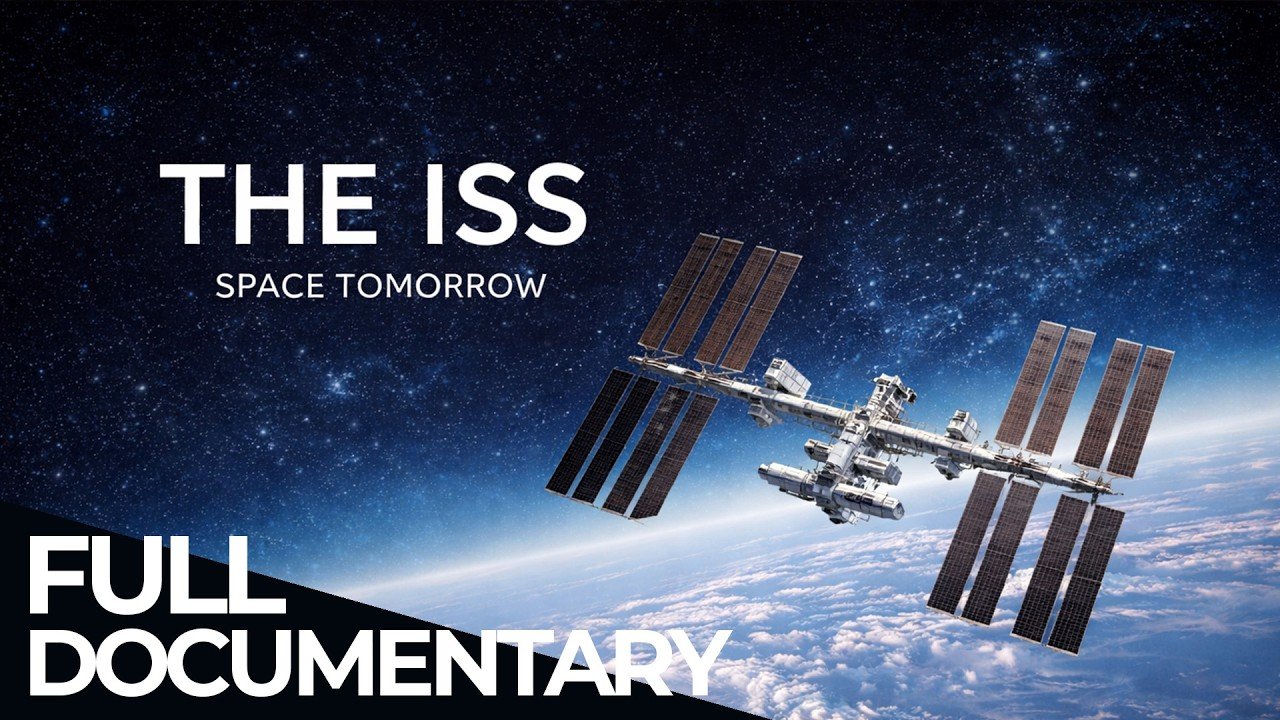
The modules sit on either side of a 108 m truss structure, the backbone of the station, which supports the solar arrays that provide electricity. Together the modules form a living space the size of a Boeing 747, almost windowless.
One of them, Columbus, is the largest European contribution. It was carried in the hold of an American space shuttle by seven astronauts in the winter of 2008 and docked almost entirely manually. After the connection, the section between the two modules was pressurized so the door could be opened.
Living aboard
The station circles the Earth 16 times a day at 28,000 km/h, about 8 km/s, so crews see the sun rise and set 16 times a day. Atmospheric friction, even at around 400 km, makes it lose about 10 meters of altitude per day. A thruster on the back of the station pushes it higher about every 2 months.
To keep bearings, the schedule follows Greenwich Mean Time: work from Monday to Saturday, housework at the weekend, rest on Sunday. Crews generally use the modules provided by their own country. Russians eat in their own area, while Americans and Japanese share another, with no borders between segments. Food comes from the US, Japan and Russia. The Cupola, reached through the Tranquility module, is described as the station's only window onto Earth, and observing the planet is a main free-time activity.
Becoming an astronaut
ESA's 2008 recruitment campaign drew 8,400 candidates. Pesquet was selected at 31, and the final phases took six of ten candidates. Seven years passed between selection and departure. Training included learning Russian, since all crews travel on the Russian Soyuz in custom-molded seats, and a six-day confinement underground in Sardinia with six people from five nations. Pesquet's flight left from the Baikonur Cosmodrome; engines cut off 8 minutes 32 seconds after liftoff.
Research and the body
About 210 tests are carried out during a 6-month mission, including blood tests and eye scans. Astronauts develop a "moon face" and "chicken legs" through fluid redistribution, and lose calcium, blood volume and muscle mass. Gym work takes 2 and a half hours per day.
Professor Arbeille's robotically controlled ultrasound probe, tested with a doctor in Richelieu 60 km from him, was taken into space. He reports that after 6 months astronauts had artery walls as thick as those of people 30 years older. This is reversible after 6 months, but unknown after 18. He suggests the cause is stress rather than microgravity.
Plant experiments by a Paris Museum of Natural History team flew in 2010. Proteins showed the plants were stressed inside despite a healthy look. In 2015, astronauts grew and tasted the first space lettuce.
Future
The station's end was first programmed for 2011, then 2016, and has been extended again. Pesquet says no other program is planned before 2025.
Questions this video answers
How big is the International Space Station?
The documentary describes it as the size of a football field, with modules that together form a living space the size of a Boeing 747, and a 108-m truss as its backbone.
How long did it take to build the ISS?
It was assembled in space over 13 years beginning in 1998, using no less than 140 space shuttle and rocket launches.
How fast and how high does the ISS fly?
About 28,000 km/h (8 km/s) at around 400 km altitude, circling the Earth 16 times a day. It loses around 10 meters of altitude per day and is pushed higher about every 2 months.
How do astronauts get to the station?
In the film, Thomas Pesquet travels aboard the Russian Soyuz spacecraft, launched from the Baikonur Cosmodrome.
Why does the ISS matter for life on Earth?
Experiments include remotely controlled ultrasound, tested for use in isolated areas, and research on arterial ageing and plant growth.