New Horizons at Pluto: Heart, Mountains and 20 Haze Layers
The short version
NASA's New Horizons probe flew past Pluto in 2015 after a nine-year journey, passing about 12,500 kilometers from the surface on 14 July. The video walks through what it found: the heart-shaped ice plain, water-ice mountains, possible cryovolcanoes, dark tholin deposits, an atmosphere with up to 20 haze layers, and the unusual relationship between Pluto and Charon.
Full written account
In 2015, after a nine-year journey, NASA's New Horizons probe flew by Pluto and gave scientists detail of the dwarf planet and its moons they had never had. Until then, the best image of the system came from Hubble, which could see only a few blobs of color variation. On 14 July the probe made its closest approach, at only 12,500 kilometers from the surface.
Launch and the road to Pluto
New Horizons launched in 2006 as part of NASA's New Frontiers program for medium budget space missions. The goal was to reach Pluto as soon as possible. As a light spacecraft on the Atlas 5, it passed the Moon in only nine hours, which the video says is a tenth of the time the Apollo missions took. It used Jupiter as a gravity assist, shaving three years off the arrival time, and as a trial run for its systems. It then went into hibernation mode to prevent wear and tear on its instruments, and was turned back on ahead of the 2015 approach.
Waiting for the data
During the flyby the probe was too busy taking photos to send anything back immediately. When transfer began, the uplink speed was only one kilobit per second, and there was a 4.5 hour latency between the spacecraft and Earth. What arrived showed mountain ranges, ice plains, glaciers and an atmosphere.
Pluto and Charon
Charon orbits very closely to Pluto and is very big in comparison, so the barycentre of the two lies outside Pluto and both orbit a point in space. The two are tidally locked to each other, so from one the other does not move in the sky. Charon is much darker than Pluto, which implies they are not from the same origin. The other moons are only a few kilometers across, with exceptionally circular, coplanar orbits.
The heart and the ice
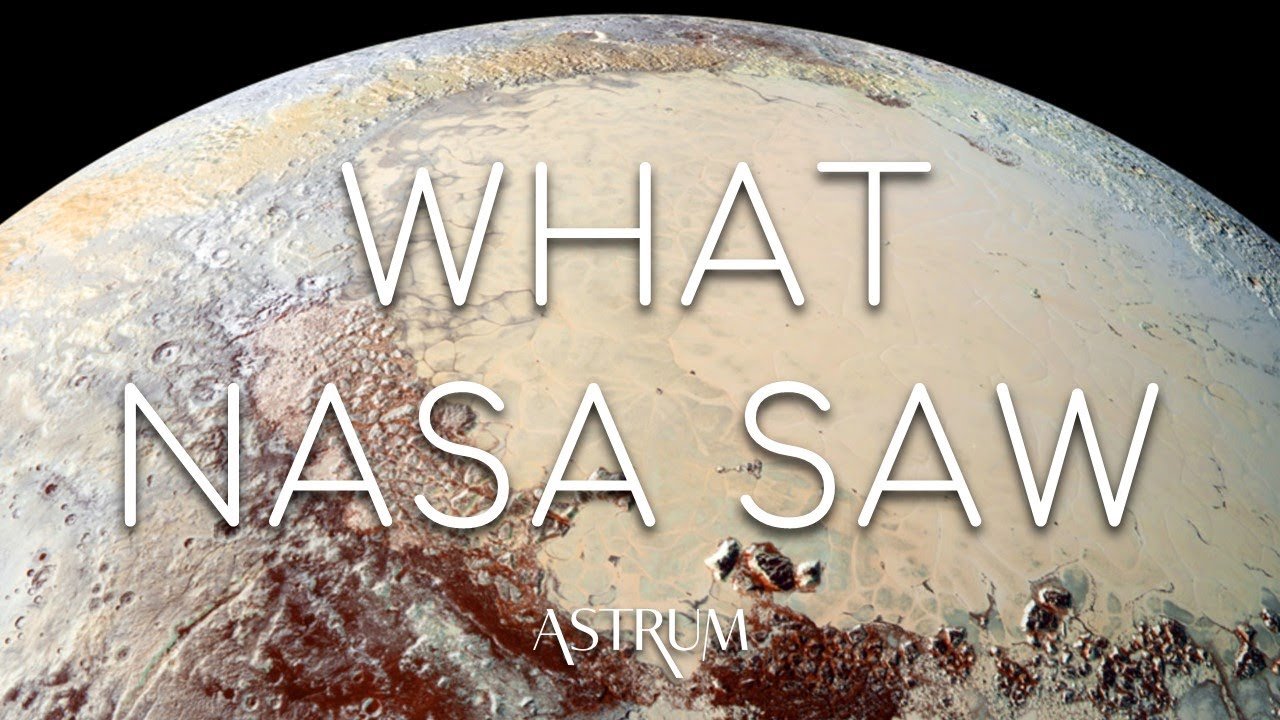
The biggest feature is a giant heart shape, since named Sputnik Planitia, about the size of Texas. It is a giant ice plain with strong color contrast. The flyby confirmed that 98% of the surface is nitrogen ice. The average surface temperature is minus 229 degrees Celsius, at which water ice is rigid and brittle but nitrogen ice can flow as glaciers, seen around the heart's edge. The plain has giant polygon shapes and no craters, so it is relatively new or continually renewed, perhaps only ten million years old. The ridges on the polygonal cells are likely caused by sublimation. It is not known for certain how it formed; it could be an impact basin filled by ice from a potential subsurface liquid ocean.
Mountains, dark regions and snakeskin terrain
Surrounding mountain ranges are made of water ice, the only ice strong enough to support heights of several kilometers. Wright Mons, four kilometers tall with a huge central depression, is a likely cryovolcano candidate. Cthulhu Macula is a large dark area thought to be a deposit of tholins, a tar of hydrocarbons altered by sunlight; it is much more heavily cratered, implying an older surface. Mountains there are topped with what is thought to be methane ice. Tartarus Dorsa has 500 meter high mountains resembling snakeskin or tree bark, thought to be penitentes, which on Earth are rare and found in places such as the Atacama Desert.
Atmosphere
New Horizons confirmed that Pluto has an atmosphere, which extends high because of the weak gravity. Surface pressure is roughly 10 microbars, 100,000 to 1 million times weaker than on Earth. Density can vary by a factor of four within one year due to seasonal variations. The probe found up to 20 haze layers, more than expected, and they are not level across the planet; in one image a layer sits high above the surface while on the other side it touches the ground.
New Horizons was then headed for a flyby of the small Kuiper belt object 2014 MU69, due on 1 January 2019.
Questions this video answers
When did New Horizons make its closest approach to Pluto?
New Horizons made its closest approach on 14 July 2015, at only 12,500 kilometers from Pluto's surface.
When and how did New Horizons launch?
It launched in 2006 as part of NASA's New Frontiers program for medium budget space missions, on an Atlas 5 rocket.
What is the heart on Pluto?
A giant heart-shaped ice plain, since named Sputnik Planitia, about the size of Texas. It is a giant ice plain with a strong color contrast to its surroundings.
Does Pluto have an atmosphere?
Yes. New Horizons confirmed that Pluto has an atmosphere, with up to 20 haze layers.
Why did the data take so long to arrive?
Data transfer ran at an uplink speed of only one kilobit per second, with a 4.5 hour latency between the spacecraft and Earth.
Explore related missions
Connected by the topic: Deep space