Mission timeline
Apollo 13, hour by hour
At 55 hours, 54 minutes and 53 seconds into the flight, on the evening of 13 April 1970, an oxygen tank in Apollo 13's service module failed. All three astronauts came home. This page follows the flight hour by hour from NASA's own records, sets out the cause as the Review Board found it, and puts the best videos in order.
The viewing path
A suggested order, not a chronological timeline.
5 videos
-
1970Apollo 13
Apollo 13 Hour by Hour: Tank Explosion and the Lifeboat Return
Why it belongs
The quickest way in: 20 minutes from launch to splashdown. The bang is at 7:25, the cause at 8:14, the move into the lunar module at 12:01 and the improvised carbon dioxide filters at 16:11.
Play: Apollo 13 Hour by Hour: Tank Explosion and the Lifeboat Return Read & explore: Apollo 13 Hour by Hour: Tank Explosion and the Lifeboat Return
-
1970Apollo 13
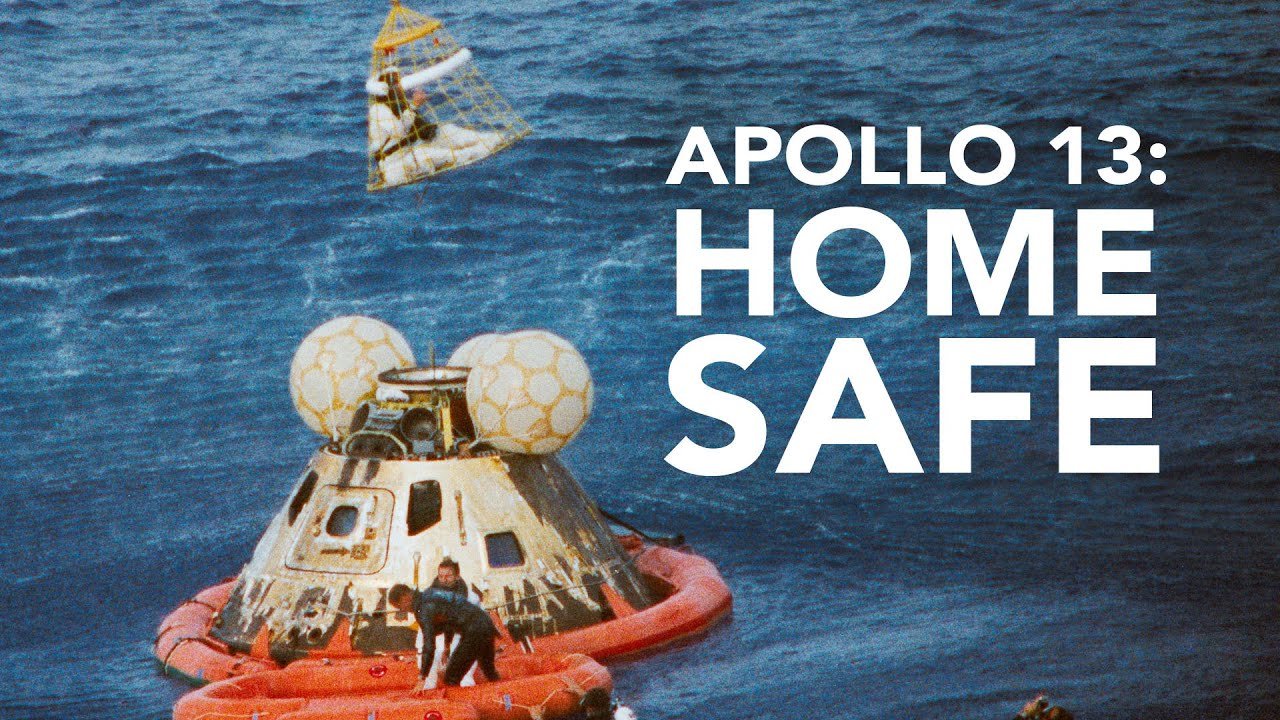
Home Safe, Survival After the Oxygen Tank Explosion
Why it belongs
NASA's own documentary, with Jim Lovell, Fred Haise and flight directors Gene Kranz and Glynn Lunney. The request to stir the tanks and the bang are at 3:45; the manual burn using the Earth's terminator is at 17:28.
Play: Apollo 13: Home Safe, Survival After the Oxygen Tank Explosion Read & explore: Apollo 13: Home Safe, Survival After the Oxygen Tank Explosion
-
1970Apollo 13
How the Lunar Module Became a Lifeboat After the Blast
Why it belongs
The long version at 2 hours 20 minutes, built from the mission voice recordings and the Review Board report. It starts with the history of oxygen tank 2 (3:55) before launch (10:00), and stays with the crew through the burn behind the Moon.
Play: Apollo 13: How the Lunar Module Became a Lifeboat After the Blast Read & explore: Apollo 13: How the Lunar Module Became a Lifeboat After the Blast
-
1970Apollo 13
How a Wrecked Spacecraft Brought Its Crew Home
Why it belongs
A 40-minute account assembled from NASA's recordings. Use it for the second half of the flight: the lifeboat days, the cold, the carbon dioxide problem, the course correction and the return.
Play: Apollo 13: How a Wrecked Spacecraft Brought Its Crew Home Read & explore: Apollo 13: How a Wrecked Spacecraft Brought Its Crew Home
-
Artemis II
Artemis II Passes Apollo 13’s Distance Record on Lunar Approach
Why it belongs
Where the record fell. At 27:30 in this live watch, Orion's crew passes the distance Apollo 13 set in 1970, and at 35:07 the host explains why Apollo 13 flew a free-return path. It is a long stream, so jump to those times.
Play: Artemis II Passes Apollo 13’s Distance Record on Lunar Approach Read & explore: Artemis II Passes Apollo 13’s Distance Record on Lunar Approach



About this collection
What went wrong, in short
NASA’s Review Board, chaired by Edgar Cortright and reporting on 15 June 1970, concluded that “an electrically initiated fire in oxygen tank no. 2 in the service module” caused the accident. It was “not the result of a chance malfunction in a statistical sense,” the chairman said, but of “an unusual combination of mistakes, coupled with a somewhat deficient and unforgiving design.”
The chain, as the Board’s report sets it out:
- 1965. The tank’s heater specification changed from 28 volts, the spacecraft supply, to 65 volts so the tank could be pressurised faster on the ground. The thermostatic switches that protect the heater were not changed. They worked at 28 volts and “could not open properly at 65 V dc.”
- October 1968. The oxygen shelf was dropped about two inches while it was being removed at North American Rockwell. The tank held a loosely fitting fill tube that was probably displaced.
- 27 March 1970. At Kennedy Space Center, tank 2 would not empty normally during a launch-countdown test. Technicians ran its heaters on 65-volt ground power for about eight hours. The switches did not open, and the heater tubes may have reached 1,000 degrees Fahrenheit. The tank’s temperature gauge read only up to 85, so no one saw it. The heat damaged the Teflon insulation on the wiring inside the tank. The Board noted that the procedures did not violate the specifications for the heaters.
- 13 April 1970. Houston asked the crew to stir the tanks. At 55:53:20 the fan in tank 2 came on. The Board judged the most probable start to be a short circuit with arcing in the fan wiring, releasing 10 to 20 joules. That lit the damaged insulation, the pressure climbed to 1,008 psia, and at 55:54:53 the tank failed.
NASA’s history account of the report adds that engineers chose not to replace the tank after the March tests, to avoid a costly launch delay. The rupture blew the bay 4 panel off the service module, damaged the high-gain antenna and, the Board found, tank 1 or its plumbing. Without oxygen the fuel cells stopped producing electricity.
The crew
- Jim Lovell, commander, flew the lunar module Aquarius.
- Jack Swigert, command module pilot, flew Odyssey. He joined the crew days before launch when Ken Mattingly was grounded after exposure to German measles.
- Fred Haise, lunar module pilot.
- In Houston, Joe Kerwin read the carbon dioxide procedure to the crew, and Gene Kranz and Glynn Lunney led the flight control teams.
The flight, hour by hour
Times are ground elapsed time (GET), hours:minutes:seconds from liftoff, taken from NASA’s Apollo Flight Journal and the Review Board report. Liftoff was at 19:13:00 UTC on 11 April 1970, 1:13 p.m. in Houston.
- 00:00:00. A Saturn V lifts Apollo 13 from Kennedy Space Center. The centre engine of the second stage shuts down early and the others burn longer to make up for it.
- 55:53:20. At Houston’s request, the fans in the oxygen tanks are switched on.
- 55:54:53. The crew hears a loud bang. Telemetry drops out for 1.8 seconds. This was 9:08 p.m. in Houston on 13 April, about 205,000 miles from Earth.
- 55:55:20. Jack Swigert: “we’ve had a problem here.” 55:55:35. Jim Lovell: “Ah, Houston, we’ve had a problem. We’ve had a Main B Bus Undervolt.” The line is often quoted as “we have a problem”. The transcript says “we’ve had”.
- 56:09:07. Lovell: “We are venting something out into the… into space.”
- 56:16:08. Capsule communicator Jack Lousma: “Do powerdown until we get a Delta of 10 amps.” Within minutes the lunar module is the plan: at 56:44:53 Kranz asks for the minimum power in the lunar module to keep the crew alive.
- 61:29:42. A burn of about 31 seconds from the lunar module’s descent engine puts the spacecraft back on a free-return path, one that loops round the Moon and comes back to Earth. Without further burns, the return would have ended in the Indian Ocean at 151:45.
- About 77:08. Closest approach to the Moon, 254 kilometres above the surface, then about 25 minutes out of radio contact behind it. Contact returns at about 77:33:50.
- 79:27:38. The “PC+2” burn, two hours after closest approach: 4 minutes 24 seconds on the descent engine. It brings splashdown forward to 142:54, almost nine hours sooner.
- About 89:08 to 93:54. Carbon dioxide is rising in the lunar module. Mission Control works out how to fit command module canisters to the lunar module’s system. Kerwin begins reading the procedure at 90:22:50, Swigert reports the first canister change complete at 91:10:26, and the second is done by about 93:53.
- 105:18:32. The manual course correction: a burn of about 15 seconds on the descent engine, aimed by lining up the spacecraft on the Earth’s terminator, the line between day and night. It sets the angle at which the capsule will meet the atmosphere.
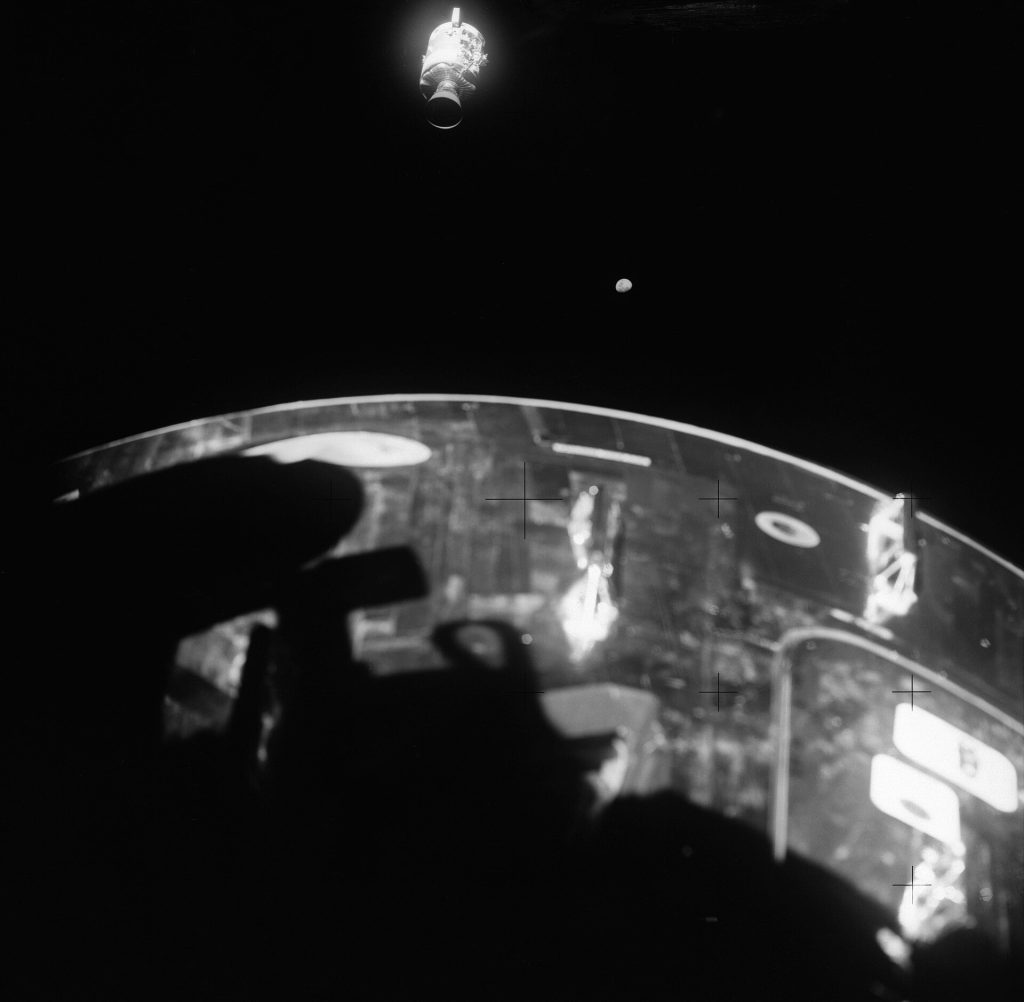
- 138:02:08. The service module is released. Lovell sees the damage: “there’s one whole side of that spacecraft missing.”
- 141:30. The lunar module is jettisoned. Joe Kerwin: “Farewell, Aquarius, and we thank you.”
- 142:40:39. Entry interface. The planned radio blackout is about three minutes.
- 142:54:41. Splashdown in the South Pacific at 18:07:41 UTC on 17 April, near the recovery ship USS Iwo Jima. The flight lasted 5 days, 22 hours, 54 minutes.
How did they fix the carbon dioxide?
The lunar module was built for two men for about two days, and it kept three alive for about four. Its lithium hydroxide canisters, which absorb carbon dioxide, were running out. The command module had spare canisters of a different shape. Following Houston’s procedure, the crew built an adapter from what was aboard: two command module canisters, two plastic bags, a cardboard lunar module cue card cut to about 11 by 6 inches, suit hoses and gray tape. They taped the cardboard into an arch to keep the bag from collapsing against the screen and routed cabin air through it. NASA’s photo captions call it the “mail box.”
Where does Artemis II come in?
Apollo 13’s free-return path also carried it farther from Earth than any crew before: about 248,655 miles (400,171 kilometres). Artemis II passed that mark on 6 April 2026, and news reports put its maximum at about 252,756 miles. The last video in the path above is the live watch of that moment.
What we don’t know
The tank was lost with the service module, so the Board worked from the telemetry, the crew’s photographs of the damage, ground tests and the pre-flight records. It calls the arc in the fan wiring the most probable start, not a proven one.
What the next crews carried forward
The Board asked NASA to redesign and recertify the service module’s oxygen system, to review every Apollo system that used liquid oxygen, and to make sure anomaly reviews included each component’s complete history. Apollo 14 and later flights got a third oxygen tank in a different bay, upgraded thermostats, no stirring fans and stainless steel sheathing on the wiring. The investigation and the redesign pushed Apollo 14 from October 1970 to January 1971. Apollo 13 itself remains NASA’s “successful failure”: the landing was lost and the crew was saved.
Go deeper
- The Apollo 13 mission page has the video timeline, and the Apollo programme page puts it among the other flights.
- The Saturn V and the Apollo spacecraft pages list the videos on the hardware.
- Where we've been shows that the Moon is the only world people have walked on.
- New videos by email: get the updates.
Sources
- NASA, Report of Apollo 13 Review Board, 15 June 1970 (findings, determinations, accident sequence).
- NASA History, 50 Years Ago: Apollo 13 Review Board Report.
- NASA, Apollo 13 Flight Journal: the problem, free return, leaving the Moon, the CO2 adapter, service module separation, farewell, Aquarius, splashdown.
- NASA Space Science Data Coordinated Archive, Apollo 13 (launch and splashdown times).
- NASA, Apollo 13 mission page.
Facts checked against the sources above on 3 November 2026. The closest-approach altitude, Apollo 13’s distance record and the Artemis II distance come from reference works and news reports citing NASA, not from the pages linked above.