Apollo 11: From Sputnik to the First Landing in the Sea of Tranquility
The short version
This documentary traces the road to Apollo 11, from Sputnik and Kennedy's 1961 goal through Mercury, Gemini and the early Apollo flights. It then follows the July 1969 launch, the Eagle's landing in the Sea of Tranquility with a 1202 alarm and low fuel, and Armstrong's first step on the Moon.
Full written account
Apollo 11 launched on July 16, 1969, carrying Neil Armstrong, Michael Collins and Buzz Aldrin toward the first attempt at landing people on the Moon. It came less than nine years after the United States had gone from, in the documentary's words, space amateur to technological hyperpower. By 1961, when President Kennedy set the goal of a landing before the decade was out, the country had successfully launched only 12 satellites and had seen 16 further attempts fail.
A race the United States was losing
The Soviet Union launched Sputnik, an 83-kg sphere with a beeping radio transmitter, in October 1957 on the heavy-lift R-7 rocket. Two days later it tested a giant thermonuclear bomb, and Americans linked the two events. In December 1957 a Vanguard rocket was to lift a tiny 1-kg payload; the failure was an intense humiliation. The army's Redstone-based Juno I then put a satellite up in 1958, and NASA was established later that year. By 1959 the United States had attempted 20 satellite launches, and only eight had succeeded.
Yuri Gagarin flew Vostok 1 on April 12, 1961, completing one orbit in 108 minutes. Alan Shepard's suborbital flight in Freedom 7 followed three weeks later, reaching 187 km and ending 15 minutes later in the Atlantic. Kennedy's moon-landing commitment came about three weeks after that.
Choosing lunar orbit rendezvous
NASA had no clear idea how to do it. Direct ascent and Earth-orbit rendezvous both needed a huge rocket, and designs for the giant Nova were studied. Langley engineer John Houbolt argued for a third method, a rendezvous in lunar orbit with a dedicated lander that could be discarded. At a time when two craft meeting in Earth orbit seemed a tremendous challenge, the idea was seen as madness and dismissed. Frustrated at being blocked from higher management, Houbolt wrote a strongly worded letter to the NASA administrator, insisting a man could reach the Moon without Nova. The theory was scrutinized, the plan proved sound, and when Wernher von Braun became convinced, lunar orbit rendezvous was adopted.
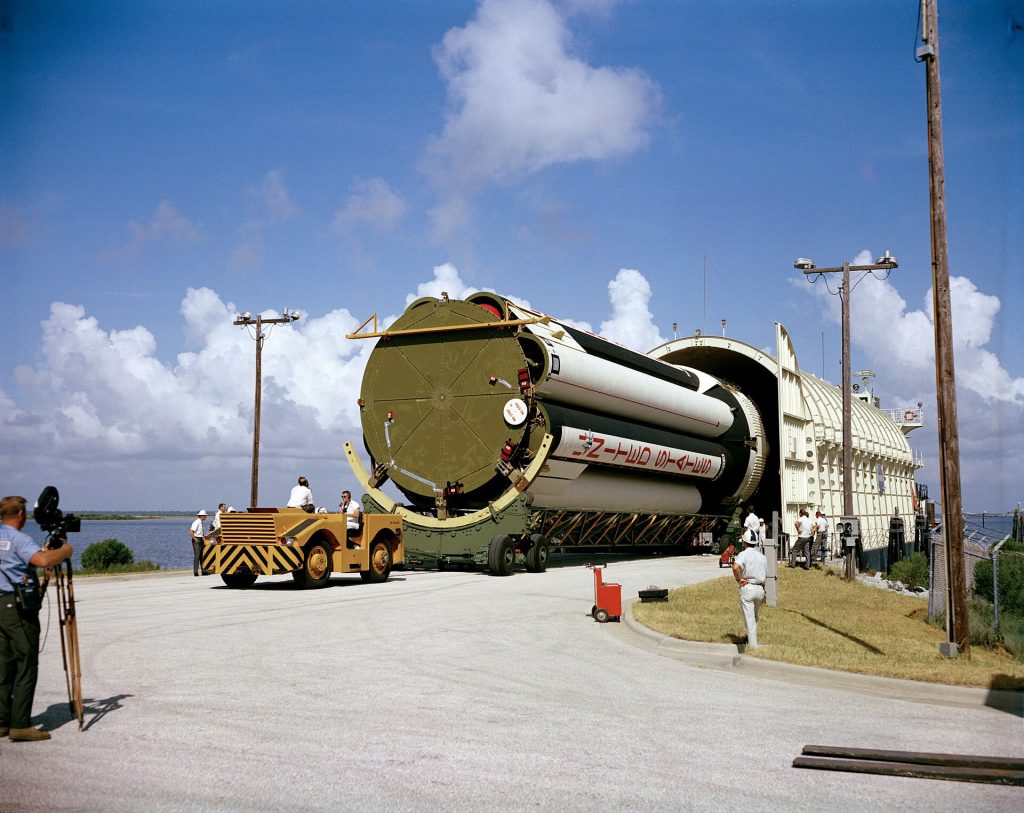
The launcher line was built on the Saturn I, which clustered eight H-1 engines, a descendant of the engine behind the V-2. Engineers decided every component would be tested exhaustively before launch, and the H-1 had to deliver 99% reliability. The first Saturn flight in October 1961 performed flawlessly. The Saturn V that would take men to the Moon replaced the clustered tanks with larger, lighter single tanks and the eight H-1s with five much larger F-1 engines.
Gemini: learning the skills
Because of the rendezvous plan, Project Gemini was added before Apollo, with a two-man capsule on a Titan II. Its objectives were orbital rendezvous, routine docking and surviving outside in a pressure suit. Soviet achievements kept pace: Alexei Leonov left Voskhod 2 in March 1965, and his suit swelled so much that he had to vent pressure drastically to get back into the airlock.
The Gemini record was mixed:
- Gemini 4: Ed White's spacewalk, on an 8-m tether, with a jammed hatch and a zip gun running low on gas.
- Gemini 6 and 7: the Agena target for Gemini 6 exploded, so Gemini 6A was reassigned to rendezvous with Gemini 7. Gemini 6 had a plug release early and force a shutdown at ignition. Within six hours of the later launch, the two craft were side by side.
- Gemini 8: Armstrong and Dave Scott docked with an Agena, but a stuck-on yaw thruster sent the docked craft spinning. Armstrong separated them, and flight rules called for a prompt return.
- Gemini 9: the target adapter's shroud stayed in place, nicknamed the angry alligator, and Cernan's spacewalk left him exhausted with his helmet fogging.
- Gemini 11: a direct ascent rendezvous just 94 minutes after launch, the type planned for Apollo.
- Gemini 12: after neutralbuoyancy training, restraints and scheduled rest periods, Aldrin's spacewalks were straightforward.
Apollo 1 and the redesign
On January 27, 1967, Gus Grissom, Ed White and Roger Chaffee were doing a plugs-out test, a launch simulation, with the Saturn 1B not fueled. A spike in voltage triggered a flash fire, and in seconds the crew were dead. Flammable materials and a pure oxygen atmosphere were a lethal combination, and high pressure made the inward-swinging door difficult to open. Flight director Gene Kranz told colleagues, "We were too gung-ho about the schedule." Frank Borman was the only astronaut on NASA's accident review board, and his testimony helped convince Congress the program was safe to resume.
The command module was redesigned: the hatch opened outward and could be unlocked quickly, wiring was shielded in non-flammable sleeves, and combustible materials were excluded. Apollo suits dropped flammable materials too.
Rehearsals
Apollo 4 in November 1967 was the first Saturn V launch, an all-up test of all stages together, which would eliminate four launches. About 90% of its launch weight was explosive fuel, and a low-altitude failure would almost certainly have made NASA miss the 1969 deadline. There were no surprises. Apollo 7, in October 1968, was marked by colds, disputes with mission control and a refusal to wear helmets for reentry; Schirra, Eisele and Cunningham never flew again.
When lunar module problems threatened a delay of many months, Apollo 8 was changed to fly to the Moon without a lander, partly because intelligence suggested the Soviets planned something similar. The crew of Borman, Lovell and Anders entered lunar orbit with a four-minute burn behind the Moon and made 10 orbits. Apollo 9 tested the lunar module, called Spider, with the command module Gumdrop, in Earth orbit in March 1969. Apollo 10 took Stafford, Cernan and Young to lunar orbit; the lander Snoopy had been short-fueled so that it could not land. A guidance switch in the wrong position made it gyrate wildly before Stafford regained control by dumping the descent stage and flying manually.
July 1969
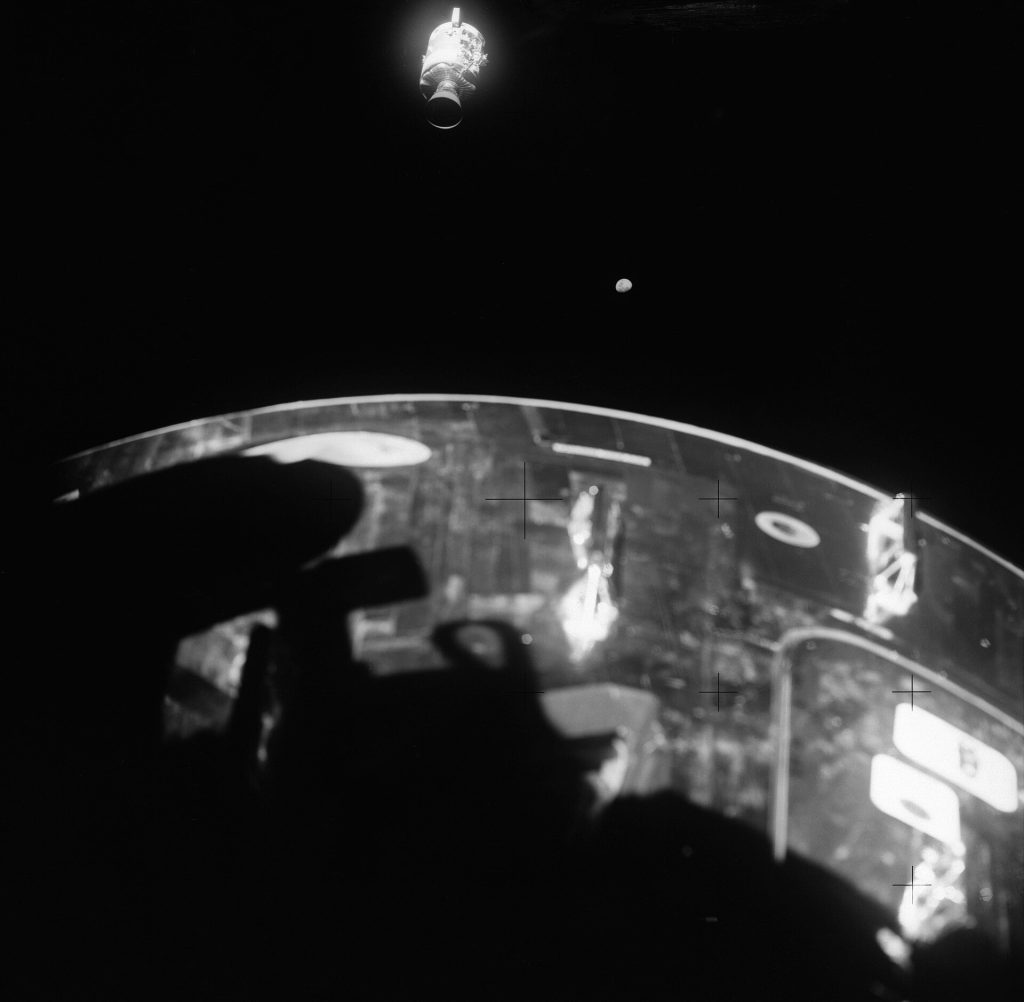
More than a million people crowded the roads and causeways around Cape Canaveral. Experts in the space business put the chance of success at no better than 50/50. Twelve minutes after launch, Apollo 11 was in low Earth orbit. During the 13th lunar orbit, the lunar module separated and the craft took the call signs Columbia and Eagle.
Descent had three stages, each with its own computer program. Fuel sloshing in the tanks muddied the landing-site indication. Then the computer sounded a 1202 alarm; only one person in Mission Control knew what it meant, a young software engineer who understood that the computer was overloaded but could still handle critical functions. The mission continued. Heading for a field of large boulders, Armstrong took control, and the descent took longer than anyone expected. Fuel was running low, with 60 seconds called, then 30. After the contact light and engine stop, Armstrong reported: "Tranquility Base here. The Eagle has landed." Mission Control replied that a bunch of guys were about to turn blue. No one had a clear idea of Eagle's exact location.
Seven hours later Armstrong climbed down the ladder while 600 million people watched. He and Aldrin spent two and a half hours on the surface. The return was smooth, and the three were celebrated in ticker-tape parades. The final three scheduled moon landings were soon canceled, the Apollo program ended in 1972, and nobody has been back to the Moon since.
Questions this video answers
When did Apollo 11 launch?
On July 16, 1969, according to the documentary.
Who was on Apollo 11?
Neil Armstrong, Buzz Aldrin and Michael Collins.
What was the 1202 alarm?
The flight computer sounded a 1202 alarm during descent; a young software engineer in Mission Control understood it was overloaded but could still handle critical functions, so the mission continued.
Why did Armstrong take over the landing?
Armstrong took manual control because Eagle was heading for a field of large boulders, and fuel was running low.
How was the landing method chosen?
Lunar orbit rendezvous, proposed by Langley engineer John Houbolt and adopted after Wernher von Braun became convinced.