Apollo 11: Landing With 17 Seconds of Fuel and the Moonwalk
The short version
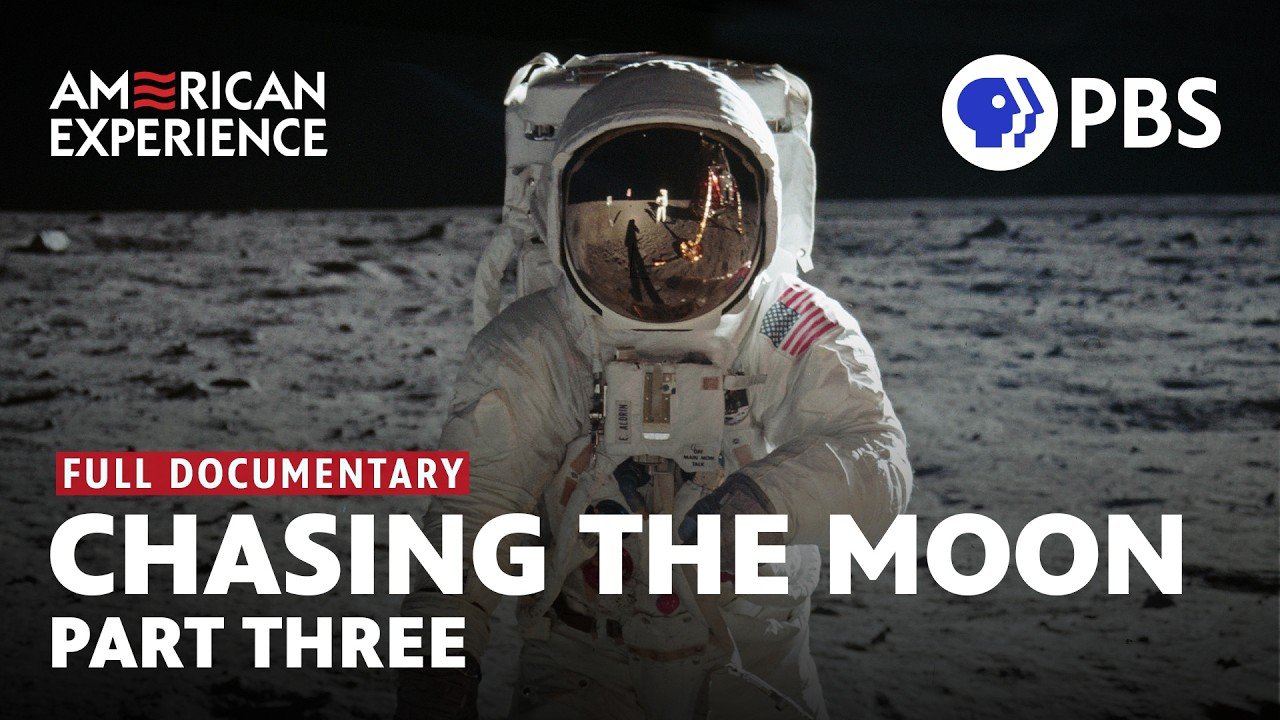
Part three of the PBS American Experience film Chasing the Moon follows Apollo 11 from the crew announcement through launch on July 16, 1969, the landing at Tranquility Base, the moonwalk and the return. It combines archival broadcast footage with interviews, and ends with what came after Apollo.
Full written account
Neil Armstrong set the Apollo 11 lunar module down on the Moon with 17 seconds of fuel left, after taking manual control to steer past a crater the video's interviewees describe as about 60 feet deep and 100 yards wide. The landing on 20 July 1969 followed a launch from Kennedy Space Center's complex 39A on 16 July, with Armstrong, Buzz Aldrin and Michael Collins aboard a Saturn V. This PBS American Experience film, part of Robert Stone's Chasing the Moon, follows the mission through archival coverage and interviews.
A landing that came down to seconds
The descent was tense for everyone watching. For the public it was an audio experience, because the camera that recorded the descent to the surface was a film camera and its images were not viewable as the landing happened. Flight controllers polled each console for "go" for powered descent, and mission director Gene Kranz was left to decide whether to let the landing proceed or abort it.
As the lunar module descended, the computer overloaded. Alarms sounded, including a "121" alarm at about 3,000 feet. Mission control answered, "Roger. 121 alarm. We're go." The narration recalls that Kranz stayed cool and calm, kept everyone focused, and had confidence in Armstrong to manage fuel and altitude. The interviewees also say the crew had overshot the planned landing site and were running low on propellant, and Houston called out fuel status.
Above the surface, Armstrong was manually steering and looking for a safe place. One interviewee says he put the craft in a hover with 30 seconds of fuel left. From then on the only callouts were fuel. A contact light came on, the engine was stopped, and the crew reported: "Tranquility base here. The Eagle has landed." Houston replied that a bunch of guys were about to turn blue and were breathing again.
The first steps
The moonwalk began about an hour later than originally planned. Armstrong climbed down the ladder, and the television picture first appeared upside down on the monitors in Houston. He stepped off with the words "That's one small step for man, one giant leap for mankind." Commentators at the time did not at first catch the second phrase. Armstrong described the surface material as adhering in fine layers, like powdered charcoal, to the sole and sides of his boot. Aldrin followed him out and called the view "magnificent desolation".
The television pictures had a ghostly quality because the transmission was limited in the amount of signal it could carry. The film notes high-definition television could not be sent from the equipment on the Moon.
The crew unveiled a plaque on the lunar module's front landing gear, reading that men from the planet Earth first set foot upon the Moon in July 1969 AD, and that they came in peace for all mankind. A White House staffer said the "AD" was a sneaky way of noting the use of a Christian calendar. The flag was placed under a resolution of Congress, and President Nixon spoke to the crew by telephone. Collins, orbiting alone in the command module, was the one crew member without television coverage of the scene.
Getting home
The ascent engine of the lunar module was the one part of the mission without redundancy. Interviewees say the crew had one shot to light it, and that a newspaper had a "marooned" headline set in type in case it failed. It fired, and Armstrong and Aldrin lifted off after a stay on the surface of 21 hours and 36 minutes. The engine burn was planned to last 7 minutes and 18 seconds.
After splashdown in the Pacific, the astronauts came out in biological isolation garments, amid concern over lunar contamination. Armstrong recalls being in isolation for 21 days from the time they left the Moon. Afterwards the crew toured 28 cities in about 33 days.
Before the launch
The film opens with the political backdrop. Wernher von Braun is shown being questioned about his past in Germany. Apollo 8 commander Frank Borman describes hostile receptions on American college campuses, in contrast with friendlier ones overseas, and Borman visited the Soviet Union in 1969.
Who would step out first was disputed. Armstrong was commander, and interviewees say Aldrin's father campaigned for his son to be first. Armstrong said he would not rule himself out. Armstrong had also ejected from the lunar module training vehicle in an accident; a failed fuel sensor meant he had about 15 seconds of fuel when he thought he had 30.
On launch eve, Ralph Abernathy led protesters to the Kennedy Space Center to protest the government's priorities, speaking of the gulf between technological ability and social injustice. NASA head Tom Paine met them and invited a group, Abernathy among them, to the launch. One estimate on the broadcast put about a million people near the Cape. Liftoff came at 32 minutes past the hour; the planned time was 9:32 a.m. Eastern Daylight Time. The film says 33 Saturns were flown and none failed.
The Soviet side
The Soviets sent the unmanned Luna 15 to the Moon at about the same time. Jodrell Bank reported it landing in the Sea of Crises, about 500 miles from Apollo 11, and later that it may have plunged to the surface at around 300 mph. Sergei Khrushchev, who was on vacation at the time, says the Soviet press carried only a few lines on the landing, and that he later brought a 16 mm film to show his father. He ties the failure of the N1 rocket, with its 30 engines, to Korolev's death and to assembling it without testing by stages.
After Apollo
Von Braun presented a Mars project to Vice President Agnew two weeks after the landing; the film says nobody was listening. By Apollo 12, interest had cooled, and the Cape began handing out pink slips after the launch. Interviewees credit the Apollo guidance computer's team with going on to build the computing industry of the 1970s.
Questions this video answers
When did Apollo 11 launch?
July 16, 1969, from launch complex 39A at Kennedy Space Center, with liftoff at 9:32 a.m. Eastern Daylight Time.
Who was on the crew?
Neil Armstrong was commander, with Buzz Aldrin and Mike Collins. Collins stayed aboard the command and service module.
How much fuel was left at landing?
One speaker in the film says Armstrong landed with 17 seconds of fuel left.
How long did Armstrong and Aldrin stay on the surface?
The broadcast states a stay of 21 hours and 36 minutes before they lifted off.