Apollo 13: How the Crew Got Home in a Lunar Module Lifeboat
The short version
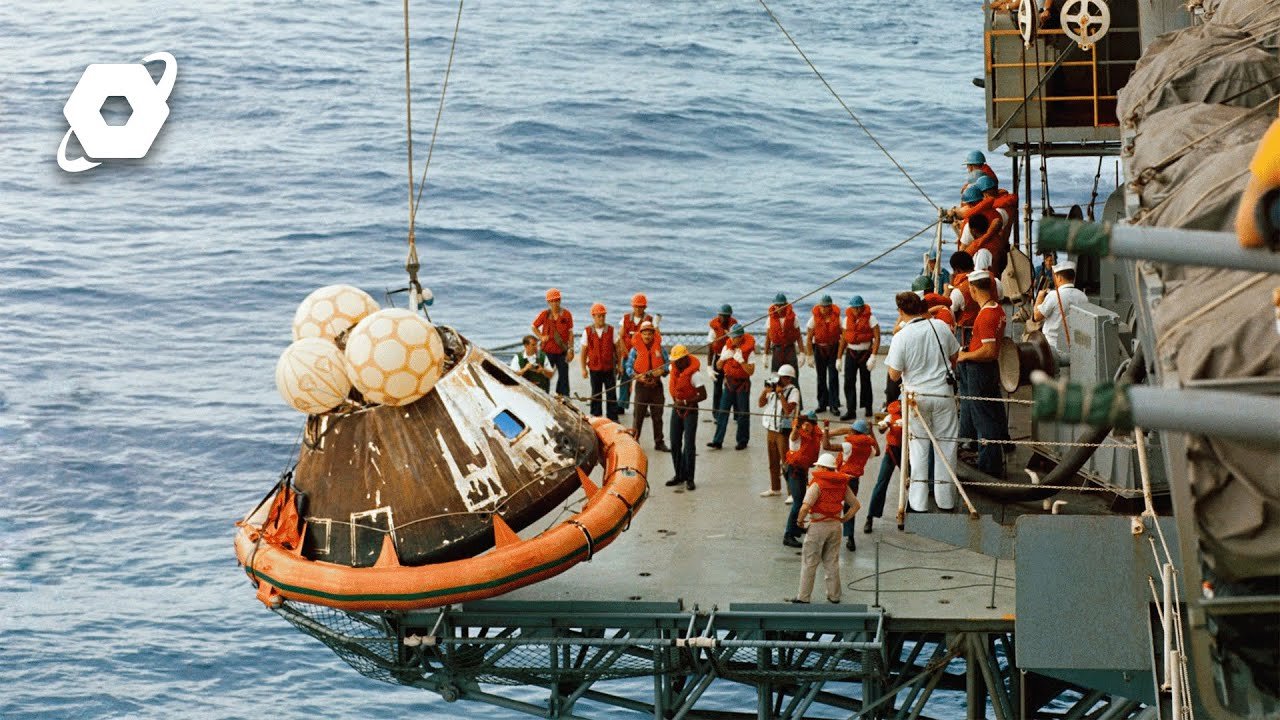
After an oxygen tank rupture, Apollo 13 became a rescue effort with the lunar module serving as a lifeboat. The film covers the burn to shorten the trip home, the carbon dioxide scrubber adapter built with duct tape, the manual course correction, powering up the command module and the Pacific splashdown.
Full written account
When an oxygen tank ruptured on Apollo 13, the crew of three, Jim Lovell, Jack Swigert and Fred Haise, used the lunar module as a lifeboat. Mission control then had to get them home, solving problems with time, cold, carbon dioxide, navigation and power along the way.
Getting home sooner
With the spacecraft back on a free return trajectory, Apollo 13 was set to splash down in the Indian Ocean in four days, where no recovery forces were deployed. Controllers wanted a Pacific splashdown, where naval forces were waiting. The flight time home was 155 hours if nothing else was done.
Two burns of the lunar module's descent engine were considered. The first would have saved 36 hours but required jettisoning the service module, exposing the command module's heat shield to very high and very low temperatures, and would have used all the fuel, ruling out later corrections. NASA chose a 4-minute burn that returned the crew about 12 hours sooner. The burn was done using the lunar module's guidance computer, which then had to be shut down because it drained power. The burn lasted about 4 minutes 24 seconds and ended at 79 hours 32 minutes, almost exactly 24 hours after the tank rupture.
Cold and power
The lunar module was powered down except for guidance, communications and water cooling, settling at about 11 amps. The command module became very cold, with ice forming on the windows and temperatures falling to about 38 degrees before re-entry. Apollo 13 was the first mission to carry wet pack food, from which the crew could draw moisture. Passive thermal control, a slow rotation of about three turns an hour, evened out the sun's heat.
Carbon dioxide
The lunar module was designed for two men for two days, but now carried three for four days, and its scrubbing canisters were overwhelmed. The command module's lithium hydroxide canisters were square and the lunar module's round. Within hours engineers built an adapter from spacesuit hoses, plastic bags, cardboard flight plan cards and duct tape. Within an hour of switching it on, carbon dioxide levels were way down. The crew used four command module canisters.
Course correction and batteries
The craft drifted off course, and the entry angle had to be between 5.5 and 7.5 degrees. With the primary guidance computer off, the crew used the abort guidance system and aligned on the Earth's terminator with the crewman optical alignment system, a technique Lovell had tried on Apollo 8. Starting around 105 hours, the three men did the manual burn together: Swigert timed it, Haise handled pitch, and Lovell handled roll and the engine buttons.
The command module's re-entry batteries had been drained, so power from the lunar module's batteries raised them from 20 to about 40 amp hours.
Re-entry
The service module was jettisoned and the crew photographed it, seeing a whole panel blown out. The command module was powered up with a new procedure. The video says improvements after the Apollo 1 fire kept condensation from shorting vital systems. The lunar module was jettisoned at 141 hours 30 minutes, and after blackout controllers confirmed the spacecraft on its main parachutes. A review board later determined that an unlikely chain of events caused a fire in oxygen tank number two.
Questions this video answers
Why did NASA choose the shorter 4-minute burn?
It returned the crew about 12 hours sooner while preserving fuel for later course corrections and keeping the service module attached to protect the heat shield.
How was the carbon dioxide problem solved?
Engineers built an adapter from spacesuit hoses, plastic bags, cardboard flight plan cards and duct tape so square command module canisters could be used in the lunar module.
Why were the re-entry batteries important?
After the service module is jettisoned the command module depends on its batteries, so the lunar module batteries were used to charge them.
What did the review board find?
An unlikely chain of events caused a fire in oxygen tank number two, which ruptured.