Apollo 13: The Dropped Tank and Switches Behind the Explosion
The short version
Apollo 13 was meant to be the third Moon landing, but an oxygen tank exploded about 55 hours 54 minutes into the mission, and the crew used the lunar module Aquarius as a lifeboat. The video covers the crew swap, the exact radio wording, the improvised carbon dioxide filter fix, and the splashdown in the South Pacific with all three men alive. The review board traced the failure to a tank dropped about 2 inches in 1968 and to heater switches rated for the wrong voltage.
Full written account
On April 13, 1970, roughly 205,000 miles from Earth, an oxygen tank exploded aboard Apollo 13, 55 hours, 54 minutes and 53 seconds into the mission. All three crew members, Jim Lovell, Jack Swigert and Fred Haise, were alive at splashdown. The mission was supposed to be the third Moon landing.
A crew change and an early warning
Lovell was commander on his fourth spaceflight, after circling the Moon on Apollo 8 in December 1968. Haise was lunar module pilot. Ken Mattingly was to be command module pilot, but six days before launch backup astronaut Charlie Duke came down with German measles, caught from the three-year-old son of family friends. Tests showed Mattingly had no immunity, and the day before launch NASA replaced him with backup Jack Swigert. Mattingly never got sick.
Apollo 13 lifted off on April 11 at 1:13 in the afternoon, Houston time. During the second stage burn the center engine shook violently, a effect engineers call Pogo, and shut down about two minutes early while the other engines burned longer. Investigators later found it had been dangerously close to failing.
The bang
On the evening of April 13 the crew sent a live TV tour of their spacecraft, and none of the three major American networks aired it. Minutes later Houston made a routine request to stir the oxygen tanks. Small fans keep the super-cold oxygen mixed so the gauges read correctly. Swigert flipped the switch, and 95 seconds later there was a bang, which Lovell later called dull but definite.
Swigert radioed, "Okay, Houston, we've had a problem here." Lovell then reported a main B bus undervolt, saying "We've had a problem," in the past tense. The 1995 film changed it to "Houston, we have a problem." About 14 minutes after the bang Lovell saw oxygen venting into space. Within about three hours the service module's oxygen would be gone, and with it the power for the command module Odyssey.
The lifeboat
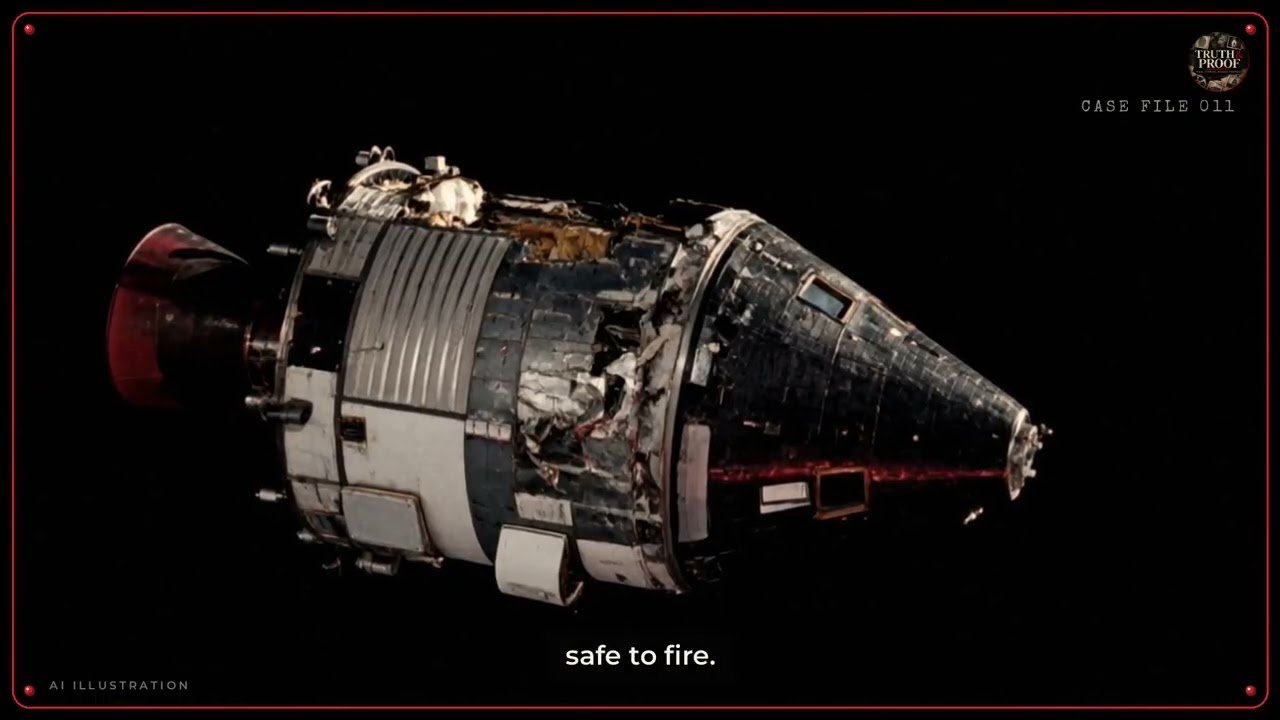
The crew moved into the lunar module Aquarius, built to keep two men alive for about two days and now needed for three men for four. Odyssey was shut down almost completely to save its last batteries for re-entry. The service module's main engine could not be trusted, so the plan was to loop around the Moon's far side. About 5.5 hours after the explosion they fired the lander's descent engine to set a path home. Behind the Moon they reached 248,655 miles from Earth, the farthest any humans had travelled.
Cabin temperature fell as low as 38°F (3°C), and water was rationed to about 200 ml per man per day. Haise developed a urinary tract infection, and the three lost 31 lb between them.
Square peg, round hole
Carbon dioxide was the deadlier threat. The lander's lithium hydroxide canisters were meant for two men for about 45 hours. The spare canisters in the command module were square, and the lander's sockets were round. A team led by engineer Ed Smylie devised a fix from plastic bags, cardboard flight-manual covers, spacesuit hoses and duct tape, which astronaut Joe Kerwin read up to the crew step by step. Within an hour of building the "mailbox," carbon dioxide levels were falling fast.
Coming home
One late course correction was aimed by eye: Lovell lined up the craft by sighting Earth through his window, Haise fired the engine, and Swigert timed the 21.5-second burn on his wristwatch. Mattingly, working with flight controller John Aaron and ground engineers, helped write a power-up procedure for Odyssey that fit the limited battery power. On April 17 the crew released the service module and saw that one whole side was missing. Re-entry blackout lasted about six minutes instead of the usual four. Splashdown came in the South Pacific about 4 miles from the USS Iwo Jima.
What the review board found
The review board traced the failure to October 1968 at the Downey, California factory, where the tank was dropped about 2 inches during removal from another spacecraft. In March 1970, during a countdown test, the tank would not empty, so technicians ran its internal heaters for about 8 hours on 65V ground power. Every part had been upgraded for 65V except the thermostatic switches, still rated for 28V. They likely welded shut, and temperatures inside likely reached about 1,000°F, beyond the gauge's range. The heat very likely damaged wire insulation.
Lovell called Apollo 13 a successful failure. "Failure is not an option" was not said during the mission; it came from flight controller Jerry Bostick telling the film's screenwriters that failure was never one of the options laid out.
Questions this video answers
What did the crew actually say after the explosion?
Jim Lovell said, "Houston, we've had a problem," after Jack Swigert's first call; the movie changed it to the present tense.
What caused the oxygen tank to explode?
The review board traced it to a tank dropped about 2 inches in October 1968, then heated for about 8 hours at 65V during a March 1970 test. The heater thermostatic switches were still rated for 28 volts and likely welded shut.
How did the crew fix the carbon dioxide problem?
Using plastic bags, cardboard covers from flight manuals, spacesuit hoses and duct tape, they adapted square command module canisters to fit the lander's round sockets, a rig known as the mailbox.
Why was Ken Mattingly not on the flight?
Doctors found he had no immunity to German measles after backup Charlie Duke caught it, so Jack Swigert replaced him the day before launch. Mattingly never got sick.
How far from Earth did the crew travel?
At their farthest they were 248,655 miles from Earth.