Artemis 1: Why Orion Flew a 26-Day Route Around the Moon
The short version
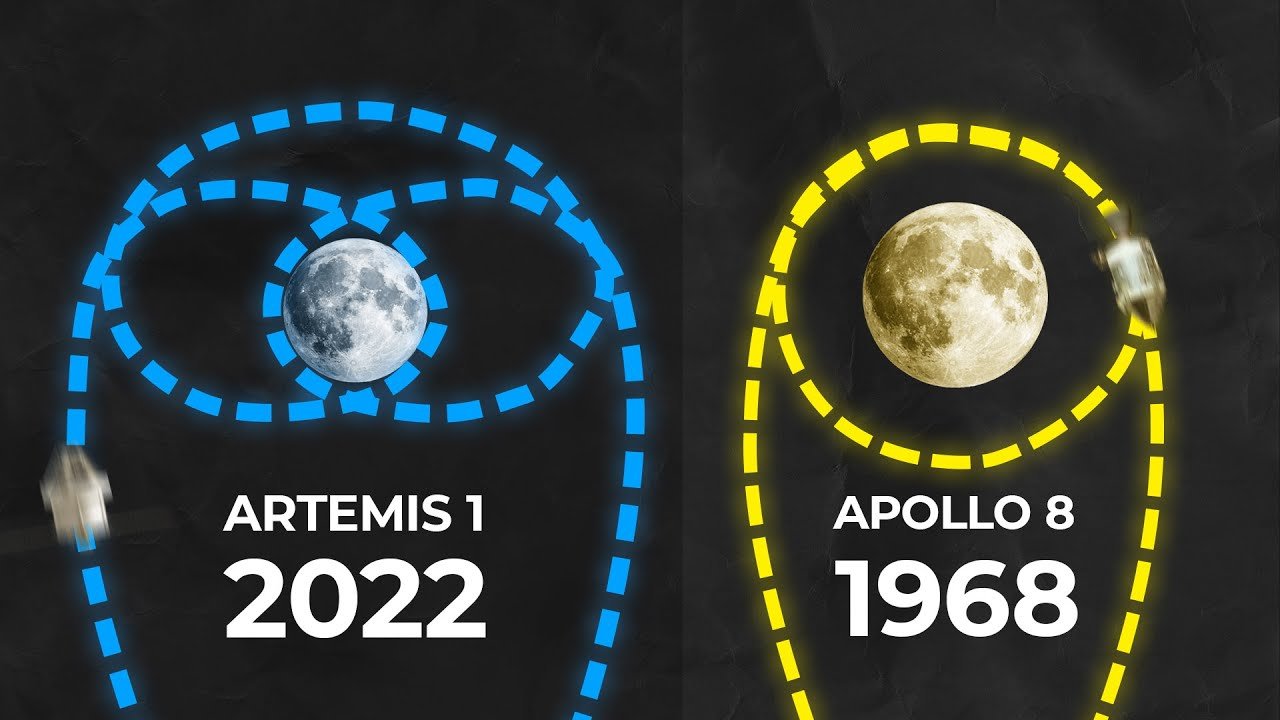
An explainer on why Artemis 1 took a 26-day route to the Moon, compared with six days for Apollo 8. It covers Delta V, Orion's smaller Delta V compared with Apollo, the gravity assist at about 100 km above the lunar surface, the distant retrograde orbit, and the return burn using the Oberth effect.
Full written account
Artemis 1 sent the Orion capsule on a 26-day trip around the Moon, while the Apollo 8 journey took only six days and followed a much simpler route. The reason lies in energy and Delta V, the change in velocity a spacecraft must achieve to complete its journey.
Why the route differed from Apollo
The goal of Artemis 1 was to send Orion around the Moon and test its systems. The Apollo missions had to land humans on the Moon and return them to Earth, which requires more energy. The Delta V needed for a given route is the same for every rocket, but a heavier rocket or less efficient engines need more energy to achieve it.
Although SLS is more powerful than the Saturn V, Orion has less than half of Apollo's Delta V. Artemis 1 used a much roomier command module with a smaller service module. Apollo did the opposite: a smaller command module with a more capable service module, with more thrust and propellant capacity. Apollo's small command module could support the crew for a total of 14 days, so Apollo took the quickest route, with a long burn on arrival to enter lunar orbit in three days, compared with 10 days for Artemis 1.
The distant retrograde orbit
To get Orion to the Moon and keep it there long enough, NASA aimed for a distant retrograde orbit, which had never been done around the Moon before. The spacecraft orbits at a distance, moving opposite to the Moon's orbit around Earth. It spends equal time at Lagrange points 1 and 2, which keeps the orbit balanced, so no fuel is wasted maintaining it.
A direct insertion would aim for a point 70,000 kilometers from the Moon and burn to slow down, which is essentially what Apollo did. Orion instead aimed for a point just 100 kilometers above the lunar surface.
Gravity assist and burns
- Orion approached the Moon from the side that makes the Moon's gravity pull against it, slowing it down rather than speeding it up.
- At closest approach it fired its engine to slow down further, entering an elliptical orbit with an apoapsis of 70,000 kilometers.
- At apoapsis it burned again to raise its periapsis to 70,000 kilometers, circularizing the orbit.
The gravity assist did most of the work, saving a huge amount of fuel. One orbit at this distance took 12 days, and NASA had the option of extending it by another 12 days with another lap. This gave more time to test Orion's systems. Seen from Earth's perspective without the Moon, Orion was technically still in an elliptical orbit around Earth, with the same orbital period as the Moon.
Returning to Earth
To return, Orion ran the gravity assist in reverse: it slowed to pass close to the lunar surface, then made a final burn sending it back toward Earth. It waited until closest approach because of the Oberth effect: with the same fuel, a rocket gains more velocity by burning closer to the Moon, where gravitational pull is strongest.
Questions this video answers
How long did the Artemis 1 journey take?
The journey took 26 days, compared with six days for Apollo 8.
Why did Artemis 1 take such an unusual route?
Orion has less than half of Apollo's Delta V, because it uses a roomier command module with a smaller service module. It therefore used a gravity assist and a distant retrograde orbit to save fuel.
What is a distant retrograde orbit?
It is an orbit around the Moon at a distance, moving opposite to the Moon's orbit around Earth. The spacecraft spends equal time at Lagrange points 1 and 2, so it does not need fuel to maintain the orbit.
How long was one orbit of the Moon?
A single orbit at that distance took 12 days, and NASA had the option of extending it by another 12 days.
Explore related missions
Connected by the topic: Artemis