CRS-35: Falcon 9 Launches Cargo Dragon With Final IROSA Arrays
The short version
NASASpaceflight's live broadcast of the Falcon 9 launch of the CRS-35 cargo Dragon (C211, fourth flight) from SLC-40 on October 13, with an instantaneous window at 06:33:44 EDT. The payload of 2,867 kg includes four IROSA roll-out solar arrays in the trunk. Booster B1096 landed at LZ-40 and Dragon separated in orbit, with docking expected about 52 hours later. A strong jellyfish effect was seen from the East Coast.
Full written account
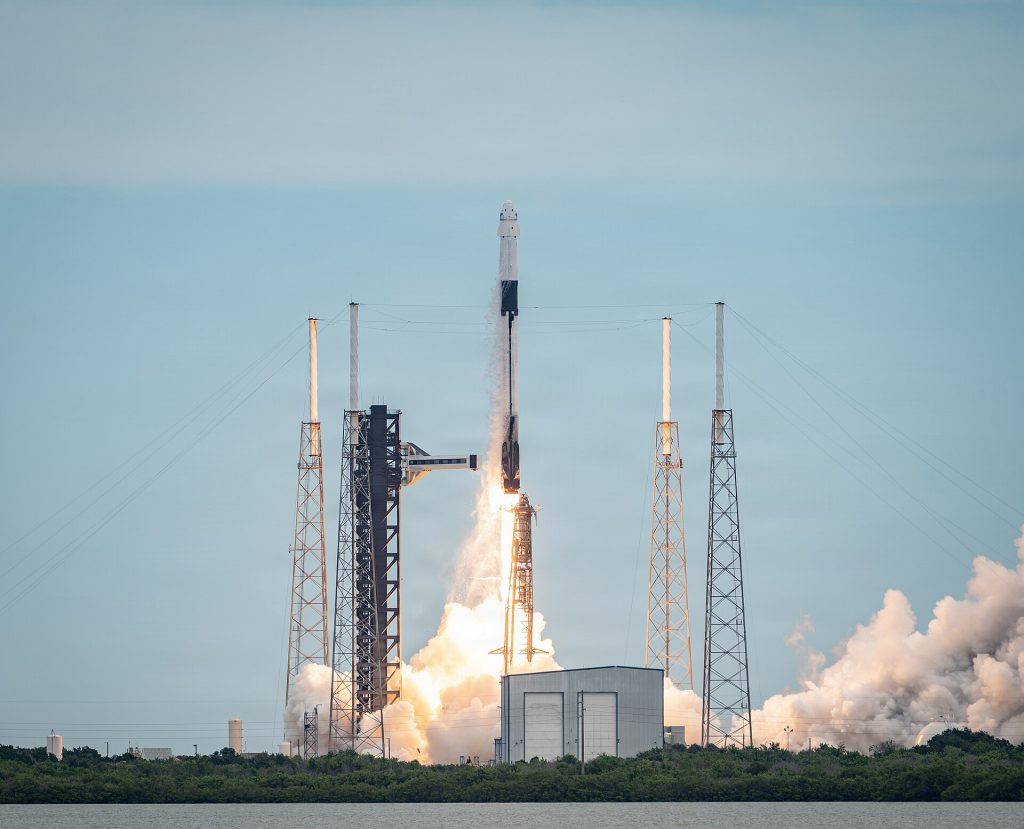
A cargo Dragon carrying 2,867 kg of supplies lifted off from Space Launch Complex 40 at Cape Canaveral Space Force Station on October 13 at 06:33:44 EDT (10:33:44 UTC), bound for the International Space Station. The CRS-35 launch had an instantaneous window: the rocket would go at that second or not at all that day. No one was aboard the capsule. Among the cargo were the last four IROSA rollout solar arrays, which were expected to raise the station's power capacity by roughly 20 to 30 percent.
The vehicles
CRS-35 was the 35th cargo resupply mission to the station by Dragon. The capsule, C211, is the 11th Dragon 2 built and was flying for the fourth time. Its earlier flights were CRS-26, CRS-29 and CRS-33. SpaceX's cargo fleet consists of three Dragons: C208 has flown five times, C209 (which flew CRS-34) has flown six times, the most of any cargo Dragon, and C211 is the newest.
The booster, B1096, was flying for the eighth time. Its history includes Kuiper Falcon 1, IMAP, Starlink 6-87, NROL-77, GPS-III SV09, CRS-34 and NROL-95. Commentators noted the irony that its first flight carried Amazon internet satellites, and it had flown only a single Starlink mission before this one.
Cargo Dragons differ from crew Dragons inside and out. They have no seats or crew displays, extra weldments in the pressure vessel to attach cargo racks, and no Super Draco thrusters, since those serve the launch abort system. All 16 Draco thrusters and the docking system remain the same.
The cargo
The load included 383 kg of crew supplies, with perishable foods, clothing, vehicle hardware, computer resources and new spacesuit equipment. The unpressurized trunk held the four IROSA arrays, the heaviest part of the load apart from pressurized supplies. The old arrays are degrading and less efficient, and the commentators said they are exposed to radiation and atomic oxygen. The new arrays partly cover the originals but still raise capacity. The battery system has also been upgraded. They are to be installed on the P4 and S6 truss segments.
Science on board included:
- an attempt to make glass in space from non-traditional elements, to see if stronger glass can be formed in microgravity;
- Lambda Vision, which will build artificial retinas one layer at a time in microgravity;
- stellar spheroids, 3D human heart tissue models, to see if microgravity improves vascular network formation;
- the MINDS experiment, using brain organoids combining cells from multiple people to study how inflammation is linked to neurodegenerative diseases;
- a demonstration and test unit for collapsible contingency urinals, ahead of the Artemis 3 flight, drawing on lessons from Artemis 2.
Dragon can also return cargo. CRS-35 is to bring back a failed Canadarm2 joint, which may be refurbished and flown again, and a spacesuit for refurbishment.
Countdown and launch
The go for propellant loading came after the go/no-go poll, with about 35 minutes on the clock. RP-1 and liquid oxygen were loaded into the first stage, and the second stage took RP-1 first. At about 20 minutes the liquid-oxygen chill-down produced the large vent. The commentators explained that the lines must be thermally conditioned so the very cold liquid oxygen does not crack them. Engine chill of the nine Merlin 1D engines began roughly six minutes out. The strongback leaned back 1.8 degrees, then swung fully away at liftoff. Dragon moved to internal power and auto idle, and the launch director gave the go for launch. Weather was greater than 95 percent favorable.
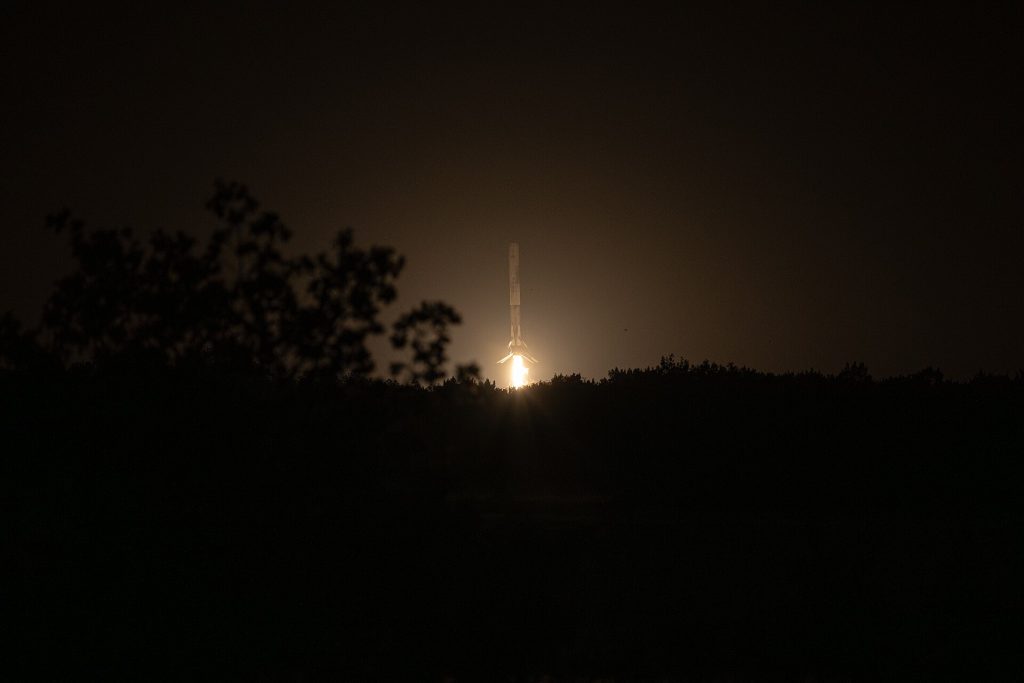
After liftoff came Max Q, main engine cutoff, stage separation, and the boost-back burn. A single-engine entry burn of about eight seconds preceded a landing burn, and B1096 touched down at Landing Zone 40, across the road from the pad, about 7 minutes 20 seconds after launch. Sonic booms were heard. Second stage engine cutoff followed, and at roughly 27,000 km/h and 197 km altitude Dragon separation was confirmed. The nose cone was then opened with the same hooks used for docking.
The jellyfish
Launching just before sunrise, the plume rose into sunlight while the ground was still dark. This is the jellyfish effect: the high plume expands and lights up, like the top of a jellyfish with a tail. Viewers reported seeing it from places including Tallahassee, Pennsylvania, Maryland, North Carolina, West Virginia and Montreal, and one posted video showed it over New York City. Camera operators also caught the ISS passing near the boost-back burn.
Docking
Docking to Harmony's zenith port was expected on Thursday, October 15, at 11:00 a.m. Eastern, about 52 hours after launch. That would be the longest launch-to-docking time of any Dragon 2, after Crew 13 had the shortest.
Launch statistics
It was SpaceX's 728th launch overall, its 119th of the year and the 347th from SLC-40. It was the 8th landing on LZ-40 in 8 attempts and the 59th orbital flight of a Dragon spacecraft. It came about a month after the last non-Dragon launch from SLC-40.
Questions this video answers
When did CRS-35 launch?
On October 13 at 06:33:44 EDT (10:33:44 UTC), from Space Launch Complex 40 at Cape Canaveral Space Force Station.
What did CRS-35 carry?
2,867 kg of cargo, including 383 kg of crew supplies, science investigations and four IROSA roll-out solar arrays in the unpressurized trunk.
Where did the booster land?
Booster B1096, on its eighth flight, returned to Landing Zone 40, across the road from the launch pad.
When was Dragon expected to dock?
Thursday the 15th at about 11:00 a.m. Eastern, at the Harmony zenith port, about 52 hours after launch.
Was anyone aboard?
No. It is an uncrewed cargo Dragon.