CRS-35: Falcon 9 Launches Dragon With Final Two ISS Solar Arrays
The short version
NASA and SpaceX launched the 35th commercial resupply services mission on a Falcon 9 from Space Launch Complex 40 at 6:33 a.m. EDT. The Dragon carried over 6,000 lb of cargo including the final two iROSA solar arrays, and the booster landed at Landing Zone 40. Docking to Harmony was targeted for October 15.
Full written account
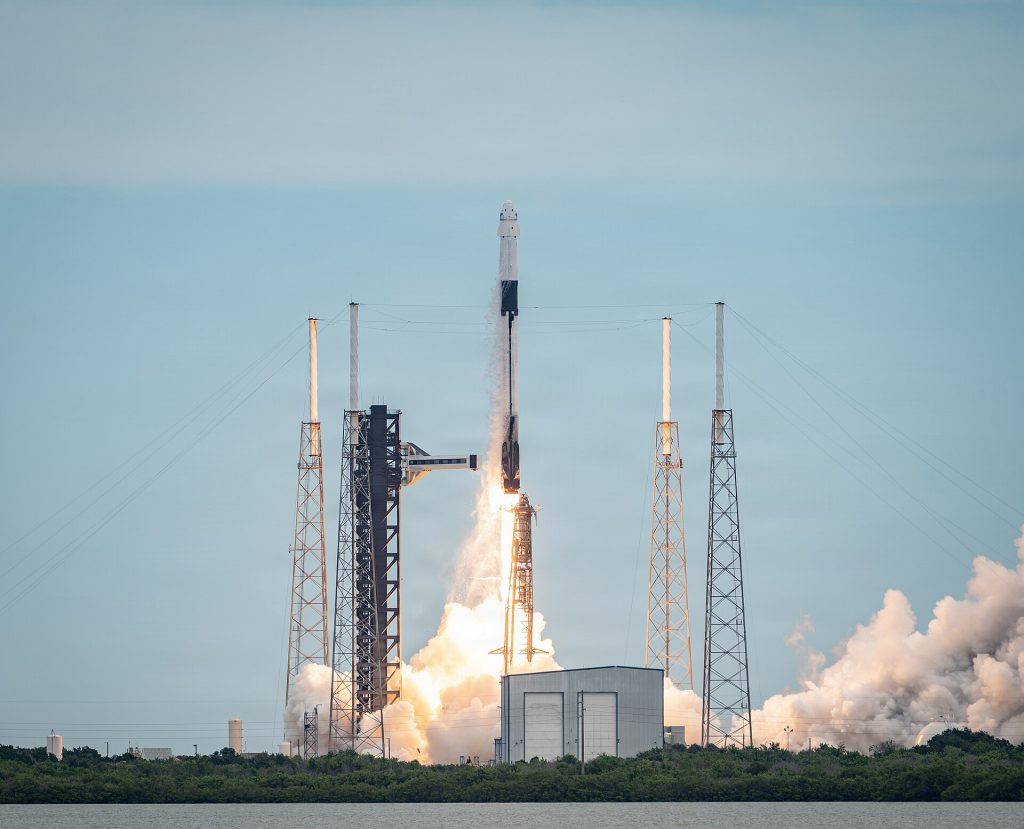
Why does a cargo Dragon have to leave the pad at one exact moment? On Tuesday, October 13, SpaceX's 35th commercial resupply services mission (CRS-35) lifted off at 6:33 a.m. EDT from Space Launch Complex 40 at Cape Canaveral Space Force Station in Florida, carrying more than 6,000 lb of cargo, food, equipment and science to the International Space Station. The mission is uncrewed.
Why the launch window is instantaneous
SpaceX's Ronnie Foreman, director of the rideshare program, explained that every Dragon mission to the station has an instantaneous launch window. The station moves at over 17,000 mph, and to put Dragon on the most efficient path for rendezvous and docking, the rocket must lift off at the exact moment the station's orbital plane lines up over the pad. That alignment lasts a split second. Had the countdown gone into a hold, the next opportunity was Wednesday, October 14, at 6:08 a.m. Eastern.
The countdown
Propellant loading began at T-minus 35 minutes. At T-minus 7 minutes the engine pre-valves opened and a trickle of liquid oxygen began chilling the Merlin engines, which prevents thermal shock. The transporter erector, or strongback, held the rocket until the last seconds: white clamp arms beneath Dragon's trunk opened, the strongback reclined about 2 degrees, and at liftoff it would kick back to a full 45 degrees. Both stages ended up fully loaded with over 1 million pounds of rocket-grade kerosene and liquid oxygen. With just under a minute to go, Falcon 9 went into startup and its flight computers took over the count. The nine Merlin 1D engines ignited just inside T-minus 2 seconds.
Ascent and booster return
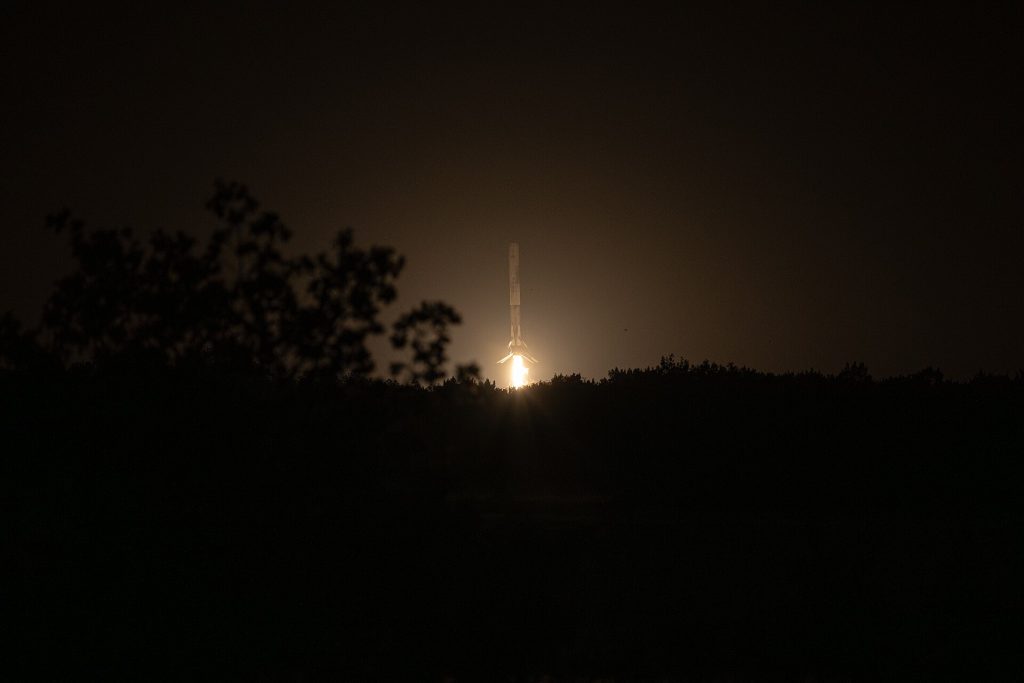
The engines throttled down for max Q, the point of maximum aerodynamic pressure, after the call that the vehicle had gone supersonic. About 2.5 minutes into flight the stages separated. The first stage flipped, and began the first of three burns on its way back to landing zone 40, followed by an entry burn using three of the nine engines and a single-engine landing burn. The booster, making its eighth flight, had previously launched CRS-1, IMAP, NROL-77, GPS 39, CRS-34, NROL-95 and one Starlink mission. The soot on such boosters comes from flying through Merlin's exhaust plume during the entry burn.
The second stage's single Merlin Vacuum engine burned for roughly six minutes. Second engine cutoff came at about 8.5 minutes, followed by confirmation of a nominal orbit. Dragon then separated, and its nose cone, held by 12 hooks, hinged open to expose four forward Draco thrusters. The initial orbit was about 190 km by 210 km.
The spacecraft
Dragon has 16 Draco thrusters, each providing 90 lb of force. Dragon has completed 57 missions, including 53 station visits and 21 human spaceflight missions with 82 crew members from 20 countries. This capsule previously flew CRS-33, CRS-29 and CRS-26, making CRS-35 its fourth flight. The cargo totals over 6,300 lb.
Cargo: the final iROSA pair
The key hardware is the final two ISS Roll-Out Solar Arrays, or iROSAs, which will be installed on future spacewalks. Angie Patel, operations integration manager for the low Earth orbit program, said each array brings up to 20 kW, about a 30% increase in power generation, and that six of the eight arrays are installed. She said the arrays give more margin for science and minimize the need to power down low-priority systems when the station must hold fixed positions. They also matter for safe deorbit of the station, which she called a very complex operation. She traced the effort to the ROSA launched on CRS-11 in 2017, and said modification kits were needed because the legacy arrays lack standard interfaces. Two spacewalks are planned for the installation.
The research aboard includes:
- Lambda Vision 1, testing manufacture of artificial retinas in microgravity one thin layer at a time.
- Stellar Spheroids, studying how microgravity affects 3D human heart tissue models.
- Elf Unconventional Glass 2, studying how glass forms in microgravity.
- Minds, studying brain organoids to understand inflammation linked to neurodegenerative diseases.
Food in bulk overwrap bags includes pizza kits, hummus, candy, cookies and a tostada kit, plus a holiday kit with lobster, crab, quail, roasted turkey, jellied cranberry sauce and vegetables.
Rendezvous and docking
Dragon will take approximately 52.5 hours to reach the station, using five burns: phase, boost, close, transfer and coelliptic. Docking is targeted for about 11:00 a.m. EDT on Thursday, October 15, at the space-facing port of the Harmony module. The Expedition 75 crew includes NASA astronauts Jessica Watkins, Luke Delaney and Anil Menon, CSA astronaut Joshua Kutryk, and Roscosmos cosmonauts including commander Pyotr Dubrov. Menon and Kutryk were named to monitor Dragon's approach.
Questions this video answers
When and where did CRS-35 launch?
6:33 a.m. EDT on Tuesday, October 13, from Space Launch Complex 40 at Cape Canaveral Space Force Station, Florida.
What cargo did Dragon carry?
Over 6,000 lb, given as over 6,300 lb after liftoff, including food, equipment, science investigations and the final pair of iROSA solar arrays.
When was Dragon due to dock?
Docking was targeted for around 11:00 a.m. EDT on Thursday, October 15, at the space-facing port of the Harmony module.
Did the Falcon 9 booster land?
Yes. The first stage made its eighth launch and landing at Landing Zone 40.
Who installs the new solar arrays?
The station crew will install them on future spacewalks.