How NASA Recovered Space Shuttle Boosters From the Atlantic
The short version
Scott Manley explains how NASA recovered the Space Shuttle's two solid rocket boosters from the Atlantic after each flight. He covers the parachute sequence, the Liberty Star and Freedom Star recovery ships, the diver operated plug, and the early failures that changed the hardware. He states that 266 of the 270 boosters that flew were recovered, and that NASA decided against recovery for the SLS boosters.
Full written account
Across 135 Space Shuttle missions, 266 of the 270 solid rocket boosters that flew were recovered from the Atlantic and returned for refurbishment. Two were lost on STS-4, and the pair from Challenger were the other primary exceptions. The operation depended on two purpose-built ships, the Liberty Star and the Freedom Star, and on divers working about 110 feet down.
From separation to splashdown
The two boosters together massed about 1,200 tons, over half the Shuttle's mass at liftoff. About two minutes after liftoff they burned out and separated from the external tank at roughly 3,000 mph and about 47 km up. They continued on a parabolic arc to about 70 km, then fell back in a steep re-entry with no attitude control, tumbling as big steel tubes.
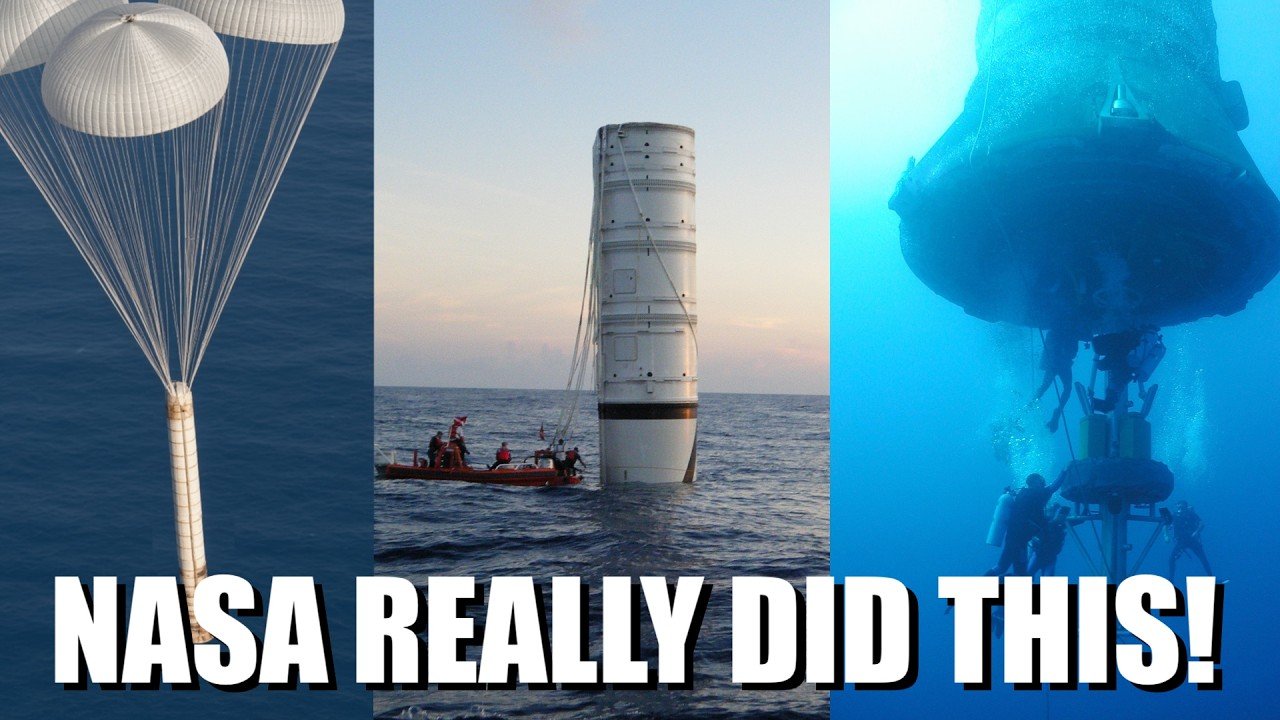
At around 15,700 ft a pressure sensor triggered the parachute sequence. A nose cap was blown off, a pilot parachute pulled out a 54 foot conical ribbon drogue, and the drogue stabilised the booster vertically. At about 5,500 ft the frustum was pulled away from the forward skirt, extracting three main parachutes that inflated in stages. Just before impact the booster ejected its nozzle extension, sacrificing it to protect the thrust vector control hardware. Water impact came at about 50 mph, roughly 400 seconds after launch and typically about 135 nautical miles downrange. An empty booster massed about 91 tons and settled in what the recovery team called spar mode, with about the forward 20% above water.
Starting with STS 41D in 1984, larger 136 foot main parachutes replaced the 115 foot ones, cutting impact speed by about 20%, and they were fully incorporated by STS-51D in 1985. If one of the three failed, the remaining two gave the same drag as the original three small ones.
Ships and divers
The ships were about 176 ft long and displaced about 1,000 tons. Their bow and stern thrusters were enclosed water jets, required originally because the ships transited manatee waters, and they made work beside a floating booster with divers and parachute lines safer. The ships left port the day before launch and positioned 8 to 10 miles from the predicted landing zone.
After splashdown the parachutes were recovered and wound onto reels. Divers then inspected the booster and inserted the diver operated plug into the nozzle. Air pumped in from the ship pushed the water out, and the booster rose from vertical through semi-log to a log attitude, so it could be towed without standing up in a swell. This took at least 4 hours and sometimes 8 or more. Each ship recovered one booster and towed it to Port Canaveral, then up the Banana River to a dock beside hangar AF. The segments were washed, disassembled and shipped to Utah, and they still fly on SLS.
Lessons from early failures
On STS-3 a main parachute tangled with a flotation device, and the booster landed on two parachutes at 120 km/h with significant aft skirt damage. On STS-4 a g-load-triggered detachment system fired when the first drum disconnected, releasing the parachutes on both boosters just as the mains were meant to deploy. Both sank in 3,000 ft of water. Later, remotely operated submersibles and sonar located the wreckage for imaging.
From STS-5 the g switches were deactivated, so divers detached the lines by hand, which was dangerous in high seas. A timer mechanism followed, but it exposed slapdown damage: a booster moving sideways in about 30 mph wind could pitch over and slap its forward skirt on the water, and spares were scarce. Starting with STS-86 in September 1997, seawater activated release switches solved it.
The plug had its own problem: debris could block the drain port, and a plug could pop out like a one-ton cork. The enhanced plug added a burst disc and dye packages, turning the water fluorescent green as a warning. On STS-1116 two boosters landed about half a mile apart and drifted together, tangling their parachutes.
Challenger and other duties
On the day Challenger was lost in January 1986, the ships were about 30 miles from their assigned position after two days in 60 mph winds and 15 to 25 ft seas. Afterwards they supported debris search and salvage for months and helped recover critical pieces of the right-hand booster joint.
From 1998 the ships also towed the Pegasus barge carrying external tanks from the Michoud facility to Kennedy Space Center. Freedom Star made the first of these tows in June 1998. After Columbia they towed tanks back to New Orleans for inspection.
For the five segment SLS boosters, NASA reviewed recovery again and decided against it, given the weight of the parachutes and hardware, the lower flight rate and the heritage data. Liberty Star became the King's Pointer at the US Merchant Marine Academy, and Freedom Star keeps its name at the Paul Hill Center for Maritime Training and Education.
Questions this video answers
How many Shuttle boosters were recovered?
Across 135 shuttle missions, 266 of the 270 boosters that flew were recovered. The two lost on STS-4 and the pair from Challenger were the primary exceptions.
What were the booster recovery ships?
The Liberty Star and the Freedom Star, built in the 1970s specifically for this job.
What was the diver operated plug?
A neutrally buoyant device that divers inserted into the booster nozzle and inflated. Air pumped in from the recovery ship forced water out so the booster could float on its side and be towed.
Why did STS-4 lose both boosters?
The system meant to detach the parachute lines on landing was triggered by g-load. The bang from the first drum disconnecting activated the cutters, so the parachutes were disconnected on both boosters when the mains were supposed to deploy, and both boosters sank.
Are SLS boosters recovered?
No. NASA looked at the recovery process again and decided against it, so the SLS boosters are expended, though the Shuttle booster segments still fly on SLS.
Explore related missions
Connected by the topic: Space Shuttle