Inside the ISS: Sunita Williams Tours Sleep, Food, Toilet and Soyuz
The short version
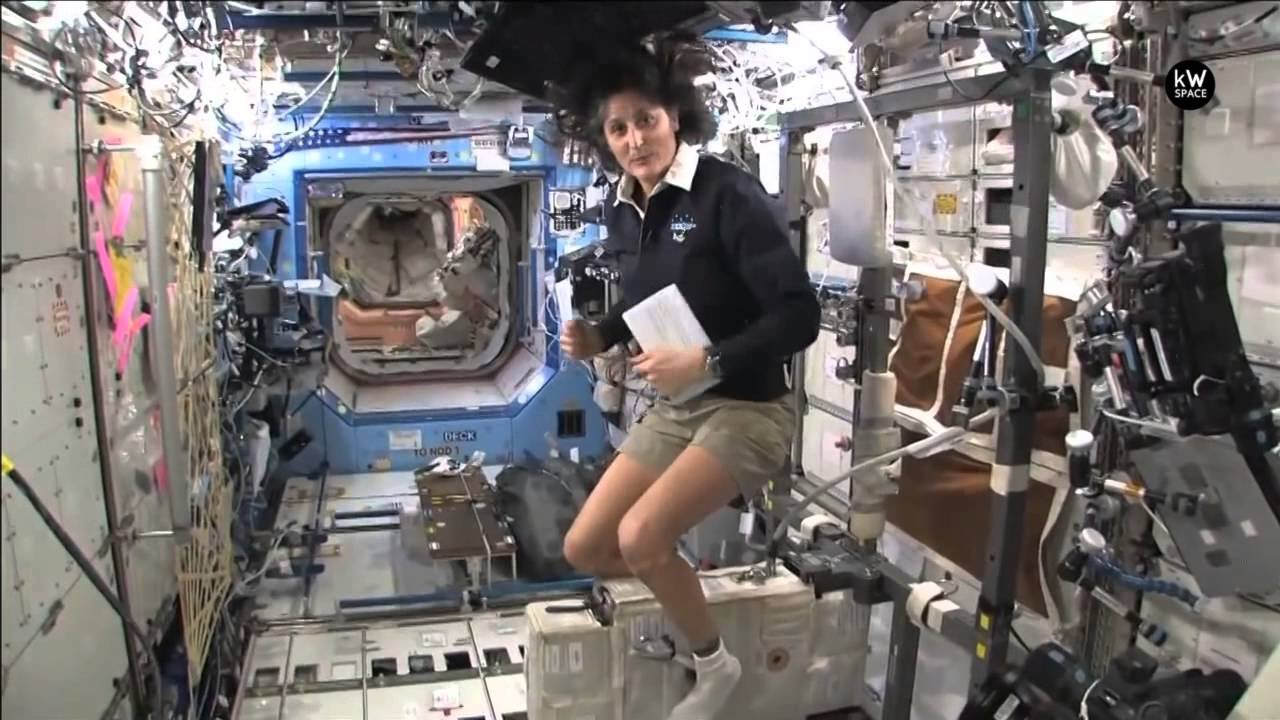
NASA astronaut Sunita Williams leads a room-by-room tour of the International Space Station, showing the sleep stations in Node 2, the bathroom, the galley, the exercise equipment, the spacesuits and the laboratories. The tour ends in the Russian segment and inside a Soyuz descent module, where she says the crew will be home within the next 12 hours.
Full written account
NASA astronaut Sunita Williams takes viewers through the International Space Station in a guided tour, answering questions people ask about daily life in orbit. She is part of a crew of six, and she says four of them sleep in Node 2, the module where the tour begins.
Sleeping and hygiene
The sleep stations are small booths on the four sides of Node 2: one on the floor, one on the ceiling and one on each wall. Inside, the crew member sits in a sleeping bag, with a computer, books, toys and clothes nearby. Because there is no sensation of lying down, orientation does not matter, and Williams says she gets no sense of being upside down.
For brushing teeth, the toothpaste is sticky enough to stay on the brush, and water forms a bubble on the toothbrush through surface tension. Afterwards the toothpaste can be swallowed or spat into a paper towel. The toilet has two color-coded openings, yellow for number one and another for number two, with suction to keep waste moving in the right direction. A selection of gloves, Russian wipes, soft tissues, Huggies and disinfectant wipes sits beside it. A second bathroom is in the Russian segment.
Food
The galley holds drinks, meats, eggs, vegetables, cereals, bread, snacks and candy. Some food is dehydrated and needs water, and some is ready-made and only needs heating. Williams pulls out barbecued beef brisket. Food comes from the US, Japan and Russia, in red containers for the Russian food, and family can send favorites; she mentions fluff for fluffernutters.
Laboratories and exercise
The tour passes through the Japanese laboratory, Columbus, the European module used for many medical experiments, and the US laboratory. Crew exercise because they lose bone density and muscle mass without gravity. The bike has clip pedals and no seat, and it is not held firmly to the wall, so the forces from exercise do not shake the structure and its solar arrays. The advanced resistive exercise device lifts weights using vacuum in cylinders and allows single-leg squats.
Spacesuits and the Cupola
In the airlock, two spacesuits are primed for spacewalks. Williams says the suit and backpack weigh about 300 lb. The backpack supplies oxygen, removes carbon dioxide, regulates temperature, and has a computer display that warns of problems. The Cupola sticks down below the station, and she says crew go there to look at Earth and guess where they are flying.
The Russian segment and the Soyuz
The FGB was the first piece of the station, launched in 1998, and works as the Russian pantry with a lot of storage. The service module is the central post where the crew gather for a fire, depressurization or toxic atmosphere such as an ammonia leak. Portraits of Sergey Korolev and Yuri Gagarin hang on the wall, and Williams introduces crewmates including Yuri Malenchenko. In the Soyuz, the habitation module carries cargo and is burned up on descent, while three crew sit in molded seats in the descent module with parachutes and survival gear behind them. She says they will be home within the next 12 hours.
Questions this video answers
How do astronauts sleep on the ISS?
Each sleeps in a sleeping bag inside a small sleep station that Williams compares to a phone booth. It holds a computer, books and clothes, and sleeping in any orientation makes no difference.
How do astronauts keep fit?
They use a bike, a treadmill and a weightlifting machine, because they lose bone density and muscle mass without gravity. The weights work on vacuum in cylinders.
What is the Cupola?
A window module that sticks down below the station. Williams says it is where crew spend free time looking at Earth.
What happens if there is an emergency on the station?
For a fire, a depressurization or a toxic atmosphere such as an ammonia leak, the crew gather at the central post in the service module to decide how to respond.
How big is the Soyuz?
Three crew members fit in the descent module in molded seats, and the cargo-carrying habitation module is burned up on descent.