Kennedy Space Center Tour: From Atlas and Titan to Saturn V
The short version
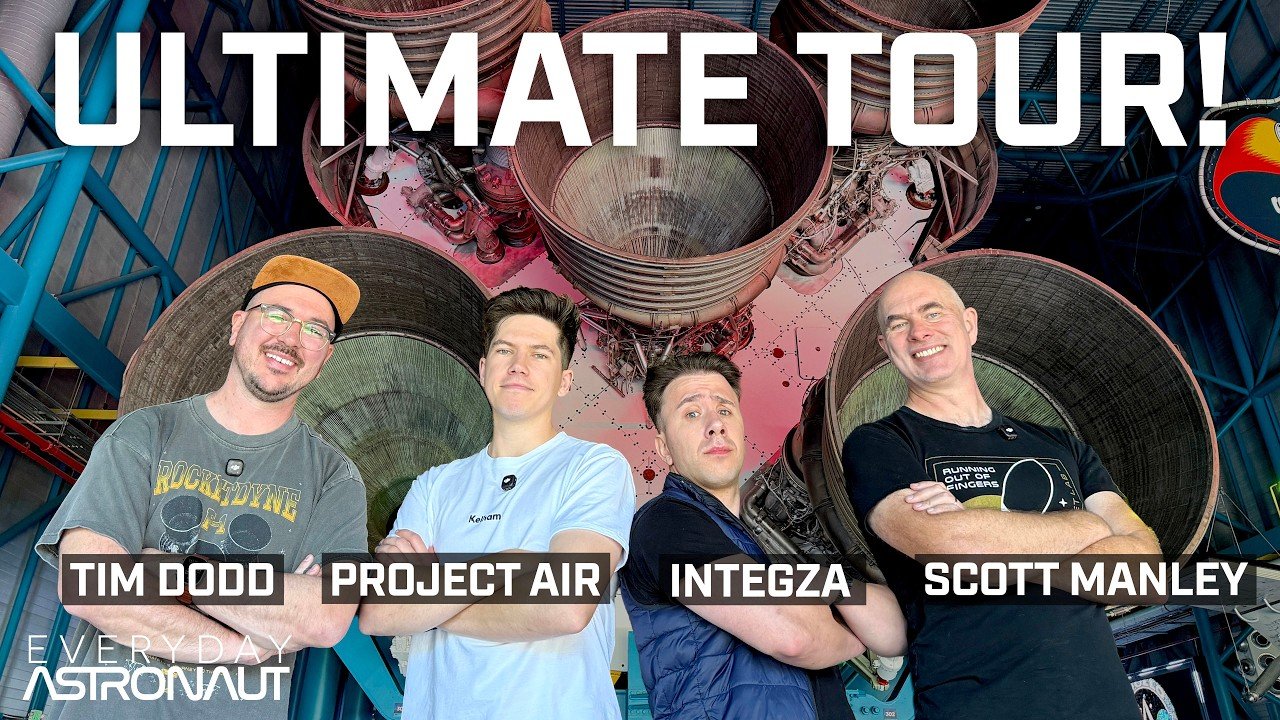
Tim Dodd of Everyday Astronaut walks the Kennedy Space Center Visitor Complex with Scott Manley, Joel Gomez and James Whomsley. They go from the Atlas, Redstone and Titan II in the rocket garden to a Falcon Heavy booster, Orion, SLS, a first-generation Dragon, Starliner and the Saturn V hall. Along the way they discuss engine cycles, staging, heat shields and Apollo Lunar Module details.
Full written account
Four space content creators spent an afternoon at the Kennedy Space Center Visitor Complex walking the rocket garden and the exhibit halls, and they talked through the hardware as they went. Tim Dodd of Everyday Astronaut was joined by Scott Manley, Joel Gomez and James Whomsley. They were all special guests at Reinvented Magazine's Space Gala fundraiser. It was Scott Manley's first time in Florida. They did not have time to see Atlantis.
The rocket garden: Atlas, Redstone and Juno
The tour opens at a first-generation Atlas with an Agena stage. Its thin stainless steel tanks are balloon tanks, held rigid by pressure. That is why museums sometimes keep a compressor running, and they call Atlas the only rocket that has imploded. The two side engines and the skirt drop away, leaving the center engine. The Agena was a full spacecraft bus with attitude control, but it was guided from the ground. They recall an early Venus spacecraft that went out of control, described as a missing minus sign in the code.
A Mercury capsule model sits nearby. Mercury flew twice on Redstone and five times on Atlas. Redstone was a von Braun design that continued V-2 technology, burning alcohol and oxygen, with graphite vanes for steering. Beside it is a model of Explorer 1, whose upper stages sat in a spinning barrel. With no guidance mass margin in the upper stages, the spin stabilized the final stages, which they call a glorious hack.
The Juno 2 tank is the core tank of the Saturn 1. Saturn 1 and 1B clustered tanks around it. The H-1 engines gimbal on only one axis each, offset so together they can control pitch, yaw and roll. Saturn 1 first flew with six RL10 engines in its second stage, and the 1B became the test platform for the J-2 engine.
Delta II and Titan II
The Delta II on display is described as the 101st and newest addition to the garden. Its last flight was in 2018. Delta began as the Thor, which NASA renamed because Thor was a military name. The Delta II launched Spirit and Opportunity, and flew with three, four or nine solid boosters.
The Titan II used hypergolic propellants, and the group says Gemini had ejection seats rather than an escape tower. Its LR87 engines were started with a solid start cartridge, and the wine on startup comes mostly from a gear reduction between turbine and pumps. Panels on the stage were designed to blow out for hot staging, which they compare to Starship.
Falcon Heavy, Orion, SLS and the RL10
The Falcon Heavy side booster dates from the 2018 demo flight and began life as a Falcon 9. It has aluminium grid fins; the center core, which was not recovered, also had aluminium fins. The Orion on display is 5 m wide against 3.9 m for Apollo. Its tiles puzzle them, because they look non-ablative, unlike the Avcoat-type shield they expected.
The SLS model includes the mobile launcher and the crawler beneath it, which keeps the load horizontal on the slope. They describe it as a hybrid, with diesel generators powering electric motors.
The RL10 uses heat from regenerative cooling to boil hydrogen, which spins the turbine. They explain this limits how large such an expander engine can be. They say it was once the most expensive engine in the world, at about $35 million each.
Commercial vehicles
Dream Chaser, a model, is described as a baby shuttle meant for commercial resupply and also pitched for crew. It is now planned for Vulcan, with its wings folding inside the fairing. Jared Isaacman's Inspiration4 suit is a full-pressure nitrox suit, which they call a get-me-down suit.
The first-generation Dragon, which visited the space station in 2012, has only a common berthing adapter. It must be grappled by the robot arm and latched on. The Starliner mockup has five seats, lands on airbags, and its docking system derives from Apollo. They show the Falcon Heavy booster's heat shielding and engine-section blankets, and say Falcon 9 boosters do an entry burn.
Saturn V and Apollo
The Saturn V hall draws the most awe. They explain that the F-1 uses its gas generator exhaust for film cooling in the nozzle extension, which is why the exhaust starts out black. Ribbed sections are structural, while smooth sections have propellant tanks. The five J-2 engines of the second stage burn hydrogen and oxygen, and helium spheres on the S-IVB are needed to restart its engine after a full orbit. The instrument ring held the gyroscopes, accelerometers and flight computers; the computer was semi-analog, built by IBM, with perhaps 8K of memory.
At the Lunar Module they discuss the ladder, which is shorter than expected because the landing gear was assumed to compress more. They recall that Apollo 15 landed at an angle close to the maximum for takeoff, and describe a procedure of jumper cables to jump-start the ascent engine. Beside the Apollo capsule they describe how, on Apollo 14, the abort switch kept triggering by accident. Operators edited computer memory by hand so the landing could proceed.
Questions this video answers
Who takes the tour?
Tim Dodd of Everyday Astronaut is joined by Scott Manley, Joel Gomez of Integza and James Whomsley of Project Air.
Why were they at Kennedy Space Center?
All four were special guests at Reinvented Magazine's Space Gala fundraiser event.
Why did Atlas need pressure to stay rigid?
Its thin stainless steel tanks are balloon tanks held rigid by internal pressure, so museum examples sometimes need a compressor.
Why is the Orion tile exhibit confusing to them?
The tiles look like non-ablative tiles rather than the Avcoat-type material they expected, and they wonder whether exhibits were swapped.
Did they see Atlantis?
No. They say they did not have time to visit Atlantis together.