Six Mars Rovers Compared: Landings, Discoveries and Distances
The short version
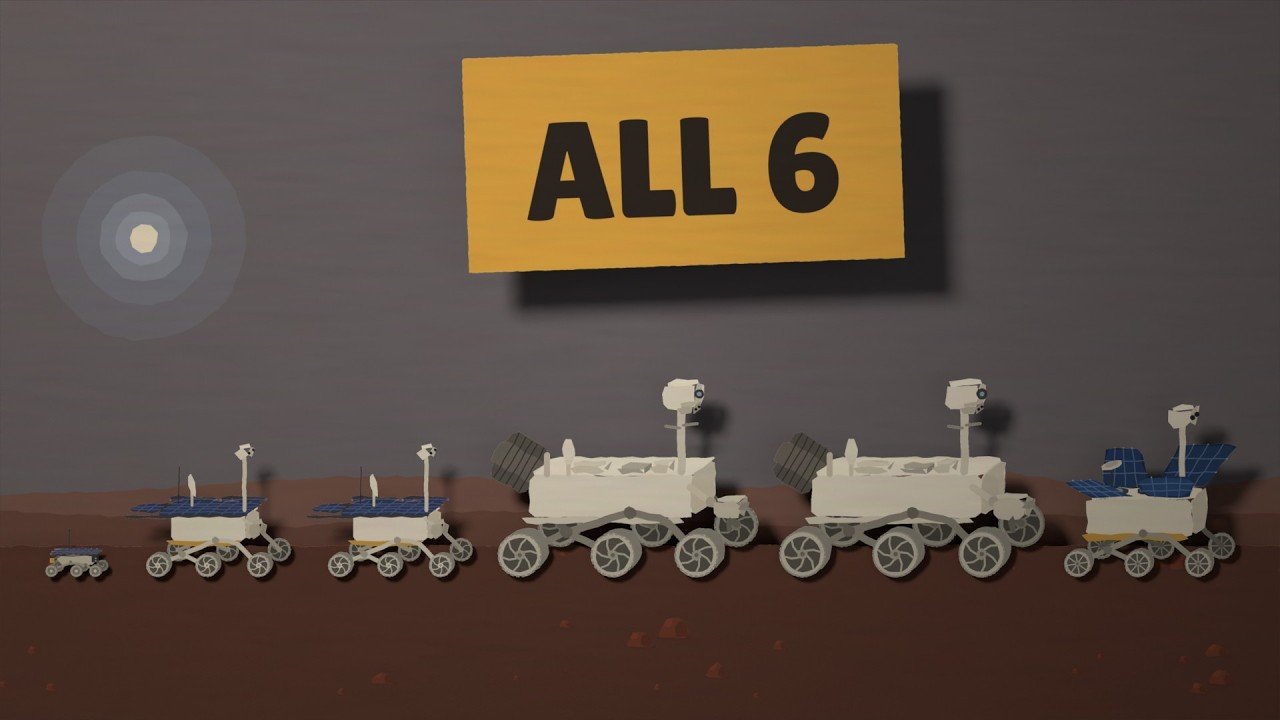
A walk through the six rovers that have driven on Mars: Sojourner, Spirit, Opportunity, Curiosity, Perseverance and Zhurong. For each it covers the landing, main findings, distance driven and whether it still works. It also covers the Soviet Mars 3 rover of 1971 that sent no data, the helicopter Ingenuity, and Perseverance passing Opportunity's driving record on October 11th, 2026.
Full written account
Opportunity, built to drive about 1 km over 90 Martian days, worked for more than 14 years and drove 45.16 km. No vehicle drove farther on another world until NASA's Perseverance passed that distance on October 11th, 2026, after less than six years. Six rovers have driven on Mars, five American and one Chinese, and their stories show how much each exceeded its plan.
Before the six: Mars 3 and Ingenuity
According to NASA, only about half of all attempts to land on Mars have succeeded. In 1971 the Soviet lander Mars 3 touched down carrying a small rover that moved on skis. The lander's signal stopped after about 15 to 20 seconds, and the rover never drove or sent back data. The helicopter Ingenuity flew 72 times but never drove, so it belongs to the Perseverance story.
Sojourner (1997)
On July 4th, 1997, NASA's Mars Pathfinder lander entered the atmosphere at about 26,000 km/h. Wrapped in airbags, it hit the flood plain Ares Vallis and bounced at least 15 times. The six-wheeled Sojourner, 65 cm long and 10.6 kg, rode folded on one of the lander's petals. A partly deflated airbag blocked its ramp, so it drove onto the ground on its second day. It was built for seven Martian days and worked for 83, driving about 100 m in total but never more than about 12 m from the lander. The last data arrived on September 27th, 1997. A 2006 image from Mars Reconnaissance Orbiter showed a spot that might be Sojourner, but it was never confirmed.
Spirit and Opportunity (2004)
Spirit landed in Gusev crater, about 160 km wide, in January 2004. On its 18th day its computer kept restarting, and engineers needed two weeks to fix it. It drove about 3 km to the Columbia Hills, named for the seven astronauts who died on the space shuttle Columbia in 2003, and found goethite there, an iron mineral that forms only in the presence of water. After its right front wheel failed in March 2006, Spirit dragged it, and in March 2007 the wheel scraped up bright soil near Home Plate that was about 90% silica. Lead scientist Steve Squyres said the team would not have found it if the wheel had still worked. Spirit became stuck in soft sand at Troy in April 2009, NASA stopped trying to free it in January 2010, and its last signal came on March 22nd, 2010. Planned for 90 Martian days, it worked for more than six years and drove 7.7 km.
Opportunity landed three weeks after Spirit on Meridiani Planum and rolled into a crater only about 22 m wide. Rock there held hematite balls nicknamed blueberries and jarosite, a mineral that forms only in acidic water. It spent more than five weeks freeing itself from Purgatory Dune in 2005, then drove almost three years to Endeavour crater, about 22 km wide. At Endeavour a rock named Esperance contained clay that forms in water of near neutral pH. Squyres said the earlier rocks pointed to sulfuric acid, but this was water you could drink. A global dust storm in June 2018 cut its daily energy from 645 to 22 watt hours. For the last attempt in February 2019 the team played Billie Holiday's I'll Be Seeing You as a wake-up song.
Curiosity (2012)
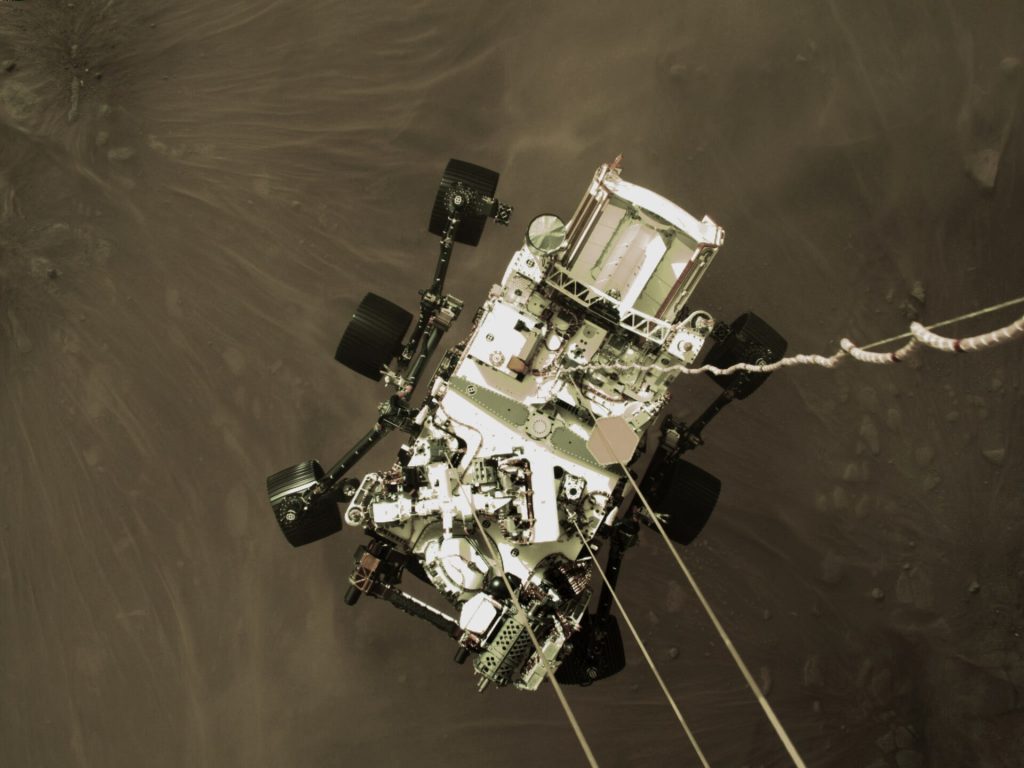
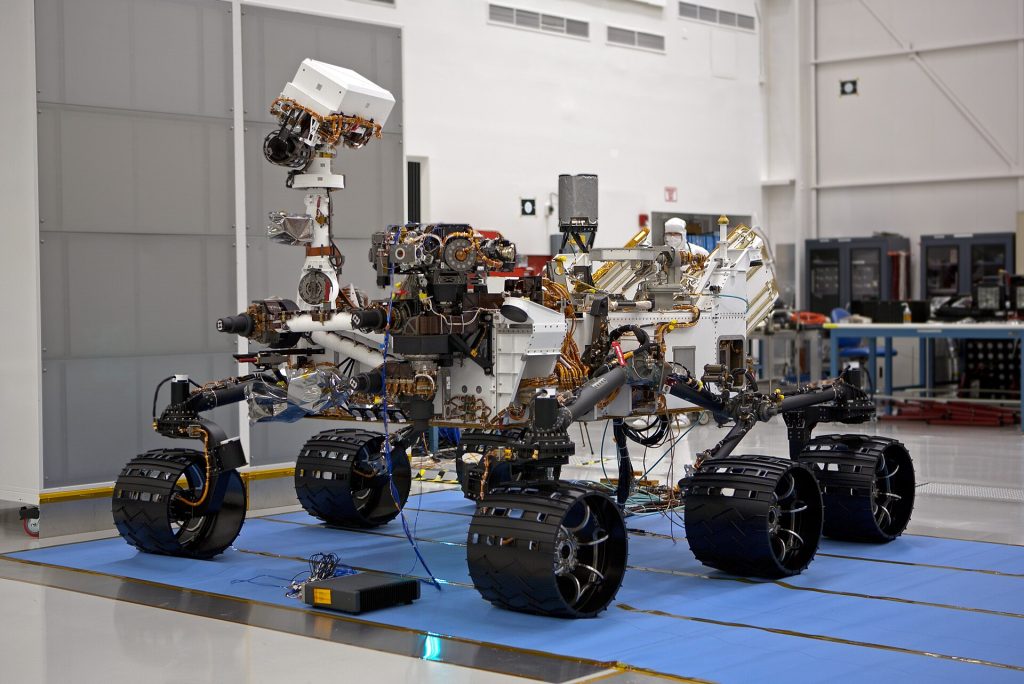
Curiosity weighs 899 kg, about five times as much as Spirit or Opportunity. In August 2012 a sky crane lowered it on three nylon cords 7.5 m long from about 20 m up. The cords were cut and the platform flew off to crash about 600 m away. In Gale Crater, in February 2013, it drilled the first rock sample ever taken on Mars, which showed that water once flowed or pooled there with ingredients microbes could have used. It has climbed Mount Sharp since 2014 and has found organic molecules, though scientists do not know whether life or ordinary chemistry made them. In 2024 a wheel cracked open a rock full of pure sulfur crystals. On August 26th, 2026 it reached 1 km above its landing site, higher than any other rover has climbed on Mars. It has driven about 38 km.
Perseverance (2021)
Questions this video answers
How many rovers have driven on Mars?
Six: Sojourner, Spirit, Opportunity, Curiosity and Perseverance from the United States, and Zhurong from China.
Which rovers are still driving?
Curiosity and Perseverance. The other four have been silent for years.
What happened to the Soviet rover on Mars 3?
Mars 3 touched down in 1971 carrying a small rover on skis. The lander's signal stopped after about 15 to 20 seconds and the rover never drove or sent data.
Who holds the Mars driving record?
Perseverance. On October 11th, 2026 it passed the 45.16 km that Opportunity had driven.
Why did Opportunity go silent?
A planet-wide dust storm in June 2018 blocked almost all sunlight at the rover. Its last signal came on June 10th, and over eight months more than 1,000 commands got no reply.
When will Europe's Rosalind Franklin rover launch?
It is planned to launch in 2028 and land in 2030.
Explore related missions
Connected by the topic: Mars exploration