Skylab: From Von Braun’s Station Plans to Its 1979 Re-entry

The short version
Skylab was a solely US space station that orbited Earth between 1973 and 1979. It was launched uncrewed on a Saturn V on 14 May 1973 and was visited by three crews, who stayed 28, 59 and 84 days. After being abandoned, it re-entered in July 1979 and came down in western Australia, with no injuries or property damage recorded.
Full written account
Skylab, a solely US space station, orbited Earth between 1973 and 1979. After being abandoned for five years, it fell back on 11 July 1979, and the world watched the skies because nobody knew where the debris would land. It came down in western Australia, with no injuries and no property damage recorded.
Origins
Between 1952 and 1954 Wernher von Braun published a series of articles, Man Will Conquer Space Soon, describing a circular station 75 meters (250 feet) in diameter for 80 people. Skylab never came close to that size. In the early 1960s NASA considered plans from a cluster of joined spacecraft supporting two or three people to a large station for 24 people with a five-year service life. The Department of Defense announced its Manned Orbital Laboratory in December 1963, a small station for photo reconnaissance; it competed with NASA for funds and was scrapped in 1969.
Design
In 1964 von Braun proposed building a station from the S-II second stage of a Saturn V. The first design, the wet workshop, would vent the spent stage's fuel in orbit and fit equipment inside the tank. Budgets tightened: in 1967 the Apollo Applications Program received $42 million of the $450 million it requested. The cancellation of Apollo missions 18 through 20 freed three Saturn rockets, and NASA settled on a dry workshop, a prepared mini station launched with stages one and two of a Saturn.
Astronauts told designers they did not want TVs or video games but did want books and individual choices of music. The menu had 72 items, 15 of them frozen, including shrimp cocktail, butter cookies, lobster Newberg and ice cream. Each astronaut had sleeping quarters about the size of a small walk-in closet.
Skylab weighed 77 tons, was 25.1 meters long and 17 meters wide, with 351 cubic meters of pressurized volume. A control moment gyroscope, the first used in space, helped control its attitude.
The missions
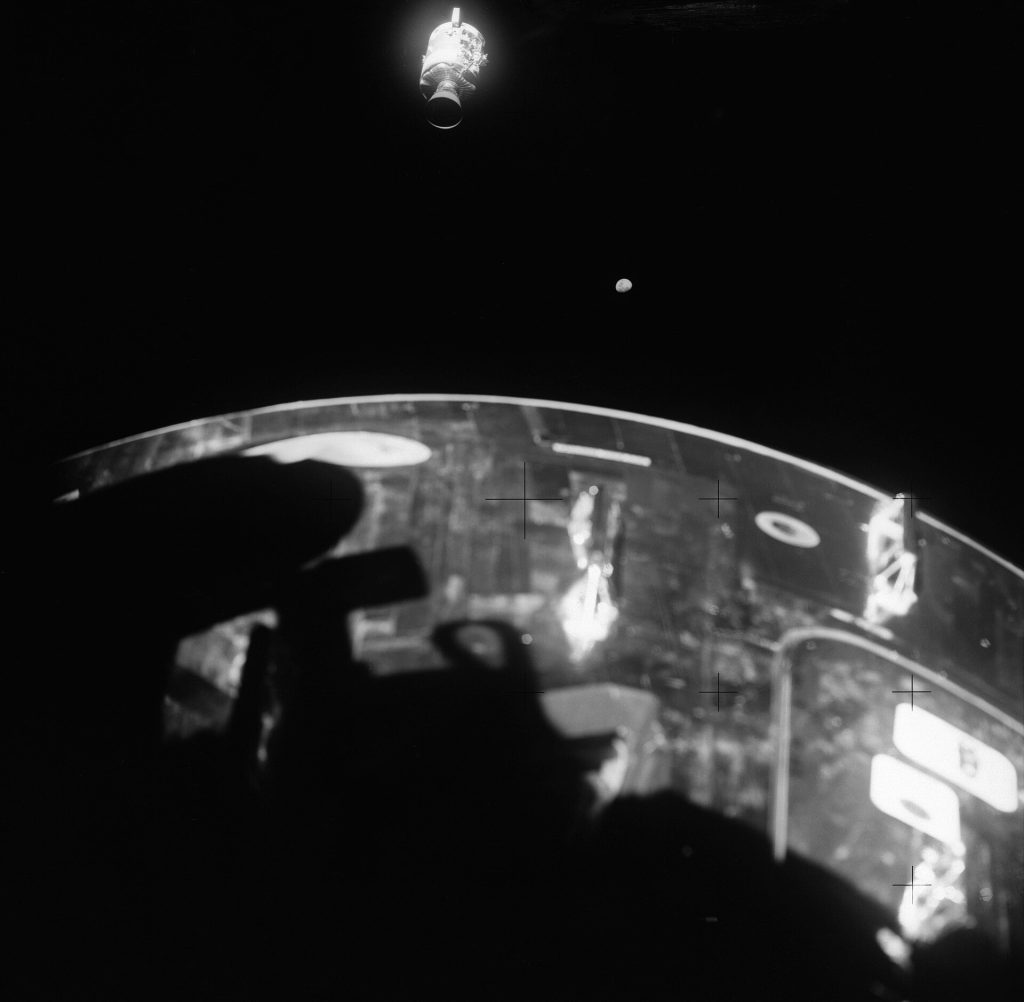
On 14 May 1973 a Saturn V launched the uncrewed Skylab 1. The micrometeoroid shield, sunshade and one of its main solar panels were destroyed shortly after takeoff, but it reached orbit. Skylab 2 launched with three crew on 25 May 1973 and spent much of its time repairing the station, installing a parasol-like sunshade that kept temperatures down and prevented the plastic insulation from melting and releasing poisonous gases.
- Skylab 2: 28 days
- Skylab 3: launched 28 July 1973, 59 days
- Skylab 4: launched 16 November 1973, 84 days
The last crew returned on 8 February 1974. Each mission extended the human spaceflight duration record, beating the 23 days of the Soviet Salyut 1. Ten spacewalks totaled 42 hours and 16 minutes. The crews logged 2,000 hours of experiments and took 127,000 frames of film of the Sun and 46,000 of Earth, confirming the Sun's coronal holes.
Re-entry
The final crew left a welcome bag for visitors who never came; Skylab 5 was scrapped. NASA had expected the station to remain spaceworthy until 1982, but British mathematician Desmond King-Hele had predicted in 1973 that increased solar activity would bring it down in 1979. NORAD made the same prediction in 1977. Space Shuttle Columbia, which might have boosted the station higher, would not be ready; that was clear by December 1978.
A newspaper offered $10,000 for the first piece brought to its offices. A NASA report put the chance of hitting a human at one in 152. NASA aimed for a spot 810 miles (1,300 km) south southeast of Cape Town, but a four percent calculation error meant Skylab did not burn up as quickly as expected, and it fell in western Australia. NASA was fined $400 for littering.
Skylab was occupied for 171 days in total and spent 2,249 days in orbit, circling Earth 34,981 times.
Questions this video answers
When was Skylab launched?
The uncrewed Skylab 1 launched on a Saturn V on 14 May 1973.
How long did the three Skylab crews stay?
Skylab 2 stayed 28 days, Skylab 3 stayed 59 days and Skylab 4 stayed 84 days.
Why did Skylab come down early?
Solar activity rose to the second highest level seen in a century, heating the outer atmosphere and increasing drag on the station.
Where did Skylab land?
It came down in western Australia instead of the targeted area south southeast of Cape Town, due to a four percent calculation error.
Was anyone hurt?
No injuries and no property damage were recorded.