Why the Apollo Lunar Module Was Built So Light and Odd-Looking

The short version
Explains why the Apollo Lunar Module looked the way it did: a two-stage design by Grumman built to save weight, with four legs, honeycomb shock absorbers, small windows and a thin hull wrapped in layered thermal film. It also covers astronaut feedback that changed the design, clean-room assembly, and the thermal protection that led conspiracy theorists to call it a stage prop.
Full written account
The Apollo lunar lander, built by Grumman, looked like one of the oddest spacecraft ever made, yet it landed on the Moon six times without fail. Its shape followed its function, and almost every feature came from the need to save weight: for every 1 kilo of weight, it took 4 kilos of fuel to lift it from Earth.
Early ideas and the Moon's surface
When President Kennedy announced Moon missions in 1962, no one at NASA knew how to land men on the Moon and return them. Early ideas borrowed from science fiction: a rocket landing and taking off vertically. Many at NASA and its contractors favoured a dedicated lunar spacecraft instead, because a general-purpose rocket might be too heavy or too tall and could tip over on uneven ground.
Little was known about the surface. Some thought the dust might be up to 10 m deep and swallow a heavy lander like quicksand. The Surveyor missions of the mid-1960s showed there was dust, rocks and craters, but the dust was not as deep as some had expected.
Two stages and four legs
Grumman had already done much of the design work and proposed a two-stage craft: a descent stage, and a smaller ascent stage that would lift off and rendezvous with the command service module in lunar orbit. Less weight to lift off the Moon meant smaller engines and less fuel.
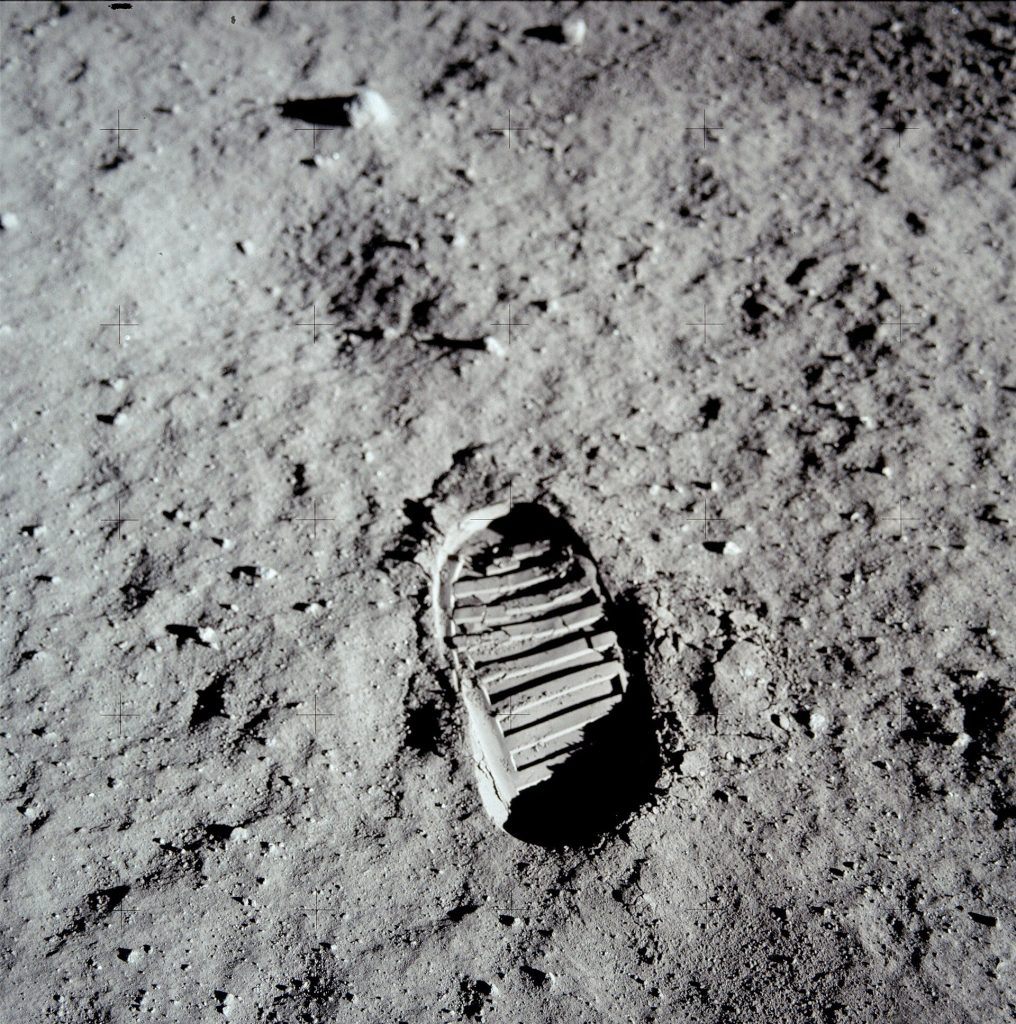
Engineers tested landing models on different surfaces and inclines, including cases where the lander was still moving sideways. Five legs were considered, but four proved adequate and stable. For shock absorption, heavy hydraulic or pneumatic systems were a concern in cold and vacuum, so a single-use dry absorber was developed, using aluminium honeycomb from Hexcel that compressed in the cylinder on touchdown. The honeycomb could take 10 ft per second, but the actual landing only exerted about 4 ft per second, so the legs stayed longer than expected. Neil Armstrong's small step was therefore a couple of feet longer than anticipated, and on Apollo 12 Pete Conrad's first words from the ladder were "Whoopee, man, that might have been a small one for Neil, but it was a long one for me."
Cabin changes
The original cabin was hemispherical with large glass windows. Glass was heavy, so it was cut to two small triangular windows, and the rest was a lightweight aluminium hull with titanium fasteners. After the first revision proved too heavy, NASA went through the structure shaving off a kilogram here and a few hundred grams there.
Astronaut trials changed the design:
- Seats were dropped, since standing in one-sixth gravity was much less of a problem.
- A winch and harness meant to lower astronauts failed on a full-scale mockup because they could not get back up with the hand-operated rope winch, so the ladder was restored.
- The round hatch was replaced with a square one because astronauts with large rectangular backpacks could hardly get through.
There was no airlock, so the crew suited up before the cabin was depressurized, and repressurized it after coming back in.
Cleanliness
During pressure testing in a vacuum chamber, one triangular window shattered, spraying glass that cut wires and punctured the structure. Technicians hunted for every shard, since debris would float in weightlessness. The cause was never satisfactorily resolved, but the windows on the other landers were replaced and the new ones rechecked.
The landers were built in clean rooms cleaner than an operating theatre. The ascent module was put in a tumbling rig, turned upside down and shaken, and the fallen pieces were counted; only when nothing else fell out was it deemed clean. Inside, wear marks on controls stayed visible, because astronauts had practised every switch and lever in full suits and the 1970 deadline left no time for cosmetics.
Thermal protection
Temperatures could reach 150°C in sunlight and fall to minus 170°C in shade, raising the worry that the aluminium hull could buckle and that resin-glued structures such as the honeycomb core of the legs could be affected. A new DuPont material, aluminium-covered Mylar film in gold colour, wrapped the exterior including the legs and feet. Three layers of Inconel, a nickel-chromium superalloy, were used, then 25 layers of Mylar sandwiched into a thermal blanket, then an aluminium structural skin. The layers were only a few millimetres thick and also protected against micrometeorites. The result looked like tin foil, which conspiracy theorists seized on to call it a stage prop.
Questions this video answers
Why did the lunar lander have two stages?
A smaller ascent stage lifted off from the Moon and rejoined the command service module in lunar orbit, which cut weight, engine size and fuel needed from Earth.
Why did the lander have four legs?
Five legs were first considered, but four were found to be adequate and stable and saved weight.
How did the landing legs absorb the shock of touchdown?
They used a single-use dry shock absorber with a compressed aluminium honeycomb material made by Hexcel.
Why were the windows so small?
Glass was heavy, so the original large windows were reduced to two small triangular ones.
Why did the lander look like it was covered in foil?
It was wrapped in aluminium-covered Mylar film to insulate against temperatures from up to 150°C in sunlight to minus 170°C in shade.
Did the lander have an airlock?
No. The crew put on full suits and the whole cabin was depressurized before they exited.