YES2: How a 31.7 km Tether Was Meant to Drop a Capsule
The short version
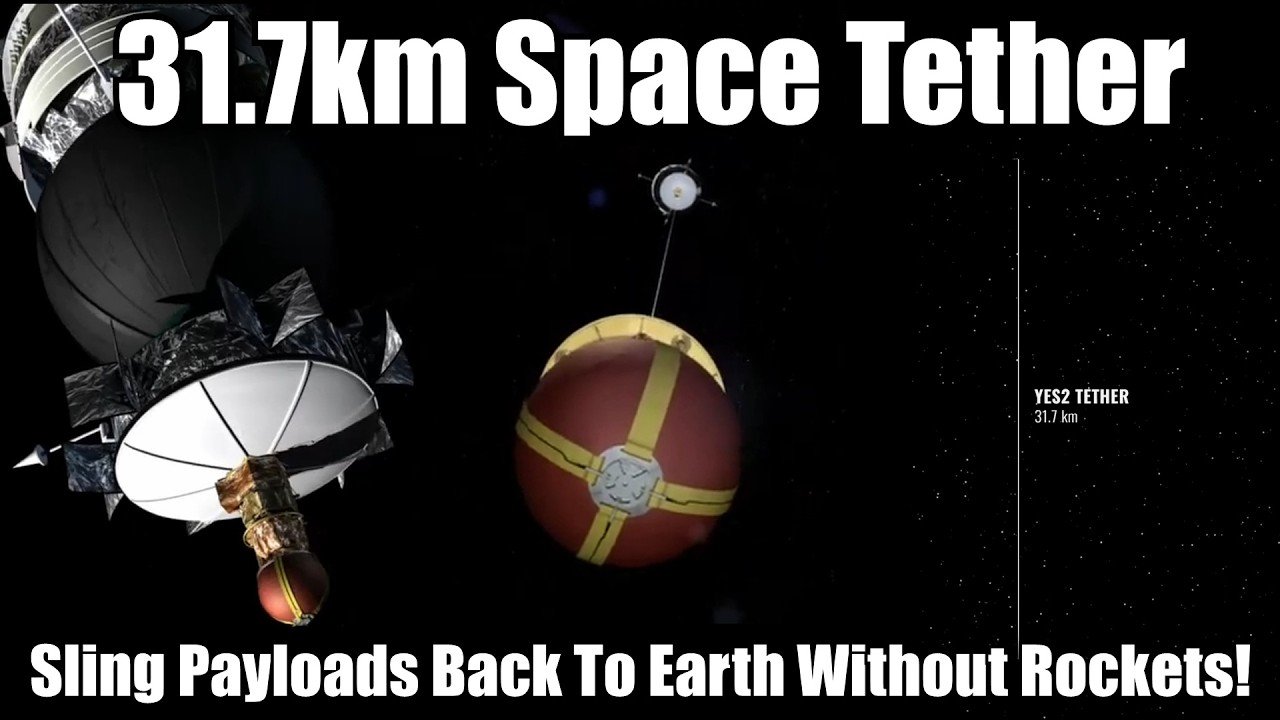
YES2 (Young Engineers Satellite 2) was a European Space Agency tether experiment carried on the Russian Foton-M3 spacecraft. It deployed a tether of 31.7 km, the longest spacecraft ever, to swing the small Fotonino capsule into a re-entry trajectory without rocket engines. Sensor power was lost after about 8 km, and no signal came from the capsule, which was never recovered. Later analysis of accelerometer data and tracking of Foton's altitude indicated the tether system had worked.
Full written account
YES2, the Young Engineers Satellite 2, deployed 31.7 km of tether from the Russian Foton-M3 spacecraft, which makes it the longest spacecraft ever launched. The European Space Agency project aimed to return a small capsule to Earth by swinging it on the tether rather than firing rocket engines. The capsule was never found.
Background
The original Young Engineers Satellite also involved a tether. It arose after the failure of the first Ariane 5 launch, when ESA put together payloads to attach to the mass simulator on the second flight. Around 2002 an opportunity arose for the second satellite, a project on which students across Europe could work. Its concept was called Photon Mail: play out a long tether from a parent satellite with a re-entry capsule on the end, adjust the orbits through the interaction between the two, and release the package on a re-entry trajectory.
The parent was Foton-M3, a descendant of Vostok with a pressurized spherical module that returns science to Earth. A Dutch engineering company that had pitched tether ideas led the project. A planned test on Foton-M2 was dropped, and the final version went straight onto Foton-M3. The green light came less than a month before launch, because of concerns about interaction between a very long tether and the parent spacecraft.
The hardware
The roughly 30 kg package sat on the front of the rocket and had three parts:
- Floyd, holding the 30 km spool of tether.
- MASS (Mechanical and Data Acquisition Support Systems), which also added mass to pull the pieces apart.
- Fotonino, the small re-entry sphere.
The pieces were to separate by springs at about 3 m/s, extending to about 2 km. Deployment would then be held, so the payload swung backwards like a pendulum. When it reached the right point, deployment resumed and tidal gravity difference pulled the pieces apart. A barber-pole braking system wrapped the tether around a metal cylinder, and more turns meant more friction, so the deployment rate could be controlled and slowed at the end to avoid oscillations. The capsule was to re-enter over Kazakhstan.
What happened
After about 8 km of deployment, power was lost in the sensor system and the team could not tell whether the tether had stuck. They thought it had only released after 8 km, which would not give enough velocity to deorbit, and considered the mission a partial success. No signal came from the capsule, which carried a parachute and a recovery beacon, and it was never recovered.
Later analysis
About a month later the team concluded the mission had largely succeeded. The DIMAC experiment on Foton, a very sensitive accelerometer, recorded the tugs of the tether. Oscillations at the playout frequency let them count loops through the braking system, and a large signal marked the end of the cable at 31.7 km. The tether reached the end at about 15 m/s, stretched about another 100 m and bounced back.
The release ran on a timer. Because the swing was going faster than expected, the capsule was released at a lower velocity than intended and would have landed a little earlier downrange. The US Space Surveillance Network saw Foton climb about 1.3 km, which is what would be expected if the capsule was cut free on a 30 km tether.
The accelerometer data suggested the capsule would have come down in an area below the horizon of the recovery area, so the beacon would not have been heard. The area is near the Aral Sea and contains several lakes, so it may have landed in one. The capsule carries text offering a $1,000 reward for its return.
Questions this video answers
What does YES2 stand for?
Young Engineers Satellite 2, a European Space Agency project in which students across Europe could contribute.
How long was the YES2 tether?
It deployed 31.7 km of tether, and stretched about another 100 m when it reached the end, making it the longest spacecraft ever.
Was the capsule recovered?
No. No signal was received from the Fotonino capsule and it was never recovered; it may have landed in Kazakhstan, possibly in a lake.
How did the tether system show it worked?
Data from the DIMAC accelerometer showed the tether paying out to its full length, and the US Space Surveillance Network saw Foton rise about 1.3 km, as expected after release on a 30 km tether.
Explore related missions
Connected by the topic: Low Earth orbit