Challenger STS-51-L: NBC4’s Live Broadcast of the 1986 Launch
The short version
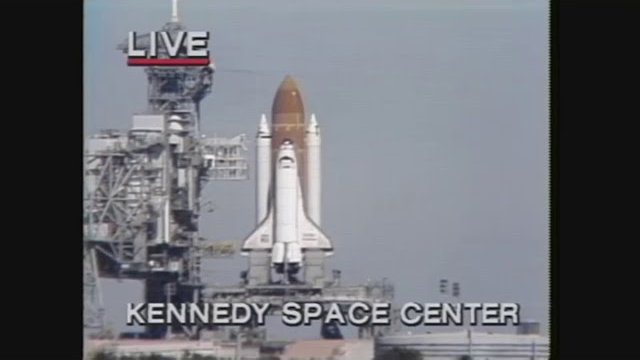
NBC4's archived live coverage of the Jan. 28, 1986 Space Shuttle Challenger launch shows liftoff from pad 39B and the explosion about a minute into flight. Anchor Kent Shocknek's broadcast follows the unfolding reports, including that the vehicle had exploded and that the crew was assumed not to be alive.
Full written account
Space Shuttle Challenger lifted off from pad 39B at the Kennedy Space Center near Cape Canaveral, Florida, on Jan. 28, 1986, and exploded about a minute into the flight. NBC4 anchor Kent Shocknek was on air with a special report as it happened. The broadcast said contingency procedures were in effect and that it should be assumed the crew was not alive.
The launch
The launch had been delayed a couple of times because of weather and mechanical problems. Hugh Harris of NASA was the voice of launch control. After main engine start and liftoff, the broadcast called it the 25th space shuttle mission and noted Challenger had cleared the tower and gone into its planned roll. It was the first use of pad 39B since the Apollo days and the Skylab missions.
It was chilly in Florida, and icicles had formed on the pad overnight. NASA engineers were concerned they might have broken off during launch and affected the fragile heat protection tiles that protect the shuttle during re-entry. The anchor said the astronauts would look at this later in the mission.
The explosion
Engines were throttled down to 65%, with three engines running normally, three good fuel cells and three good APUs. At 4.3 nautical miles altitude the shuttle was already more than 4 miles downwind. Then the call came to throttle up three engines to 104%, and Challenger was reported go at throttle up. Seconds later came an explosion, with the altitude given as 9 nautical miles and downrange distance 7 nautical miles.
The anchors saw a solid rocket booster break away and could not see the shuttle itself. One suggested the shuttle might return to the Kennedy Space Center if it could continue on one booster. Debris was seen falling, and the flight dynamics officer reported the vehicle had exploded, which the flight director confirmed. A voice later said "Obviously, a major malfunction."
Reports from launch control
At about 8:40 a.m., launch control reported that the vehicle, the orbiter itself, had exploded. Recovery forces were being checked with to see what could be done. Contingency procedures were in effect, and the broadcast said to assume the crew was not alive.
Context from the anchors
An anchor who said he had covered shuttle launches since before the first said nothing like this had happened. He recalled the Apollo 1 fire on the ground at the Kennedy Space Center, which killed three astronauts during a test, and said the shuttle program had until then had no human injuries and no human deaths. He said it was not known whether the booster tearing away came before or after the blast, or whether it caused it. He noted the large amounts of liquid oxygen and liquid hydrogen in the external tank.
Questions this video answers
When and where did Challenger launch?
On Jan. 28, 1986, from pad 39B at the Kennedy Space Center near Cape Canaveral, Florida.
When did the explosion happen?
About a minute into the flight, around 8:40 a.m. by the broadcast's account, after the call "Challenger go at throttle up."
What did the broadcast say about the crew?
The broadcast said contingency procedures were in effect and that it should be assumed the crew was not alive. The video does not give a crew count or names.
Was it a notable launch?
Yes. The anchors said it was the first use of pad 39B since the Apollo and Skylab days, and the 25th space shuttle mission.
Did the broadcast establish a cause?
No. The anchors speculated on the live broadcast, and no cause is established in the video.
Explore related missions
Connected by the topic: Space Shuttle