STS-109: Columbia’s Hubble Upgrade and the Leaking Spacesuit
The short version
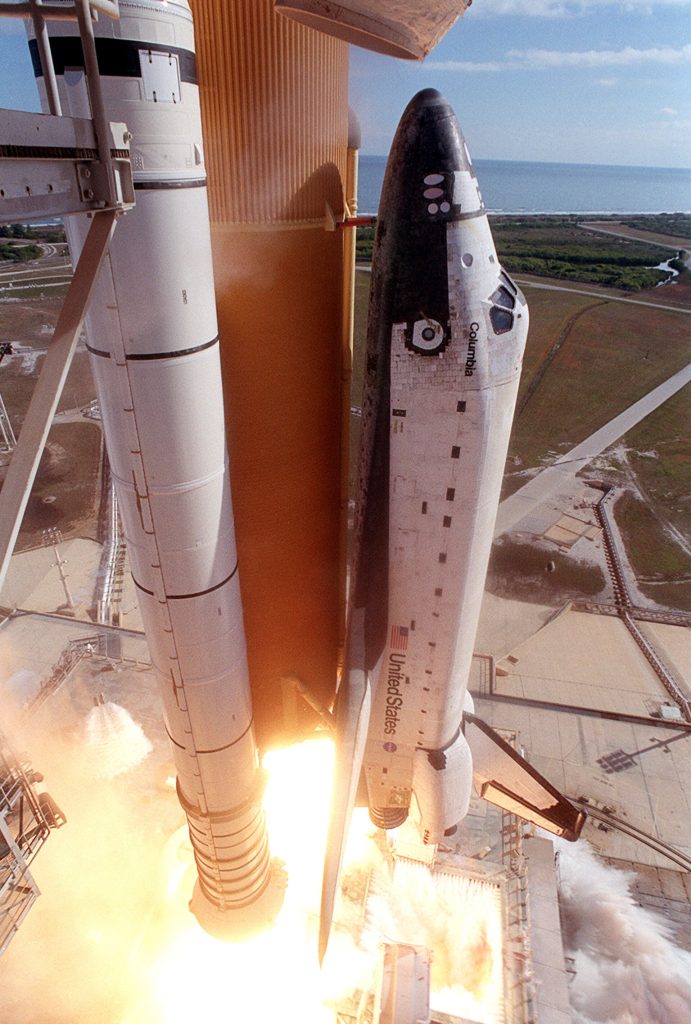
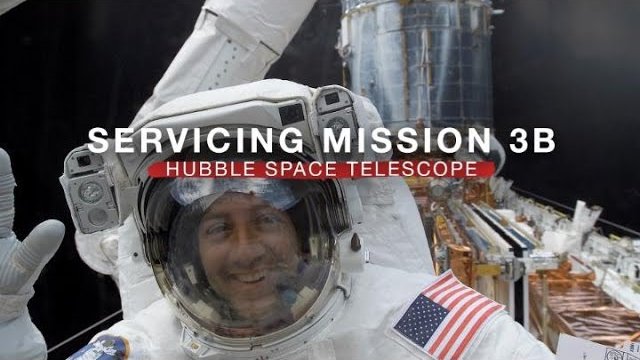
NASA's Servicing Mission 3B, flown on space shuttle Columbia as STS-109, was the fourth visit to the Hubble Space Telescope and lasted 12 days with five spacewalks. Astronauts installed new solar arrays, replaced the power control unit, added the Advanced Camera for Surveys and revived the NICMOS instrument with a cryocooler. A water leak in John Grunsfeld's spacesuit delayed one spacewalk, but the crew resized another suit and the work went ahead.
Full written account
Servicing Mission 3B, flown on space shuttle Columbia as STS-109 in early 2002, was the fourth visit to the Hubble Space Telescope. What happens when Hubble must be fully switched off for the first time, and a spacesuit fails at the same moment?
Why the mission was split
NASA divided Hubble's third servicing mission into two parts so astronauts could reach the telescope as soon as possible to replace its gyroscopes, which are needed to point it accurately. Servicing Mission 3A got Hubble running again. Servicing Mission 3B, scheduled for spring 2002, was to complete the planned upgrades. Over 12 days and five scheduled spacewalks it would add a new science instrument, the Advanced Camera for Surveys, bring an infrared camera back to life, and install new solar arrays and a new power control unit.
The crew
Scott Altman, a two-time shuttle veteran, commanded the mission. Duane Carey was pilot, on his first space flight, and Nancy Currie was flight engineer, with three previous flights. Four astronauts trained for the spacewalks: veterans John M. Grunsfeld, James H. Newman and Richard M. Linnehan, and Michael J. Massimino, who was making his first flight.
Solar arrays and the power control unit
The first spacewalk replaced the old arrays with the third version of Hubble's solar arrays. These were rigid and did not roll up like earlier designs. Being more robust, they raised Hubble's power intake by about 20 to 30 percent.
Next came the power control unit, Hubble's power switching station, which distributes the electricity generated by the arrays and batteries to the rest of the telescope. Replacing it required Hubble to be completely powered down for the first time. As the narration notes, one cardinal rule in space is that if something is working well, you don't turn it off.
The leaking spacesuit
During the shutdown, Grunsfeld and Linnehan were suiting up for the next spacewalk. A crew member monitoring Grunsfeld's suit reported a large bit of water at the bottom of the battery, and Houston was told Grunsfeld would have to be taken out of the suit. The water came from the suit's liquid coolant system. Because parts of Hubble were already shut down, the crew quickly resized another spacesuit so the spacewalker could get out before the spacewalk had to be cancelled. The start was late, but the power control unit was successfully changed out in a spacewalk of seven hours.
Camera and cooler
The astronauts then installed the Advanced Camera for Surveys, which lets Hubble capture wider views of the universe at higher resolution than before. They also revived NICMOS, one of Hubble's most critical instruments, which had been dormant for two years, by installing a cryocooler for its infrared detectors.
Questions this video answers
What was Servicing Mission 3B?
It was the fourth visit to Hubble, flown on space shuttle Columbia as STS-109 after NASA split the original Servicing Mission 3 into two parts.
How long was the mission and how many spacewalks were planned?
The mission lasted 12 days with five scheduled spacewalks.
What new instrument was installed?
The Advanced Camera for Surveys (ACS).
What went wrong with a spacesuit?
John Grunsfeld's suit began taking on water from its liquid coolant system. His crewmates quickly resized another spacesuit so he could go out.
Who flew on STS-109?
Scott Altman, Duane Carey, Nancy Currie, John Grunsfeld, James Newman, Richard Linnehan and Michael Massimino.
Explore related missions
Connected by the topic: Space Shuttle