Columbia STS-107: From Foam Strike to Breakup on Re-entry
The short version
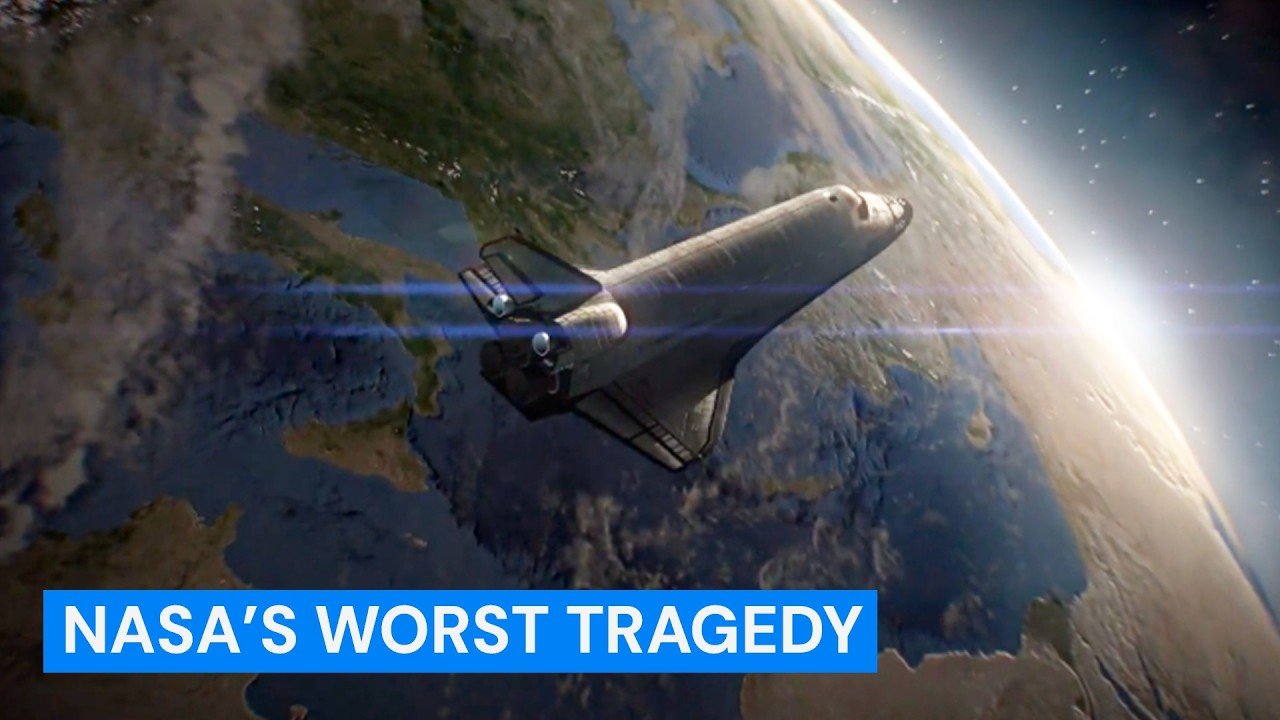
A documentary on the loss of Space Shuttle Columbia on 1 February 2003, which killed all seven astronauts on the return from the 16-day STS-107 science mission. It follows a piece of insulation foam that struck the left wing 81.9 seconds after launch, the engineers' doubts and the decisions made on the ground, and the re-entry breakup. It also covers the debris search and the question of whether a rescue was possible.
Full written account
How could a few pounds of foam bring down a 100-ton spaceship? On 1 February 2003, Space Shuttle Columbia broke apart over Texas as it returned from its 16-day STS-107 mission, killing all seven astronauts. The sequence began 81.9 seconds after liftoff on 16 January, when a piece of insulation foam broke off the external tank and struck the left wing.
A common problem on every flight
Columbia lifted off from Cape Canaveral at 10:39 on 16 January 2003. It was the orbiter's 28th mission, and the commander, Rick Husband, was on his first flight in that role. The external tank is covered in orange foam that keeps the fuel cold, and under the aerodynamic forces of launch small pieces tend to rip off and hit the shuttle. Before STS-107 there had been 112 flights, and 80% of them had some degree of foam shedding. The reinforced carbon on the wing's leading edges was considered very resistant to strikes.
The strike
On 17 January, engineers reviewing the launch tapes saw something break off the external tank, hit the shuttle and end up as dust. The foam came from the bipod ramp, one of the two connectors between orbiter and tank. It was about 6 in by 10 in by 16 in, one of the bigger examples of foam shedding in the program's history. It hit the port wing at a relative velocity of about 500 mph, with roughly 2,000 lb of force. Only two of the 12 cameras captured the falling foam, and the engineers could not identify the exact spot. Early analyses suggested it had hit the tiles near the landing gear.
Doubts on the ground
On the third day of the mission an army radar detected an object moving away from the shuttle, but the engineers did not receive that data. On 21 January a manager emailed his superiors that without a better photo the damage could not be determined, and asked to use a military satellite. NASA reacted with skepticism, in part because the bipod ramp foam had been seen to come off about 10% of the time. No cockpit alarm had been triggered, because the 26 sensors on the port wing measured quantities such as temperature and strain, not the presence of a hole.
On 23 January an email told Husband that there was a foam strike but that it was inconsequential and no cause for worry. Jonathan Clark, a flight surgeon in Houston and the husband of astronaut Laurel Clark, heard his colleagues' fears. He decided to follow the rules and not raise the matter with the crew.
Analysis that missed the mark
Engineers assumed the most likely impact was on the tiles, not on panel number eight of the reinforced carbon. To assess tile damage they used software called Crater, which was designed for very small debris. The foam was 400 times larger than the debris the software was built to assess. At a meeting on 24 January, with flight director Linda Ham present, the analysis indicated no potential for a burn-through, and the strike was treated as a maintenance issue rather than a safety-of-flight issue.
Re-entry on 1 February
The de-orbit burn was called at 8:10 a.m. and Houston reported a good burn. Columbia entered the atmosphere at 8:44. At 8:54, an engineer reported losing four separate temperature transducers on the left side, the hydraulic return temperatures. The documentary explains that hot plasma entering through a hole in the leading edge acted like a blowtorch, and that the inner wing was aluminum, which melts at 600°. At 8:59, Houston saw tire pressure messages on the left side. The pilot, Willie McCool, was working the switches to restart the auxiliary power units as the shuttle went out of control. The wing structurally failed, and the orbiter disintegrated at an altitude of 60 km, with debris falling on Texas. At Cape Canaveral, the families waited for a sonic boom that never came.
Aftermath
The debris was spread over 300 km. About 30,000 people took part in the search, which cost $300 million. Six months later, 82,000 pieces, 40% of the shuttle, had been recovered and assembled in a hangar. On whether the crew could have been saved, some proposed launching Atlantis to rendezvous with Columbia so the crew could cross over, but the chances of success were very low and no two shuttles had ever been in space at once. Shuttle flights were suspended for 18 months, and the program ended on 8 July 2011. The recovered debris is kept in a NASA building in Florida and is used to guide the design of future spacecraft.
Questions this video answers
When did Columbia launch and when was it lost?
Columbia launched on 16 January 2003 at 10:39 and was lost on 1 February 2003 during re-entry.
How many people died?
All seven crew members died. The president said there were no survivors.
What damaged the wing?
A piece of insulation foam from the external tank's bipod ramp hit the left wing 81.9 seconds after liftoff. It was about 6 in by 10 in by 16 in.
Why was the damage not confirmed during the mission?
Only two of 12 cameras captured the falling foam, so engineers could not identify the exact impact spot. A request to use a military satellite for a photo met skepticism, and no cockpit alarm was triggered.
Was the crew told about the strike?
On 23 January NASA emailed Commander Rick Husband that there was a foam strike but that it was inconsequential.
Could the crew have been rescued?
The documentary says some proposed launching Atlantis to rendezvous with Columbia, but the chances of success were very low and two shuttles had never been in space at once.
Explore related missions
Connected by the topic: Space Shuttle