Challenger STS-51-L: O-Ring Warnings, Cabin Evidence, Rogers Findings
The short version
Space Shuttle Challenger broke apart 73 seconds after liftoff on January 28, 1986, killing all seven astronauts on board. The documentary traces the cold-weather O-ring flaw in the right booster joint, the night-before teleconference between Morton Thiokol engineers and NASA managers, and the recovered crew cabin, where emergency air packs had been switched on. It also covers the Rogers Commission findings and the redesign before the shuttle flew again.
Full written account
Seventy-three seconds after liftoff on January 28, 1986, Space Shuttle Challenger broke apart, and all seven astronauts on board died. For decades the accepted story was that they died instantly in a fireball. Recovered evidence does not support that: the crew cabin separated as one largely intact piece and kept going before falling toward the ocean.
What was found in the cabin
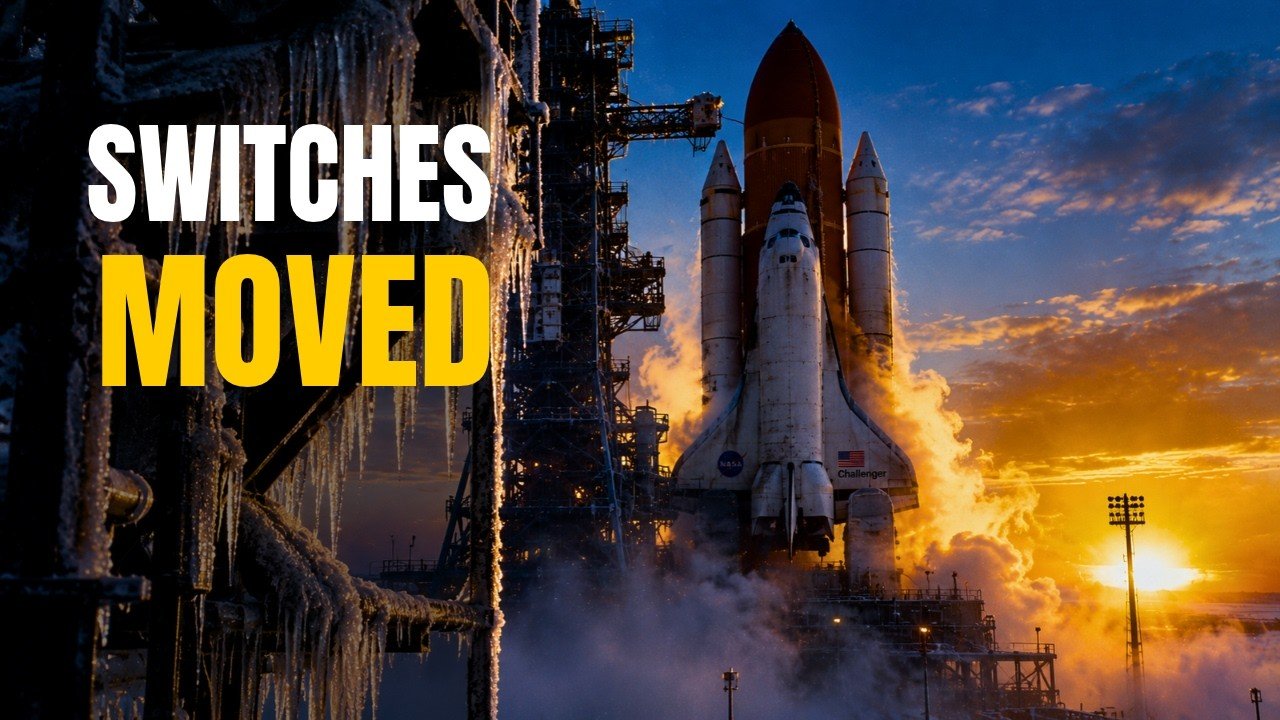
Navy teams recovered the cabin from the ocean floor months later. Investigators concluded the breakup itself was probably not enough to kill the crew. Three emergency air packs had been switched on. Pilot Mike Smith's pack sat behind his seat, so someone else must have reached over to turn it on for him. Switches on Smith's panel had been moved out of their launch positions, consistent with an effort to restore electrical power. How long anyone stayed conscious remains unknown.
A cold launch
Overnight, temperatures at Kennedy Space Center dropped to about 18° Fahrenheit, with icicles hanging from the tower at pad 39B. It was the coldest launch attempt in shuttle history. At 11:38 a.m. the engines and twin boosters ignited, and within the first second high-speed cameras caught puffs of dark gray smoke from a joint near the base of the right booster. The joint was sealed by two rubber O-rings, which the cold had stiffened. Hot gas got past, but burning fuel left aluminum oxide residue that temporarily plugged the gap.
A flaw NASA knew about
The boosters were built in Utah by Morton Thiokol, shipped in segments and stacked in Florida. Pressure tests in 1977 showed that when a booster fired, the joint did not squeeze tighter: the steel walls bent outward by about 52/1000 of an inch, opening a gap that could pull the seals loose. By December 1982 NASA officially classified the O-rings as having no reliable backup. Over the next three years it waived its launch constraints for O-ring erosion on 12 missions.
The night-before teleconference
Thiokol engineers called an urgent teleconference with NASA managers at Marshall Space Flight Center and Kennedy Space Center. Roger Boisjoly, Arnie Thompson and Bob Ebeling presented data showing the O-rings lost resilience in cold weather; no shuttle had launched with them colder than 53°. They urged NASA to wait. Larry Mulloy, the booster project manager, asked whether they expected NASA to wait until April. After a break, Gerald Mason told Bob Lund to take off his engineering hat and put on his management hat. Thiokol reversed its position and a signed launch approval was faxed to NASA. Allan McDonald, Thiokol's representative at Kennedy, refused to sign it.
Breakup
Around 59 seconds into the flight, Challenger hit strong wind shear. Investigators concluded the forces likely broke the aluminum oxide plug loose. A jet of flame burned through a support strut and then into the tank holding liquid hydrogen. At 73 seconds, at 46,000 ft and Mach 1.92, the tank failed. What looked like an explosion was mostly propellant burning in a vast cloud. Aerodynamic forces tore the orbiter apart, but the crew compartment, built stronger than the rest of the vehicle, separated in one piece, rose to 65,000 ft and fell for 2 minutes and 45 seconds.
The Rogers Commission
President Reagan appointed a commission led by William Rogers, including Neil Armstrong, Sally Ride, Chuck Yeager and Richard Feynman. On February 11, 1986, Feynman clamped a piece of O-ring rubber, dropped it into ice water and released the clamp; it did not spring back. He also found that top managers estimated the chance of shuttle failure at about 1 in 100,000, while working engineers said closer to 1 in 100. His own findings were attached to the final report, which ended: "For a successful technology, reality must take precedence over public relations, for nature cannot be fooled."
The commission concluded the accident was rooted in history. Sociologist Diane Vaughan later named the pattern the normalization of deviance. NASA grounded the fleet for 32 months and redesigned the boosters with a capture latch to stop the joint from rotating, electric heaters, new weather seals and a third O-ring. The shuttle flew again in September 1988.
Questions this video answers
When did Challenger break apart?
73 seconds after liftoff on January 28, 1986, at 46,000 ft and Mach 1.92.
How many astronauts died?
All seven astronauts on board died.
What did investigators find in the recovered crew cabin?
Three emergency air packs had been switched on, and switches on Mike Smith's panel had been moved out of their launch positions.
Why did the booster joint leak?
The video says the cold stiffened the two rubber O-rings, letting hot gas get past; aluminum oxide residue temporarily plugged the gap.
What did Feynman demonstrate?
At a televised hearing on February 11, 1986, he dropped clamped O-ring rubber into ice water, and it did not spring back when released.
How long was the shuttle fleet grounded?
32 months; the shuttle flew again in September 1988.
Explore related missions
Connected by the topic: Space Shuttle