Artemis II Explained: Crew, SLS, Orion and Flight Timeline
The short version
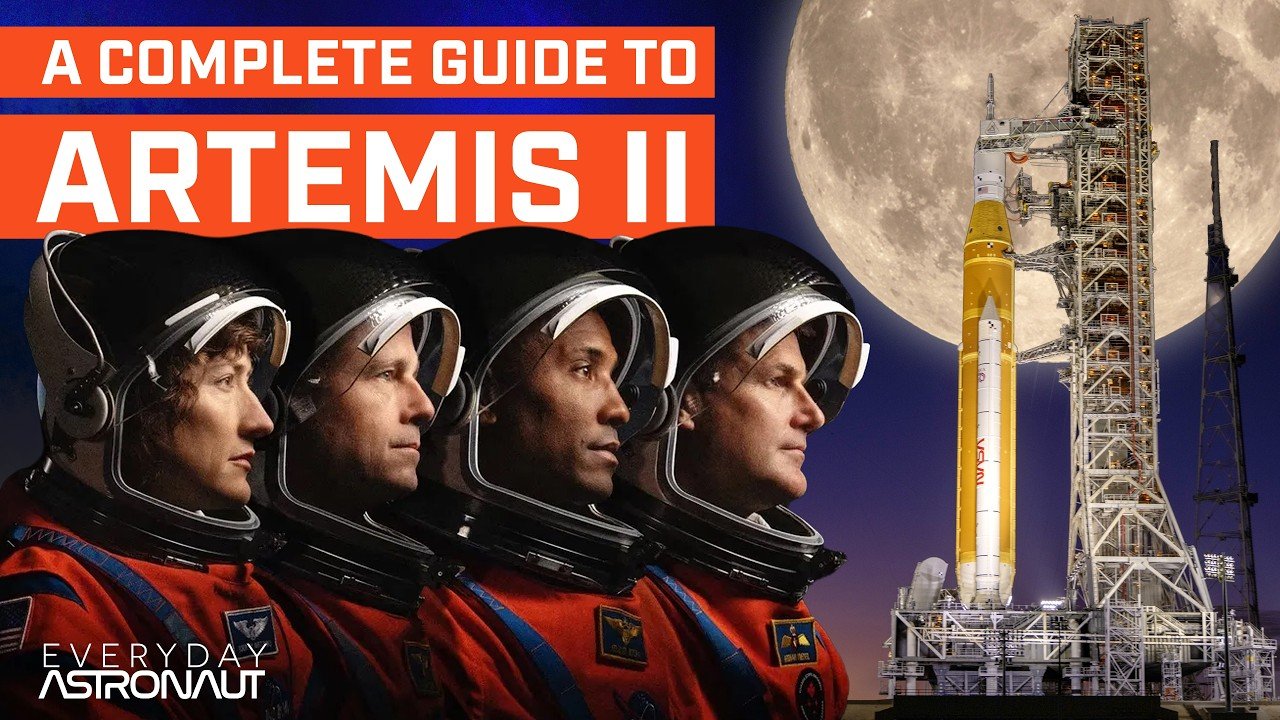
A pre-launch guide to Artemis II, the first crewed lunar mission since Apollo 17 in 1972. It covers the four-person crew, a comparison of Orion and SLS with Apollo and Saturn V, and a timeline from the countdown through splashdown. The flight is a lunar flyby on a free return trajectory, with no landing and no lunar orbit, planned for ten days.
Full written account
Artemis II is planned as the first crewed lunar mission since Apollo 17 in 1972, with four astronauts flying around the Moon on a ten-day trip. It would put humans on their first journey beyond low Earth orbit in 54 years, and it includes the first person from outside the United States to fly to the Moon.
The crew
Commander Reid Wiseman is a NASA astronaut and Navy veteran who flew to the ISS for Expedition 41 and 42 for 165 days and spent 13 hours as lead spacewalker on two spacewalks. Pilot Victor Glover, a NASA astronaut and former Navy captain, flew on Expedition 64/65 and was pilot of Crew-1, the first operational Crew Dragon mission.
Mission specialist Christina Cook served as flight engineer on ISS expeditions 59, 60 and 61. She set the record for the longest single spaceflight by a woman, 328 days, and took part in the first all-female spacewalk. Mission specialist Jeremy Hansen of the Canadian Space Agency, a former Royal Canadian Air Force fighter pilot and colonel, will make his first spaceflight.
Orion and SLS against Apollo
Orion is 5 m wide against Apollo's 3.9 m, with about 9 cubic meters of volume against about 6. It carries four astronauts instead of three and has a toilet, the first on a spacecraft outside low Earth orbit. Orion with its service module weighs 26.5 tons, against 28.8 tons for the Apollo command and service module. Because its service module is smaller, Orion cannot enter low lunar orbit.
The Space Launch System is NASA's most powerful rocket, with a little over 39 mega-newtons of thrust. Its two Space Shuttle-derived solid rocket boosters give about 32 mega-newtons, roughly 80% of liftoff thrust. Four RS-25 engines from the Shuttle program add about 7.4 mega-newtons. The Interim Cryogenic Propulsion Stage has a single RL10C engine of 110 kilonewtons and 462 seconds of specific impulse. SLS stands 98 m tall; Saturn V stood 111 m. SLS can send about 27 tons to the Moon, while Saturn V could send 45 tons.
Mission profile
Launch is from Kennedy Space Center LC-39B. The flight is a free return trajectory with no lunar orbit and no landing, a shakedown of Orion similar to Apollo 8 but without orbiting the Moon. A landing does not come until Artemis IV.
Countdown
Propellant load begins at L minus nine hours 25 minutes, and the second stage starts at L minus seven hours. The crew begins suiting up around L minus five hours 40 minutes, boards Orion at about L minus four hours, and the hatch closes at about L minus three hours 20 minutes. The count holds at T minus ten minutes. At T minus 33 seconds comes the go for the automated launch sequencer; a problem after that point means a full scrub for the day. RS-25 ignition is at T minus 6.363 seconds, and the boosters ignite at T zero.
Ascent and orbit raising
At T plus 56 seconds the rocket goes supersonic, max q is at 1 minute 10 seconds, and the boosters separate at 2 minutes 9 seconds. The launch escape tower is jettisoned at 3 minutes 18 seconds, and the core stage carries the crew until 8 minutes 3 seconds. A short second-stage burn at 49 minutes 49 seconds sets a 2,222 by 185 km orbit, and an apogee raise burn at 1 hour 47 minutes sets 70,000 km apogee. This allows disposal of the upper stage and a return on the next orbit if the service module has a problem. Orion then performs its own translunar injection at T plus one day, one hour, 37 minutes.
Flyby and return
At T plus four days, 21 hours, 2 minutes, Orion would pass Apollo 13's distance record of 400,171 km, reaching about 402,000 km. Closest approach, about 70,400 km above the lunar surface, is at T plus five days, one hour, 23 minutes. The crew module separates from the service module at T plus nine days, one hour, 13 minutes. Parachutes follow: drogues at about 8 km and mains at about 3 km, with splashdown at about T plus nine days, one hour, 46 minutes and recovery within two hours.
Questions this video answers
Will Artemis II land on the Moon?
No. It is a flyby on a free return trajectory, with no landing and no lunar orbit. The video says a landing does not come until Artemis IV.
Who is the crew of Artemis II?
Commander Reid Wiseman, pilot Victor Glover, mission specialist Christina Cook and mission specialist Jeremy Hansen of the Canadian Space Agency.
Where does Artemis II launch from?
Kennedy Space Center LC-39B, a pad formerly used for Saturn V, Saturn IB and Space Shuttle.
How long is the mission?
About ten days, ending in a splashdown the video places at T plus nine days, one hour and 46 minutes.
How far from Earth will Orion travel?
A peak distance of about 402,000 km, just beyond Apollo 13's record of 400,171 km.
How does Orion compare with Apollo?
Orion is 5 m wide versus 3.9 m, has about 9 cubic meters of volume versus about 6, and carries four astronauts. It has a toilet.
Explore related missions
Connected by the topic: Artemis