Falcon Heavy Test Flight
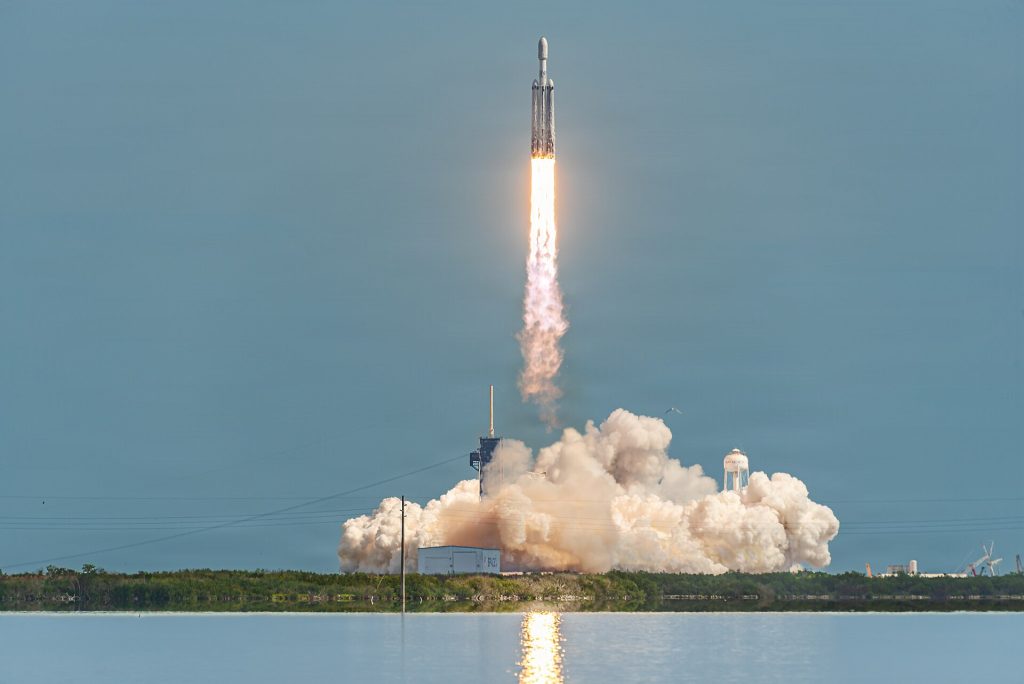
On 6 February 2018 SpaceX launched Falcon Heavy for the first time from Launch Complex 39A at Kennedy Space Center, carrying a Tesla Roadster instead of a customer satellite. Both side boosters landed side by side at Cape Canaveral, and the Roadster went into an orbit around the Sun that crosses the orbit of Mars.
What happened
-
Watch this moment · 22:30
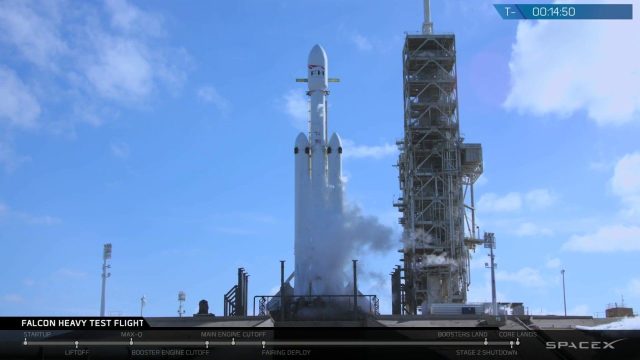
Side boosters ignite
Ignition begins on the two side boosters, followed about two seconds later by the center core. Video 56 says the three cores produce about 5 million pounds of thrust at liftoff, as stated by SpaceX.
-
Watch this moment · 22:30
Pad 39A
Falcon Heavy lifts off from the pad used by Apollo 11 and the shuttle. The side and center cores throttle up and down in flight to balance the loads on the vehicle.
-
Watch this moment · 24:30
About 2.5 minutesapproximately
Side booster separation
The side boosters shut down and a pneumatic system pushes them away, releasing at the top first and a few milliseconds later at the bottom. They turn back towards Cape Canaveral.
-
Watch this moment · 24:30
After 3 minutesapproximately
Center core cutoff and stage separation
The center core shuts down and the second stage separates to carry the payload on to its orbit.
-
Watch this moment · 27:00
Minutes laterapproximately
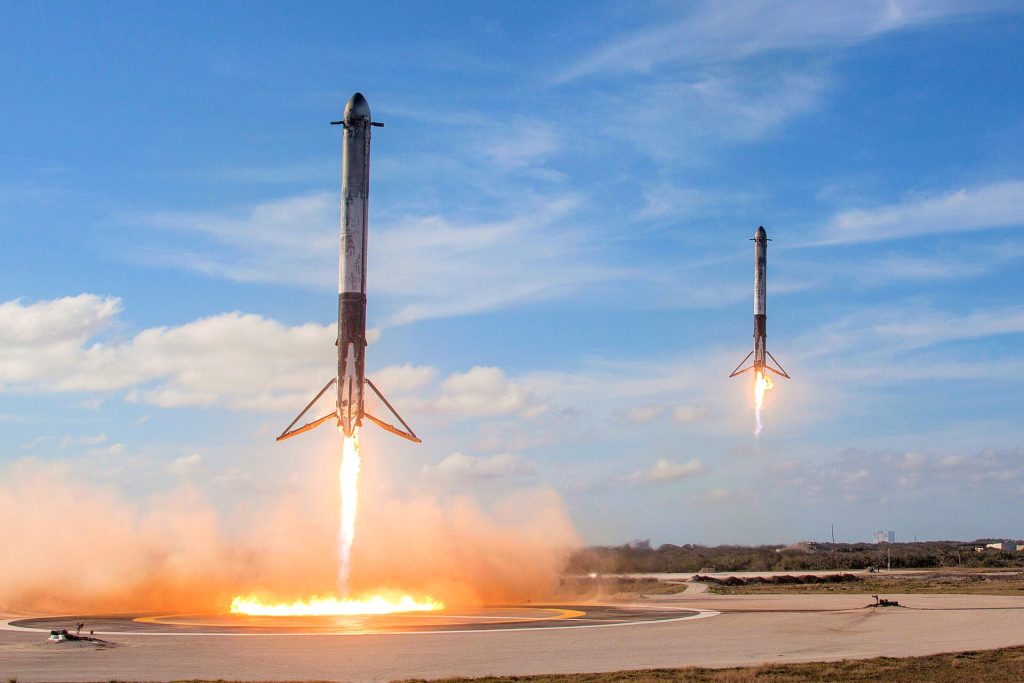
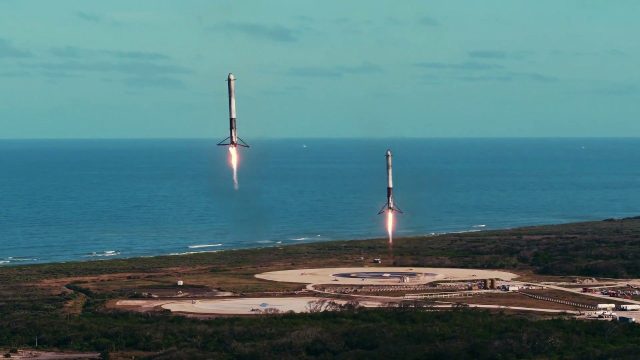
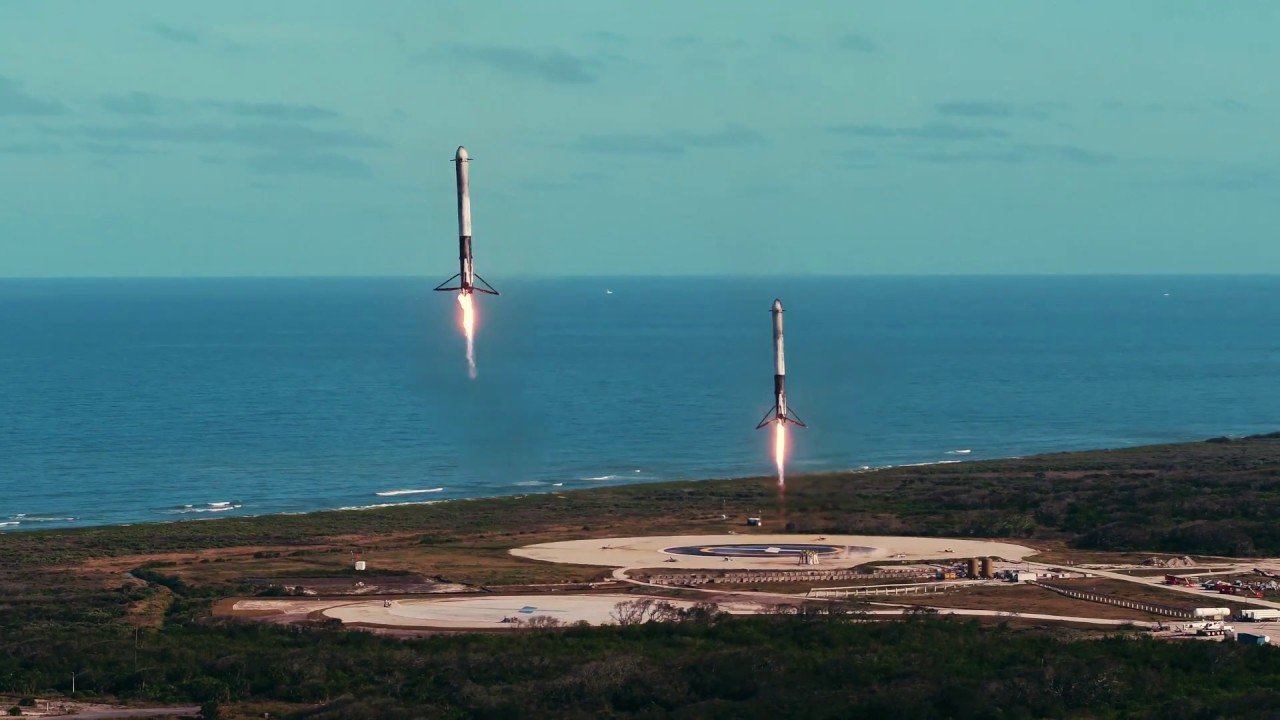
Two side boosters land
Both side boosters return to landing zones 1 and 2 at Cape Canaveral, in a planned three-burn manoeuvre. Video 56 ends before the center core result is known.
-
Watch this moment · 27:00
Minutes laterapproximately
The center core misses the drone ship
The center core was to land on the autonomous drone ship about 300 miles off the Florida coast. SpaceX later reported that it did not land on the ship.
-
Watch this moment · 11:57
Hours laterapproximately
The Roadster is on its way
The second stage put the Tesla Roadster and its mannequin, Starman, on a path around the Sun that reaches beyond the orbit of Mars.
Key facts
| Vehicle | Falcon Heavy |
|---|---|
| Mission name | Falcon Heavy Test Flight |
| Launch site | Kennedy Space Center LC-39A |
| Crew size | 0 |
| Outcome | Success |
Videos about this mission
The videos, in date order
Drag, zoom or press play to watch them on this page.
February – March 2018
Drag to explore dates · Select a video to preview.
Dates are when each video was first published on YouTube.
What kind of rocket Falcon Heavy is
Falcon Heavy is three Falcon 9 first stages side by side. Each of the three cores has nine Merlin 1D engines, 27 in all. The side boosters are the same hardware SpaceX had flown before, including on the CRS-9 mission, and they were designed to come back and land.
SpaceX's own webcast in video 56 explains the goal of the first flight: prove the vehicle, and recover all three cores. By then, it said, SpaceX had recovered 21 first stages and flown six of them again.
The launch sequence
1. Side booster ignition at T-minus five seconds, then the center core two seconds later. 2. About 40 seconds in, the side boosters throttle down ahead of the point of maximum aerodynamic load, then back up. 3. About two and a half minutes in, side booster engine cutoff, and separation. 4. The center core burns for a further 25 seconds, and then shuts down; the second stage separates. 5. The second stage carries the payload towards a Mars-crossing orbit.
The payload was a Tesla Roadster with a mannequin in a SpaceX spacesuit, called Starman. According to the webcast, it also carried an Arch Mission Foundation storage disc holding the Foundation trilogy, and a plaque with the names of SpaceX employees.
The center core landing
Two of the three landings succeeded and happened together at Cape Canaveral. The center core, which was going too fast to come back to land, was meant to land on the drone ship. It did not, and the vehicle was lost. Only one of the three engines needed for the landing burn relit, and the core hit the water about 100 metres from the ship at roughly 300 miles an hour. At the post-flight press conference Elon Musk said the core ran out of the igniter fluid, TEA-TEB, used to relight the engines (reported by CBS News on 6 February 2018 and Space.com on 14 February 2018). The webcast in video 56 stops before the outcome is known, so this comes from those reports, not from the video.
What the next flight changed
Falcon Heavy flew again in April 2019 with the Arabsat-6A satellite, the first commercial payload. On that flight the center core also landed on the drone ship, but was lost afterwards in rough seas. The side boosters landed at Cape Canaveral again. Falcon Heavy later launched NASA's Psyche mission in October 2023.
Questions and answers
When was the Falcon Heavy test flight?
6 February 2018, from Launch Complex 39A at Kennedy Space Center.
How many engines does Falcon Heavy have?
27 Merlin 1D engines, nine in each of three cores.
What was the payload?
A cherry red Tesla Roadster with a mannequin called Starman. It was a mass simulator, chosen because the first flight of a new rocket is a risk.
Did the boosters land?
Both side boosters landed at Cape Canaveral. The center core did not land on the drone ship.
Where is the Roadster now?
In an orbit around the Sun that reaches beyond the orbit of Mars. It is not going to Mars.
Sources: The facts and written text on this page come from the 2 videos on this page, by SpaceX.