Aerojet AJ260: The Giant Solid Motor Behind the Shuttle Boosters
The short version
A look at the history of solid rocket motors and the Aerojet AJ260, a 260-inch motor built in the 1960s as a possible backup to the F-1 engine on the Saturn V. It was tested three times but never flew, and its test experience fed into the Space Shuttle solid rocket boosters and, later, the SLS boosters. The video also explains why very large solid motors are unlikely to return.
Full written account
In 1965 the most powerful solid rocket motor ever built was created by Aerojet and tested by NASA as a possible backup to the F-1 engine of the Saturn V. The Aerojet AJ260 was 260 inches (almost 6.63 m) in diameter, and in its third test it produced more than 5 million pounds of thrust, over three and a half times a single F-1. It never flew, but nearly 20 years later its successors supplied 85% of the Space Shuttle's liftoff thrust.
Why a solid backup was wanted
In the 1950s and early 1960s the US Air Force researched increasingly large rocket engines with no specific purpose, partly to have something to fall back on. Two engines came out of that work: Rocketdyne's F-1 and the even bigger Aerojet M-1. Only parts of the M-1 were tested and the whole engine was never built. When NASA proposed Apollo, the F-1 was the obvious choice for the Saturn rocket. But a liquid-fuelled engine on that scale had never been built, and there was no guarantee it would work in time to meet the deadline of landing men on the Moon by the end of the decade. As a backup, work began on solid rocket motors that could replace the F-1 one for one.
Solid motors had real advantages. They were relatively simple to make and operate, and could sit in a silo for months or years with little maintenance and be ready to go in moments. Early ones also had drawbacks. Once lit, a solid motor runs at full power until the fuel is gone, unlike a liquid engine that can be throttled. Their specific impulse is low, so they burn through their fuel quickly, usually in about two minutes. That is why the Shuttle boosters were jettisoned before reaching space. Swivelling the nozzle to steer the thrust, and shaping how thrust builds, sustains and drops away, had not been done with large solid rockets. The sheer size of the motors also demanded new manufacturing and transport methods.
The AJ260 tests
Thiokol and Aerojet did the development work, but Aerojet built the motor, starting from 100-inch designs and working up through successful tests of 120-inch, 156-inch and 260-inch motors. The 260-inch motor was too wide to go on a train, so Aerojet set up a factory and test area in the Florida Everglades, from where motors could be shipped by road and barge to the Cape Canaveral launch site.
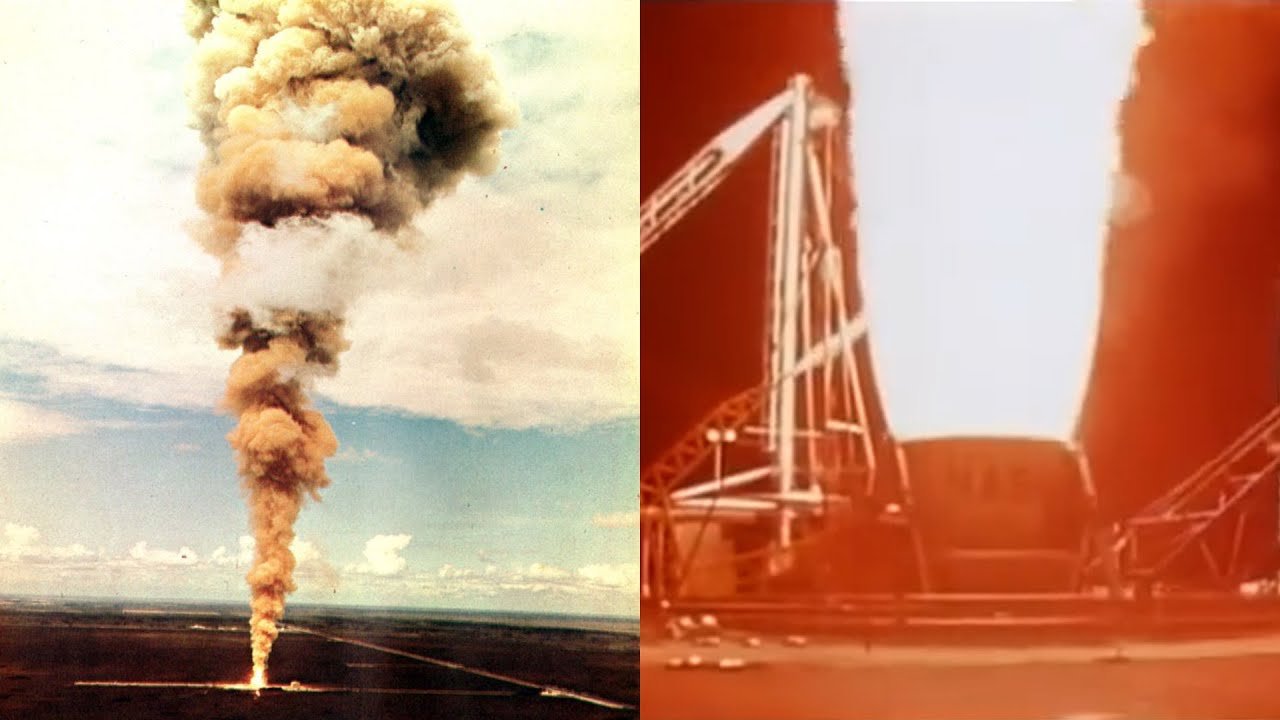
The motor was tested three times, fired in a 150 ft silo with the nozzle pointing upwards. The exhaust plume could be seen from over 132 km away. The first two firings were completely successful, with a maximum of 3.6 million pounds of thrust, more than twice the roughly 1.5 million pounds of one F-1 and enough to replace all eight H-1 engines of the Saturn I.
The third firing differed. It used a large ablative nozzle in a submerged configuration, similar to those proposed for thrust vectoring, and a propellant with a higher burn rate. The chamber from the first test was refurbished and refilled. The test was only partially successful: some propellant was ejected, and the exit cone was lost late in the burn. Later tests showed the flow characteristics of the new propellant were not compatible with the casting process. Even so, it reached more than 5 million pounds of thrust, which remains the most powerful engine of any kind ever tested.
From the AJ260 to the Shuttle and SLS
The F-1 proved so reliable that no solid backup was needed, and after Apollo there was no call for so large a motor. The test data and experience were nonetheless used for the Shuttle's solid rocket boosters, though Thiokol rather than Aerojet built them. At 146 inches (3.71 m) in diameter they were narrow enough to travel by train from Utah to Kennedy Space Center in Florida.
The Shuttle boosters were designed to be reusable, as the final AJ260 test had suggested was possible. All but four of the 270 boosters launched in the program were recovered, and over 5,000 parts were reused after each flight. They also used thrust vectoring, moving the nozzle up and down and side to side to help control the vehicle in all three axes, something only beginning to be developed when the AJ260 was tested. Each produced 3.3 million pounds of thrust, making them the most powerful solid rocket motors ever to launch humans into space.
The Space Launch System of 2022 used a pair of five-segment boosters developed from the four-segment Shuttle versions, for a longer burn time and 3.6 million pounds of thrust. None of the SLS boosters were recovered after use.
Why the largest ones are unlikely to return
Questions this video answers
What was the Aerojet AJ260?
It was a 260-inch (almost 6.63 m) diameter solid rocket motor, the largest solid rocket motor ever built and tested.
Why was the AJ260 never used?
The F-1 liquid-fuelled engine proved to be one of the most powerful and reliable ever made, so no solid backup was needed. After Apollo ended there was also no need for such a large motor.
How powerful was the AJ260?
The first two test firings reached a maximum of 3.6 million pounds of thrust. The third test generated more than 5 million pounds, over three and a half times a single F-1, and remains the most powerful rocket engine, solid or liquid, ever tested.
How much of the Space Shuttle's liftoff thrust came from the boosters?
The two solid rocket boosters, at 3.3 million pounds of thrust each, generated 85% of the thrust at liftoff.
Were the Shuttle boosters reused?
Yes. All but four of the 270 boosters launched in the Shuttle program were recovered, and over 5,000 parts were reused after each flight.