Artemis II Launch Eve: SLS, Orion and the Free-Return Flight Plan
The short version
Everyday Astronaut host Tim Dodd broadcasts from Kennedy Space Center about 24 hours before the planned Artemis II launch, answering viewer questions. He covers the two-hour launch window starting at 6:24 p.m. Eastern on April 1, the 80% go weather, the free-return trajectory and highly elliptical orbit profile, and how SLS and Orion differ from Saturn V and Apollo.
Full written account
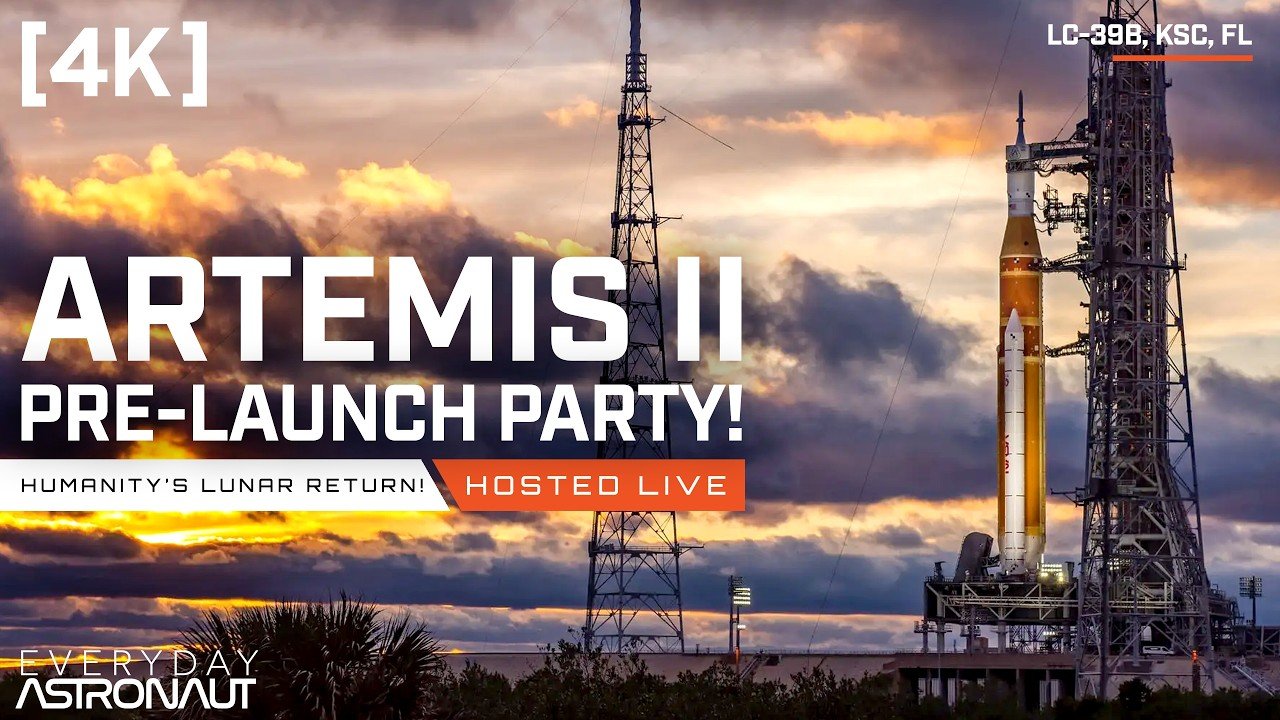
Twenty-four hours before the planned Artemis II liftoff, Tim Dodd of Everyday Astronaut broadcast from the press site at Kennedy Space Center, about three miles (5 km) from the pad. The mission was set to send four people on NASA's SLS rocket with the Orion spacecraft on a trip out to the Moon, the first time humans would leave low Earth orbit in his lifetime, as he puts it. The countdown clock read 24 hours 19 minutes 53 seconds when he started.
The launch day setup
Weather was forecast at 80% go. The launch window was two hours starting at 6:24 p.m. Eastern, with sunset at 7:39 p.m. Dodd noted that even a launch late in the window would leave roughly an hour and 40 to 45 minutes of good light, and he was glad it was not a night launch because the solid rocket boosters glow so brightly. Backup opportunities were laid out on a NASA graphic: six dates in the April window, each with a two-hour window, with the 2nd about 20 minutes before sunset and the 3rd about 20 minutes after. A scrub could be followed by a 24- or 48-hour reset.
The astronauts would board at about T-minus 4 hours. He expected hundreds of thousands of people around the Cape (a figure he mentioned as 400,000, hedged as heard) and warned of swamped cell networks; his team ran a landline, three Starlink dishes and four SIM cards.
Flight profile
The mission uses an unusual sequence of elliptical orbits. The core stage burn puts the stack in a highly elliptical orbit so the core returns and burns up at perigee. The ICPS upper stage then fires for about a minute to raise the orbit, and again for the main orbit raise, reaching about 70,000 km. Dodd says this passes through the Van Allen belts about six times, but that radiation exposure is cumulative and the passes are brief.
Because the first orbit is a free-return trajectory, a failure of the upper stage to light would leave the crew already on their way back down. The same logic applies after the orbit raise if the service module has a propulsion problem. Orion's service module has roughly 1,200 m/s of delta-V, so it cannot be used to enter lunar orbit; Dodd calls the flight a shakedown of the boosters, core, upper stage, service module and capsule, and likens the trajectory to Apollo 13's. The Moon is reached on day six, closest approach is given as 4,000 to 6,000 miles, and he says the trip takes about three and a half days one way.
SLS and Orion compared with Apollo
SLS is not larger than Saturn V, Dodd explains: 95 m tall against about 111 m, with an 8.5 m core against 10 m, and about 27 tons to translunar injection against 45 tons. It is not built to lift a lander. Its boosters are five-segment versions of shuttle boosters, about 25% more powerful, and use segments that flew on shuttle missions. Orion holds four astronauts instead of three, has a toilet and about 50% more volume than Apollo. Artemis I lacked an environmental control and life support system.
Orion previously flew uncrewed on EFT-1 in 2014 on a Delta IV Heavy and on Artemis I in 2022. Artemis I left charring and missing chunks on the heat shield, so the return flight profile was changed to limit peak temperatures; he says Artemis III will have a different heat shield.
What comes after
Dodd says Artemis III is now planned as a low Earth orbit test, docking with one or both lunar landers, with Artemis IV the first landing. He argues SLS flies because it was Congress-mandated, cost-plus and built from shuttle leftovers, while SpaceX's Starship under a fixed-price contract aims to land 7 to 9% of liftoff mass through in-space refueling, compared with about 0.25% for Apollo.
Overhead
During the stream two NASA jets flew over the pad, one flown by Jared Isaacman, which Dodd treated as a surprise treat.
Questions this video answers
When was Artemis II scheduled to launch?
On April 1, 2026, with a two-hour launch window beginning at 6:24 p.m. Eastern (22:24 UTC as stated in the stream).
Is Artemis II landing on the Moon?
No. It is a flyby on a free-return trajectory; the host says closest approach is about 4,000 to 6,000 miles.
How long does it take to reach the Moon?
The host says about three and a half days of transit, with closest approach on day six.
How does SLS compare with Saturn V?
The host says SLS is shorter (95 m vs about 111 m), with a core 8.5 m wide vs 10 m, and carries about 27 tons to the Moon vs 45 tons for Saturn V.
Has Orion flown before?
Yes, twice uncrewed: EFT-1 in 2014 on a Delta IV Heavy and Artemis I in 2022, the first SLS flight.
Explore related missions
Connected by the topic: Artemis