Challenger’s Wreckage: Why NASA Sealed It in Missile Silos
The short version
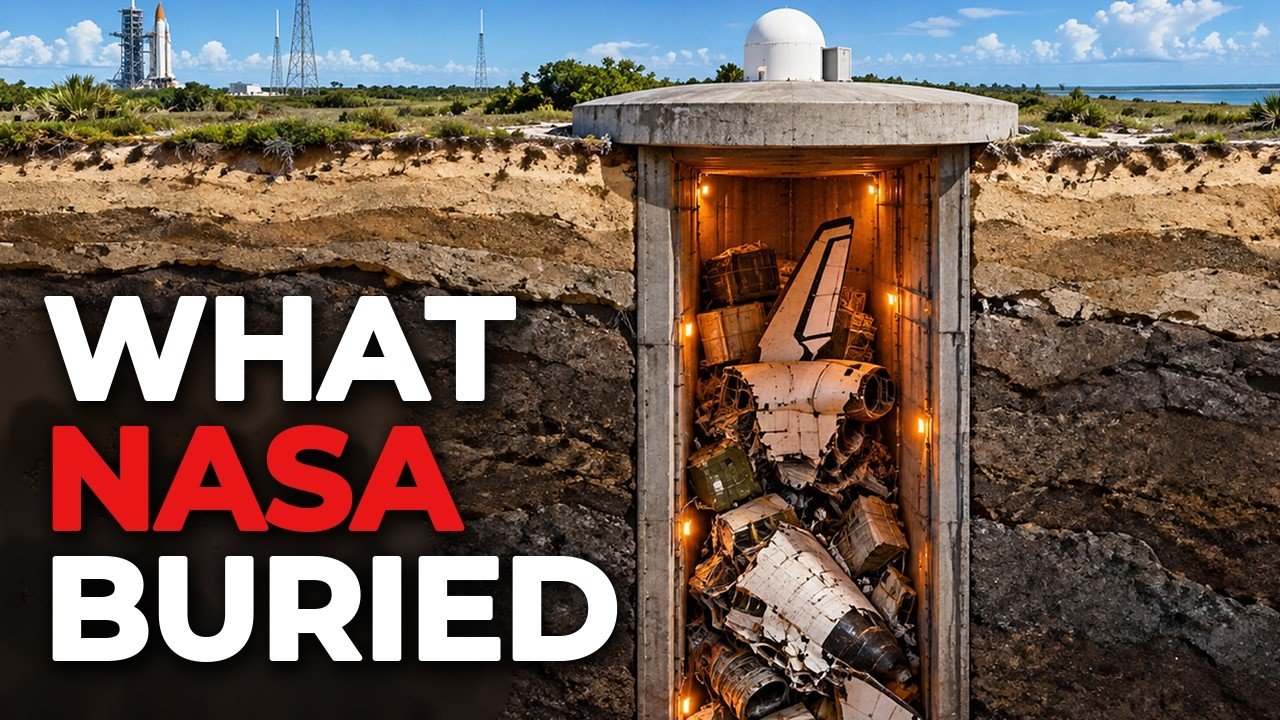
After Challenger broke apart 73 seconds after liftoff on January 28, 1986, its recovered pieces were stored in two former Minuteman missile silos at Cape Canaveral, sealed in 1987 with 10-ton concrete caps. After Columbia in 2003, NASA instead kept every piece above ground and lent them to researchers. The video traces the search, the burial, pieces that later washed ashore or were found, and the 2015 Forever Remembered exhibit.
Full written account
More than a hundred tons of Space Shuttle Challenger lie under concrete at Cape Canaveral, in two old silos built for nuclear missiles. Nobody is allowed to visit, and no sign, plaque or names mark the spot. Seventeen years after Challenger, NASA lost Columbia and did the opposite: every piece was logged, kept above ground and lent to scientists. The difference says a lot about how NASA's thinking changed.
The search
Challenger broke apart 9 miles above the ocean on January 28, 1986, 73 seconds after liftoff, after a rubber seal stiff from the cold let flame escape from one of the boosters. All seven people aboard died. Within an hour, ships were heading for the water where the pieces had come down.
The search was run by Air Force Colonel Edward O'Connor with Navy salvage experts. It grew to almost 500 square nautical miles, in water from under 100 feet to about 1,200 feet deep. Ships dragged sonar, the small Navy research submarine NR-1 crept along the bottom with cameras, and divers went to every hard echo they could reach. In March the crew cabin was found in about 90 feet of water.
The piece that settled the cause appeared on sonar on March 1 as Contact number 131, 560 feet down. It took six weeks to reach and bring up. On April 13 it surfaced: a slab of the right booster's steel wall, 11 feet by 20, with a hole about 15 inches by 28. Together with one more piece it held nearly all of the burned-through spot. The Presidential Commission's report named the cause that June, and the Navy called off the search on August 28. Nearly half of the orbiter had come back.
At Kennedy Space Center the pieces were laid out on a hangar floor divided into 4-foot squares with yellow tape, each in the square where it had sat on the ship.
The silos
NASA then had a hundred tons of wreckage that could not be put on show, because the families were still grieving, and could not be sold as scrap, because it belonged to the government. Colonel O'Connor remembered old missile sites on the Cape side and called them a low-cost solution.
The Air Force had fired 92 Minuteman missiles from launch complexes 31 and 32 in the 1960s, the last in December 1970. Each silo was a concrete tube about 80 feet deep and 12 feet across, with rooms beside it, already underground and inside a guarded base. The whole job cost about $300,000.
The first loads arrived on January 8, 1987. Booster pieces filled one silo and fuel tank pieces the other, while the cabin remains, cargo and fuselage went into the side rooms. On February 23, workers set a 10-ton concrete cap on each silo.
What did not stay buried
The Navy had left some pieces on the seabed, including an entire right wing. On December 17, 1996, two big pieces washed ashore in Florida. The larger, about 15 feet long and 6 feet wide, lay on Cocoa Beach and needed a front loader to lift it; it came from the left wing. Both were trucked away and later joined the rest at the silos. In 1999 a sailor who had worked on the recovery put a Challenger heat tile up for sale on eBay, and pleaded guilty to stealing government property.
Columbia and Forever Remembered
Columbia broke apart over Texas on February 1, 2003, and seven more astronauts died. Nearly 84,000 pieces, about 38% of the ship by weight, came back to Florida. Launch director Mike Leinbach said they should not bury the debris as was done with Challenger's. In September 2003 the pieces went to the 16th floor of the Vehicle Assembly Building. By 2018 there had been more than 60 loans.
Around 2011, NASA test director Mike Ciannilli began a project, kept quiet for four years, for a room at Kennedy's Visitor Center honouring all 14 astronauts lost on both shuttles. NASA opened the silo site in secret so he could choose a piece: 12 feet of Challenger's left side with the American flag still bright on it. The room, Forever Remembered, opened on June 27, 2015, and the panel was the first piece of Challenger the public had been allowed to see. Dick Scobee's widow, June Scobee Rogers, saw it before the doors opened.
In March 2022 divers hunting a World War plane off Florida's Space Coast found a sheet of metal more than 15 feet wide laid with square tiles. NASA announced in November that it was part of Challenger. As far as NASA has said publicly, it is still on the seabed.
Questions this video answers
Where is Challenger's wreckage kept?
Over a hundred tons of it lie under concrete in two old Minuteman missile silos at Cape Canaveral. No sign marks the site and the base is closed to the public.
When were the silos sealed?
The first loads arrived on January 8, 1987, and a 10-ton concrete cap was set on each silo on February 23.
Why did NASA treat Columbia's debris differently?
Launch director Mike Leinbach felt much could be learned from it. Columbia's pieces were kept on the 16th floor of the Vehicle Assembly Building and lent to researchers.
Can the public see any piece of Challenger?
Yes. A 12-foot section of Challenger's left side with the American flag has been shown in the Forever Remembered exhibit at Kennedy's Visitor Center since June 27, 2015.
What was found in 2022?
Divers found a large tile-covered sheet of metal off Florida, which NASA announced in November as part of Challenger. As far as NASA has said publicly, it is still on the seabed.
Explore related missions
Connected by the topic: Space Shuttle