How Shuttle Missions Built the ISS: Unity, Destiny and Canadarm2
The short version
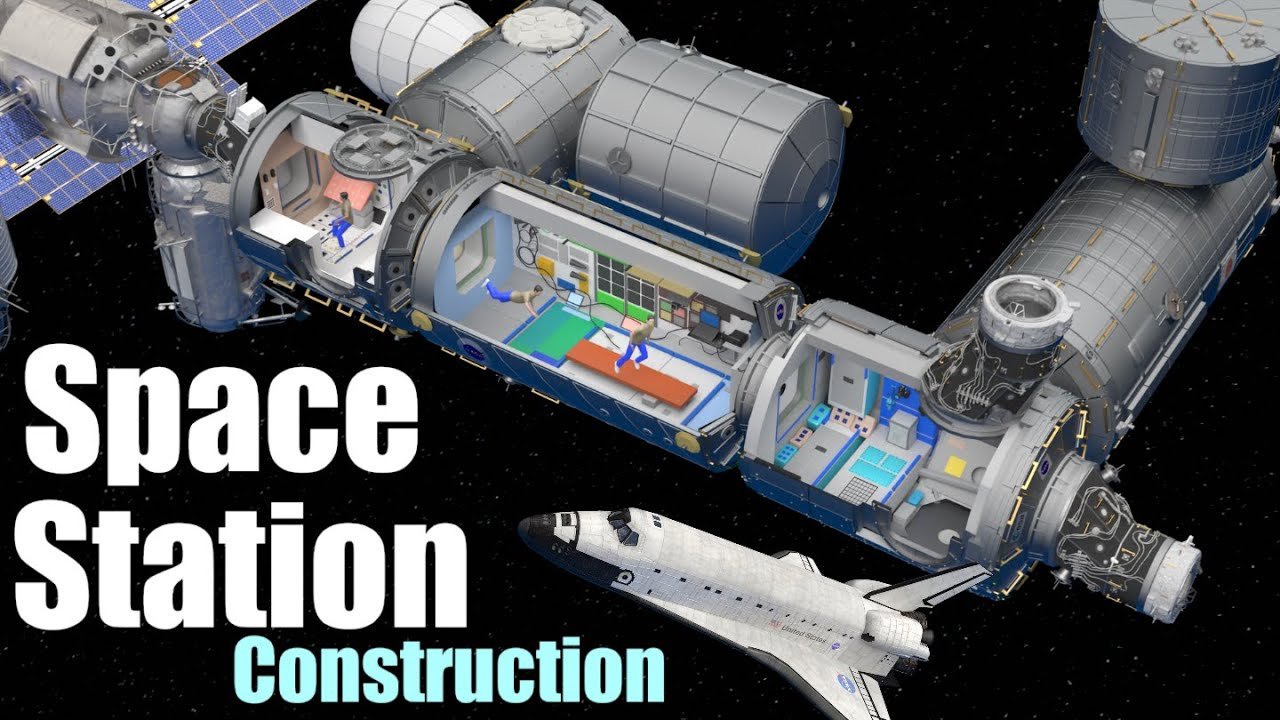
An animated explainer on how the International Space Station was assembled in its early stages using the Space Shuttle and the Canadarm robotic arm. It explains berthing ports, the common berthing mechanism and pressurized mating adapters, then walks through four shuttle missions: STS-88 (Unity), STS-98 (Destiny), STS-100 (Canadarm2) and STS-104 (Quest Airlock).
Full written account
The International Space Station took over a decade to complete, and most of its pieces were launched by the space shuttle. Modules did not float together on their own: mission controllers, astronauts aboard and robotic arms did the work. This account covers four early shuttle missions that show how.
Joining modules
Modules on the US side are connected by the common berthing mechanism (CBM), which has an active and a passive side. Latches pull the two sides in close, and 16 bolts firmly mate them. The space between, the vestibule, is pressurized in a process that takes a few hours. Then the hatch is opened, hardware is removed, and oxygen, power, data and water connections are made.
The Russian side uses a docking mechanism not compatible with CBM, so a pressurized mating adapter (PMA) sits between. Its larger side uses CBM; its smaller side uses APAS, compatible with the Russian side and the space shuttle. PMA-1 permanently connects the two sides. PMA-2 and PMA-3 served as shuttle docking ports.
STS-88: Unity
STS-88, in December 1998, was the first shuttle mission to the station, which then had only the Russian module Zarya. It brought up Unity, a hub with six berthing ports, launched with PMA-1 and PMA-2 attached. The mission took almost 12 days.
On day three the Canadarm lifted Unity from the payload bay, and PMA-2 was attached to the shuttle's orbital docking system. The arm moved slowly, over hours, to avoid straining its joints. On day four the shuttle approached Zarya, the Canadarm grabbed it and moved it above PMA-1, and thrusters brought the modules together. There were two EVAs to connect cables and install antennas. On day eight the crew entered the station for the first time, staying about a day. A third EVA came on day 10, and the shuttle undocked on day 11. Unity and Zarya then orbited without a crew for the next few months.
STS-98: Destiny
In February 2001, with three crew members living aboard, STS-98 brought the Destiny Module. The mission lasted 13 days, six of them attached to the station. PMA-3 was docked on the nadir side, and the Canadarm moved PMA-2 to the side of the Z1 Truss. The arm lifted Destiny out of the payload bay, flipped it 180 degrees and attached it to Unity's forward berthing port. The crew entered Destiny the next day. Three EVAs followed.
STS-100: Canadarm2
STS-100 was a 12-day mission that docked at PMA-2. It carried the multi-purpose logistics module Raffaello and Canadarm2 on a pallet. The shuttle's arm attached the pallet to the top of Destiny, and astronauts unfolded and assembled Canadarm2. At the end, Canadarm2 handed the pallet to the shuttle's Canadarm, the first robotic handshake in space.
STS-104: Quest Airlock
STS-104 lasted almost 13 days. It was the first time Canadarm2 was used to help construct the station, moving the Quest Airlock to the starboard side of Unity and then moving high pressure gas tanks. Before Quest, spacewalks could only be made from the shuttle's payload bay. Quest has an equipment lock and a crew lock; its opening points straight down, toward Earth.
Questions this video answers
What is the common berthing mechanism?
The CBM joins US-side modules. Latches pull the modules together and 16 bolts mate them firmly; the space between, the vestibule, is then pressurized.
Why are pressurized mating adapters needed?
The Russian side uses a docking mechanism not compatible with CBM, so a PMA adapts between them. Its smaller side uses APAS, compatible with the Russian side and the space shuttle.
What did STS-88 do?
In December 1998 it brought up the Unity Module, which was joined to the Russian module Zarya. The mission took almost 12 days.
What was the first robotic handshake in space?
On STS-100, Canadarm2 handed a pallet over to the shuttle's Canadarm; it is sometimes called the Canadian handshake because Canada built both arms.
What did the Quest Airlock add?
It gave astronauts a way to perform spacewalks other than from the shuttle's payload bay.