Hubble Servicing Mission 1: Endeavour’s Repair of a Flawed Mirror
The short version
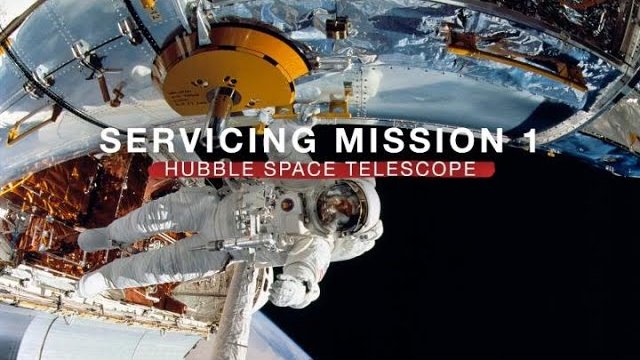
Servicing Mission 1 launched on December 2, 1993, aboard the space shuttle Endeavour to repair the Hubble Space Telescope, whose primary mirror had been ground too flat. Over five days of repairs, astronauts installed new solar arrays, gyroscopes, magnetometers, Wide Field Planetary Camera 2 and COSTAR. Hubble was then back up and running.
Full written account
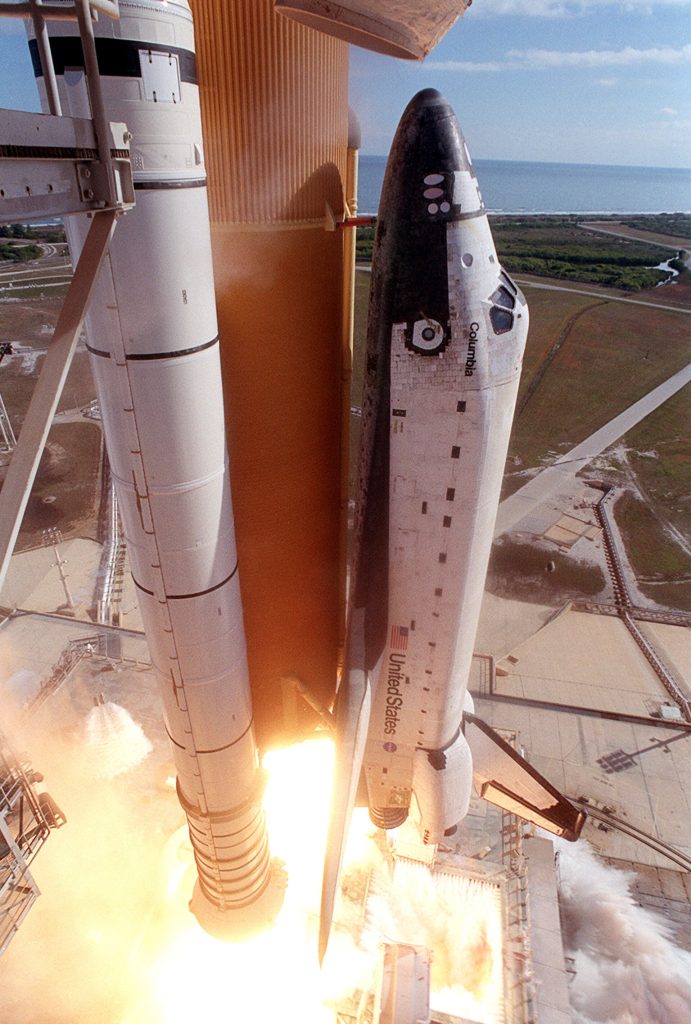
Hubble Servicing Mission 1 lifted off on December 2, 1993, aboard the space shuttle Endeavour. Its job was to repair a telescope whose first images reached Earth looking wrong: the primary mirror had been ground too flat, producing a spherical aberration that put the images out of focus.
Built to be serviced
Engineers designed Hubble to be worked on by astronauts in space. It had handrails, and its instruments were made to be easily removed and replaced. NASA and astronomers wanted to upgrade the telescope throughout its life, installing the latest technologies and repairing parts that broke or were damaged.
A flaw that raised the stakes
After Hubble's launch and deployment in 1990, the ability to fix it became more critical than anyone had imagined. Public apprehension rose and NASA's competency was called into question. The biggest impact was the loss of spatial resolution in the wide field camera. Two of Hubble's gyroscopes were also failing, which made the servicing mission urgent. Seven astronauts trained for it.
What the astronauts did
Over five days of repairs and maintenance they:
- installed new solar arrays that would not expand and contract when going in and out of sunlight, letting Hubble stay steady when taking photos
- replaced failing gyroscopes and magnetometers, allowing more accurate control of the telescope's orientation
- installed Wide Field Planetary Camera 2, which had 48 color filters covering ultraviolet to visible wavelengths and housed extra mirrors to correct for the flaw in the main mirror
- adjusted Hubble's vision with the Corrective Optics Space Telescope Axial Replacement, or COSTAR, which acted almost like a pair of glasses for the primary mirror, fixing the spherical aberration for the rest of Hubble's instruments
Afterward the telescope was back up and running. The mission restored Hubble's original expectations and then more.
Questions this video answers
When did Hubble Servicing Mission 1 launch?
On December 2, 1993, aboard the space shuttle Endeavour.
Why was the mission needed?
Hubble's primary mirror had been ground too flat, a spherical aberration that put images out of focus. Two of its gyroscopes had also failed.
What did the astronauts install?
New solar arrays, replacement gyroscopes and magnetometers, Wide Field Planetary Camera 2 and the COSTAR corrective optics.
How many astronauts trained for it?
Seven astronauts trained for the mission.
How long did the repairs take?
Five days of repairs and maintenance.
Explore related missions
Connected by the topic: Space Shuttle