ISS Module Tour: Columbus, Kibo, Destiny and Zvezda in POV
The short version
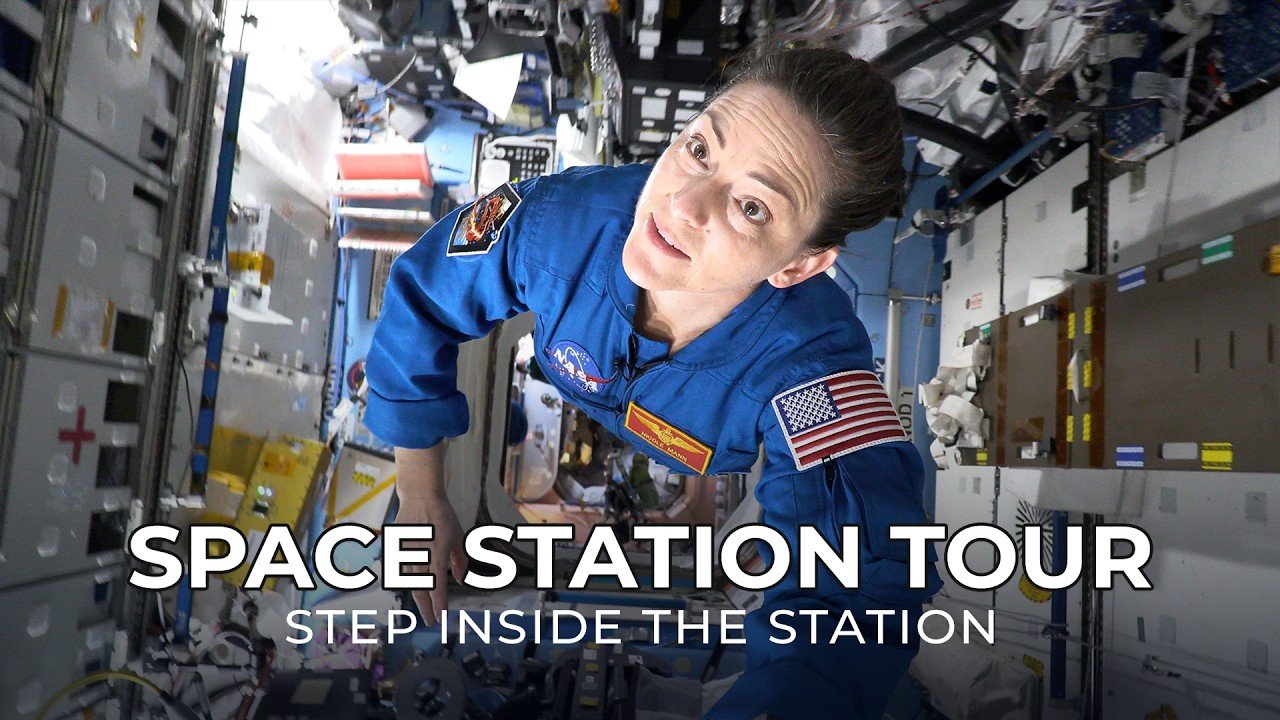
A guided point-of-view tour of the International Space Station, recorded by astronauts on Oct. 10, 2022 while NASA's SpaceX Crew-4 and Crew-5 missions were aboard. On-screen pop-ups explain modules including Columbus, Kibo, Harmony, Destiny, Unity, the Cupola, Quest Airlock, Zarya, Zvezda, Nauka and Poisk, and the tour ends with a view through SpaceX's Dragon.
Full written account
Zarya, the first space station component launched, orbited Earth alone for 16 days before space shuttle Endeavour arrived to install the Unity module. That detail opens a guided point-of-view tour of the International Space Station, recorded by astronauts in orbit on Oct. 10, 2022, while NASA's SpaceX Crew-4 and Crew-5 missions were aboard. Pop-ups name each part of the station and what it is used for.
The laboratories
Columbus is Europe's contribution and offers research facilities for studying materials science, fluid physics and the effects of microgravity on the body. The Japanese Experiment Module "Kibo" provides life science research, external demonstrations, satellite deployments and a robotic arm. Multipurpose research shelving units called EXPRESS Racks support as many as 100 experiments at a time. Destiny is the station's main U.S. laboratory.
Living and working space
Harmony, known as Node 2, connects international science labs and houses four crew quarters. Unity, known as Node 1, provides living and working space, including a kitchen and dining area. The Cupola, the station's "window to the world," offers views of Earth from seven windows. Astronauts have conducted many spacewalks from the Quest Airlock. A study of an enhanced spaceflight diet looks at immune function, the gut microbiome and nutritional status.
The Russian segment
Pressurized Mating Adapter 1 connects the U.S. and Russian segments and also serves as a storage area. Zvezda was the first fully Russian contribution to the station. Nauka, the Russian word for "science," serves as a science facility, docking port and spacewalk airlock. Poisk provides a docking port for the crewed Soyuz and the Progress cargo spacecraft, and is a place for cosmonauts to prepare for spacewalks.
Partnership, life support and research
Five space agencies from 15 countries operate the station. Its life support system recycles air and water and can recover up to 98% of the water used in the U.S. segment. Astronauts photograph Earth to document human impacts, record weather patterns and monitor events such as hurricanes. Since November 2000, more than 4,000 investigations have been conducted aboard, generating more than 4,500 research papers.
The tour ends with the ride to the station: SpaceX's Dragon can carry crew and cargo and is one of several spacecraft currently supporting station operations.
Questions this video answers
When was the tour recorded?
Astronauts recorded it on Oct. 10, 2022, while NASA's SpaceX Crew-4 and Crew-5 missions were aboard.
How many experiments can the EXPRESS Racks support?
Multipurpose research shelving units called EXPRESS Racks support as many as 100 experiments at a time.
How much water can the life support system recover?
It can recover up to 98% of the water used in the U.S. segment.
How many windows does the Cupola have?
Seven.
How long did Zarya orbit alone?
Zarya orbited Earth alone for 16 days before space shuttle Endeavour arrived to install the Unity module.
How many research investigations have been conducted on the station?
Since November 2000, more than 4,000 investigations have been conducted, generating more than 4,500 research papers.