NASA’s SpaceX Crew-13 Arrival & Welcome Remarks
The short version
NASA's live coverage follows Crew-13 from its 11:10 a.m. EDT Falcon 9 liftoff to docking with the International Space Station. Dragon Grace made contact at 6:05 p.m. Central, 7 hours and 55 minutes after launch, the fastest launch-to-docking for an American spacecraft. The broadcast explains each burn and checkpoint along the way and ends with hard capture and welcome remarks.
Full written account
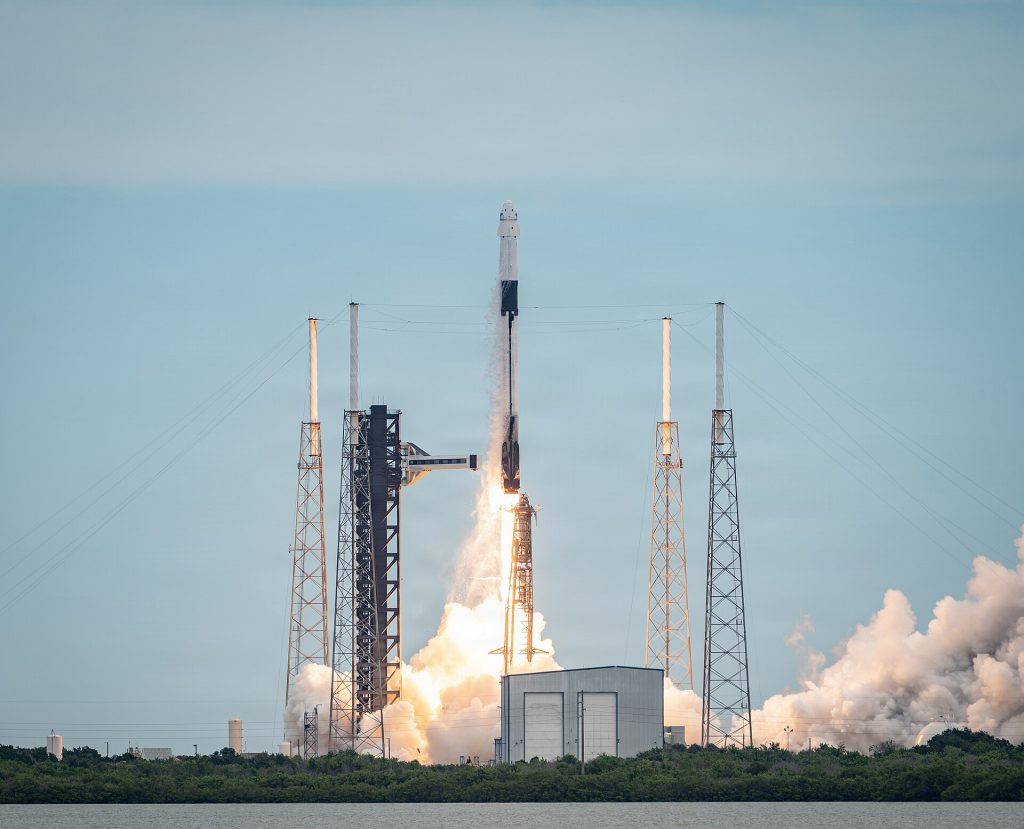
How fast can a crewed American spacecraft get from the pad to the International Space Station? On Thursday, Oct. 1, NASA's SpaceX Crew-13 answered with 7 hours and 55 minutes. Dragon Grace made contact with the station at 6:05 p.m. Central time, 263 statute miles over the northeast Pacific Ocean, after lifting off from Space Launch Complex 40 at Cape Canaveral Space Force Station at 11:10 a.m. Eastern. That is the fastest launch-to-docking time for an American spacecraft to the station so far.
The crew and the spacecraft
Jessica Watkins, a NASA astronaut, commanded the mission. She is the first NASA astronaut to fly on a Dragon twice, having been a mission specialist on Crew-4 in 2022, a flight that totalled 170 days in space. The pilot was NASA astronaut Luke Delaney, on his first spaceflight; he was selected as an astronaut candidate in 2021. Canadian Space Agency astronaut Joshua Kutryk, selected in 2017 in the same class as Watkins, and Roscosmos cosmonaut Sergey Teteryatnikov, selected for the cosmonaut corps in 2021, were also on their first flights. Three of the four were first-time flyers.
The Dragon, named Grace, had flown one earlier mission, Axiom Mission 4, also to the station. Each spacecraft's name is chosen by the first crew to fly it. Dragon has 16 Draco thrusters, each providing 90 pounds of force, and eight Super Draco thrusters used only for an abort, which are no longer active once the crew is in orbit. The nose cone opens shortly after launch to expose the docking mechanism, and the trunk carries solar cells that power Dragon in free flight.
Launch and the chain of burns
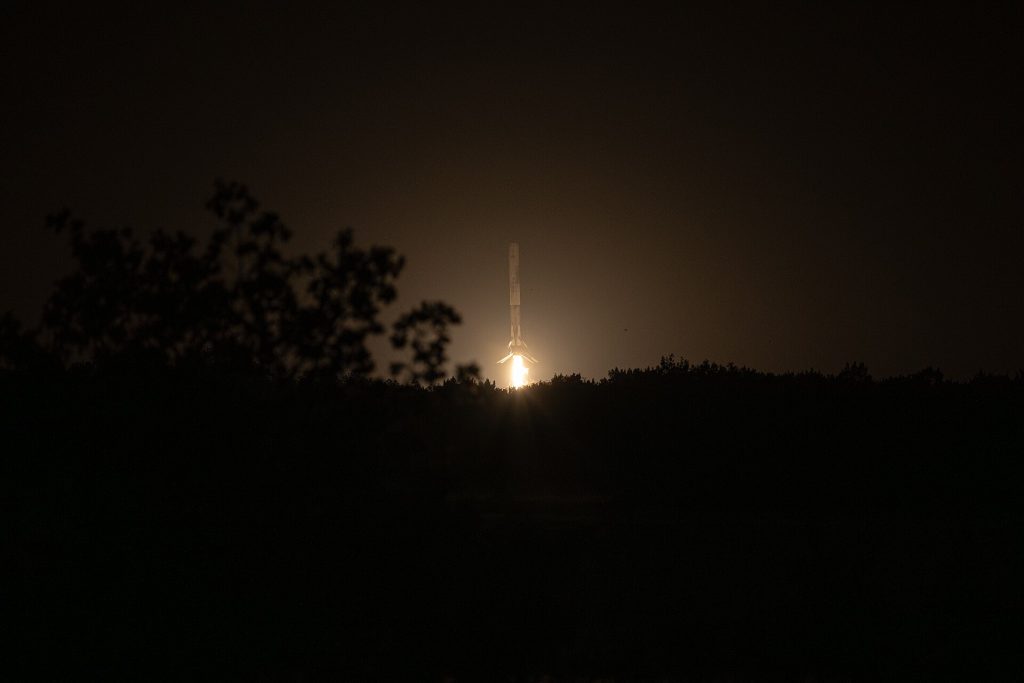
The nine Merlin 1D engines ignited at 8:10 a.m. Pacific (11:10 a.m. Eastern). The first stage performed a boostback burn and landed at landing zone 40 at Cape Canaveral. The ride to orbit took 8 minutes 48 seconds. At liftoff the station was 263 miles above Earth northwest of Havana, Cuba, and it flew over Kennedy Space Center 1 minute 37 seconds after launch.
Dragon then needed four major burns to match the station's orbit:
- Boost burn, about 45 minutes after liftoff, at 8:58 a.m. Pacific, put Dragon's apogee 10 km below the station.
- Close burn, at 9:44 a.m. Pacific, placed Dragon on an orbit roughly coelliptic with the station, about 10 km lower all the way around.
- Transfer burn, at 10:59 a.m. Pacific, raised the apogee to 2.5 km below the station.
- Final coelliptic burn, at 11:58 a.m. Pacific, kept Dragon 2.5 km below the station; it was a shorter burn.
An out-of-plane burn at 1:24 p.m. Pacific aligned Dragon's orbital track with the station's. Dragon also used C2V2, common communications for visiting vehicles, which gives a data stream from Dragon to the station and an extra command path for astronauts aboard.
The approach: gates and go/no-go polls
The approach initiation burn began when Dragon was about 2.5 km below and 7 km behind the station. It lasted about 90 seconds and was reported nominal. A midcourse burn followed about 25 minutes later and was likewise complete and nominal.
Visiting vehicles move through predetermined checkpoints. The approach ellipsoid is an imaginary shape measuring 4 by 2 by 2 km; before Dragon may enter it, it must be on a 24-hour safe trajectory, meaning that if it lost all thruster control it would take at least 24 hours to move inside. Waypoint zero is 400 meters directly below the station. Waypoint one is about 220 meters in front, on the docking axis in line with the forward port of the Harmony module. Between them sits the keep-out sphere, with a radius of 200 meters; inside it the safety requirement is four orbits, about 6 hours. Waypoint two is 20 meters from the station. Crew-13 did not stop at waypoints zero or one.
The station supported the approach: it was in attitude hold, its solar arrays feathered and locked. NASA astronaut Anil Menon monitored the approach from the station's cupola with software receiving data over the C2V2 path. Dragon held at waypoint two for roughly five minutes to check the planar reflector outside the docking port, which Jessica Meir and Sophie Adenot had recently installed on a spacewalk because thruster residue builds up on such reflectors. The forward retroreflector evaluation was successful. The crew, who had donned suits and completed suit leak checks, closed their visors before leaving waypoint two.
Docking
The call "chop," for crew hands-off point, comes less than 30 seconds before docking, a few meters from the port; after it, any abort must be done automatically by Dragon. An abort in space means backing away slowly to an earlier hold point. Both vehicles travel about 17,500 miles per hour. Dragon docked to Harmony's forward port; Crew-12's Dragon Freedom was at the space-facing port.
Soft capture was confirmed at 6:05 p.m. Central. The soft capture ring retracted, and 12 hooks, in two sets of six, drove to complete hard capture, a process of about 15 minutes. No exercise is scheduled for the station crew during docking, to avoid unintended loads.
Hatch opening and welcome
NASA's Jessica Meir was primed for hatch operations on the station side. The vestibule between the Dragon and station hatches had been exposed to vacuum and had to be pressurized and leak-checked; the cabin pressure was 14.7 PSI. Three hatches were to be opened. The crew's welcome remarks were given before the hatch opened. Kutryk spoke of being trusted to operate "humanity's one and only outpost in space."
With Crew-13's arrival, the station would hold 11 people. Seven were already aboard as Expedition 75: Anil Menon, Jack Hathaway, Jessica Meir, Sophie Adenot, and cosmonauts Pyotr Dubrov, Andrey Fedyaev and Anna Kikina. Crew-12 was to hand over for a couple of days and return home in the Dragon in which they arrived in February. Crew-13 is expected to stay approximately six months, conducting science including stem-cell-derived tissue production, a new plant growth facility, studies of blood flow abnormalities in space and a new in-flight diagnostic device.
The crew's mission patch bears a resemblance to the Apollo 13 patch, with a gold dragon instead of gold horses. The day was also NASA's 68th birthday.
Questions this video answers
Who flew on Crew-13?
Four: NASA astronauts Jessica Watkins and Luke Delaney, CSA astronaut Joshua Kutryk and Roscosmos cosmonaut Sergey Teteryatnikov.
When and where did Crew-13 launch?
Falcon 9 lifted off from Space Launch Complex 40 at Cape Canaveral Space Force Station at 11:10 a.m. EDT on Oct. 1.
How fast was the trip to the station?
Dragon Grace made contact with the station at 6:05 p.m. Central, 7 hours and 55 minutes after launch, the fastest launch-to-docking for an American spacecraft to the station.
Where did Dragon dock?
The forward-facing port of the Harmony module (node 2 forward). Crew-12's Dragon Freedom is at the space-facing port.
Which Dragon spacecraft was used?
Grace, which had flown one earlier mission, Axiom mission 4.