Skylab: Damaged at Launch, Repaired in Orbit, Lost in 1979
The short version
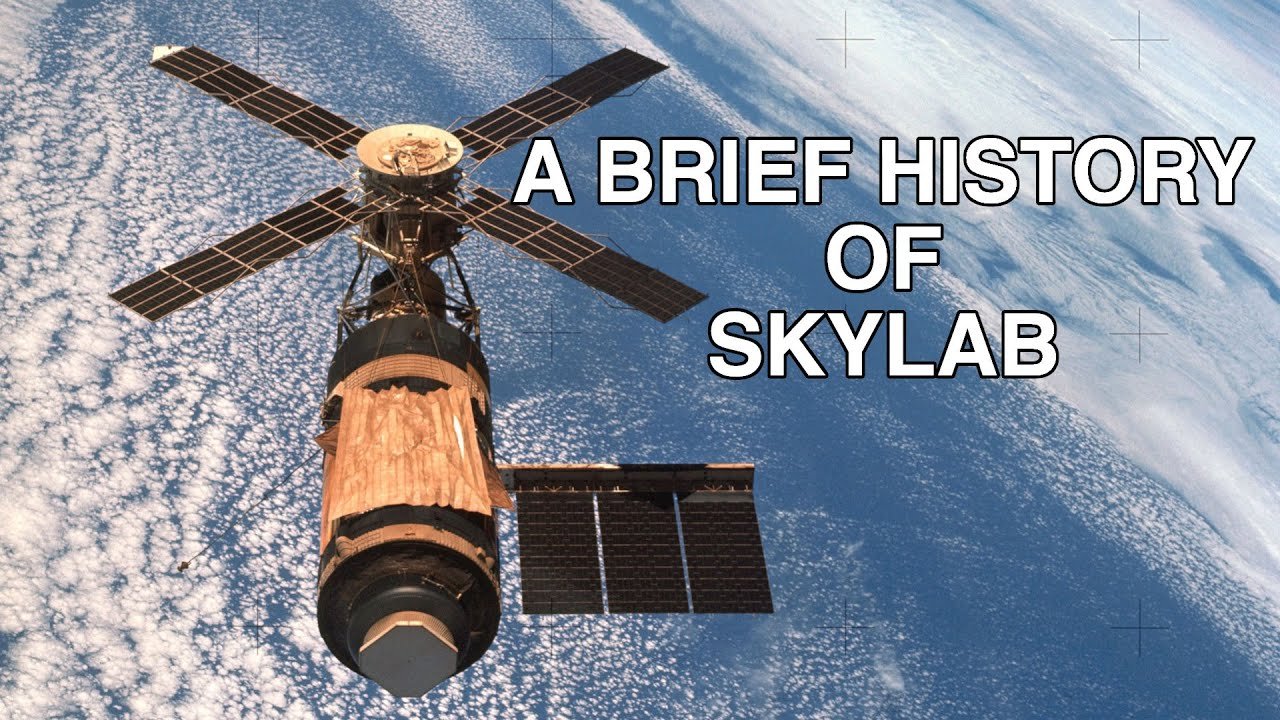
A history of Skylab, America's first space station, from the Apollo Applications Program origins and the switch from a wet to a dry workshop, through the damaged launch on May 14, 1973, the three crewed missions and their repairs, to its re-entry over Western Australia on July 11, 1979. The video also addresses the alleged Skylab 4 mutiny, which it calls a myth.
Full written account
On May 14, 1973, the last Saturn V roared off Launch Complex 39A at 1:30 p.m. carrying Skylab, America's first space station. About a minute into the ascent, the station's micrometeoroid shield ripped away. It had also served as the station's primary thermal control, and debris jammed one of the main solar arrays. Skylab reached a near-circular orbit of 433 km by 431 km, but with little power and far too much heat. Six years later, on July 11, 1979, it came down over Western Australia.
From Apollo leftovers to a space station
Wernher von Braun, head of the Marshall Space Flight Center, worried about giving Apollo's workforce a reason to keep working. His earlier idea was a wheel-shaped, 30 m station rotating at 3 RPM with a crew of 80, but it was never attempted because of the difficulty of building it. He then pushed for a smaller station launched in one go on a Saturn V. The Apollo Applications Program was cut hard: fiscal year 1967 allocated $42 million against the $450 million NASA estimated was needed, and only the idea of a small station survived.
The first concept was a "wet workshop": a spent rocket stage fitted out in orbit after it had held propellant. Saturn V availability ruled this out, and the plan moved to the S-IVB stage. Astronauts raised concerns about living in a former hydrogen tank, but the plan continued until 1968. When Saturn V boosters were freed up by Apollo cancellations, Skylab became a "dry workshop", fully outfitted on the ground and launched directly into orbit. McDonnell Douglas received the contract on August 8, 1969. The Department of Defense's Manned Orbiting Laboratory, a competitor for funding, was cancelled in June 1969.
Designing for people
George Mueller, a NASA associate administrator, wanted Skylab to be better than a boiler room. Seeing an early mockup, he judged nobody could have lived in it for more than two months. Industrial design experts recommended pale yellow walls and reorganized lighting. When told the wardroom had no window, Mueller said simply: put in a window. Skylab got four porthole-style windows. A full-body shower was designed at about $3 million, used by the first crew but skipped by the second because setup took an hour. The Gemini-style hatch on the airlock was publicly presented as cost saving, but internally it was not, since it needed significant work to fit a cylinder.
Crew selection was contested. Scientist astronauts wanted two scientists per mission; Deke Slayton and others argued for redundancy among pilots. The compromise was one scientist astronaut per crew. Crews trained for 2,200 hours over 18 months.
The damaged launch and the rescue
The shield failure was investigated by a board formed by NASA administrator James Fletcher, which found the shield's designers had not coordinated sufficiently with aerodynamics experts and that testing at simulated supersonic speeds was insufficient. Mission Control first suspected an instrumentation problem, and only later saw anomalous lateral acceleration pointing to structural failure. The workshop wing was gone, the other wing stuck, and temperatures rose. Controllers tilted the station about 45° toward the Sun, but by May 17, 23% of the nitrogen thruster supply was gone, twice the expected amount.
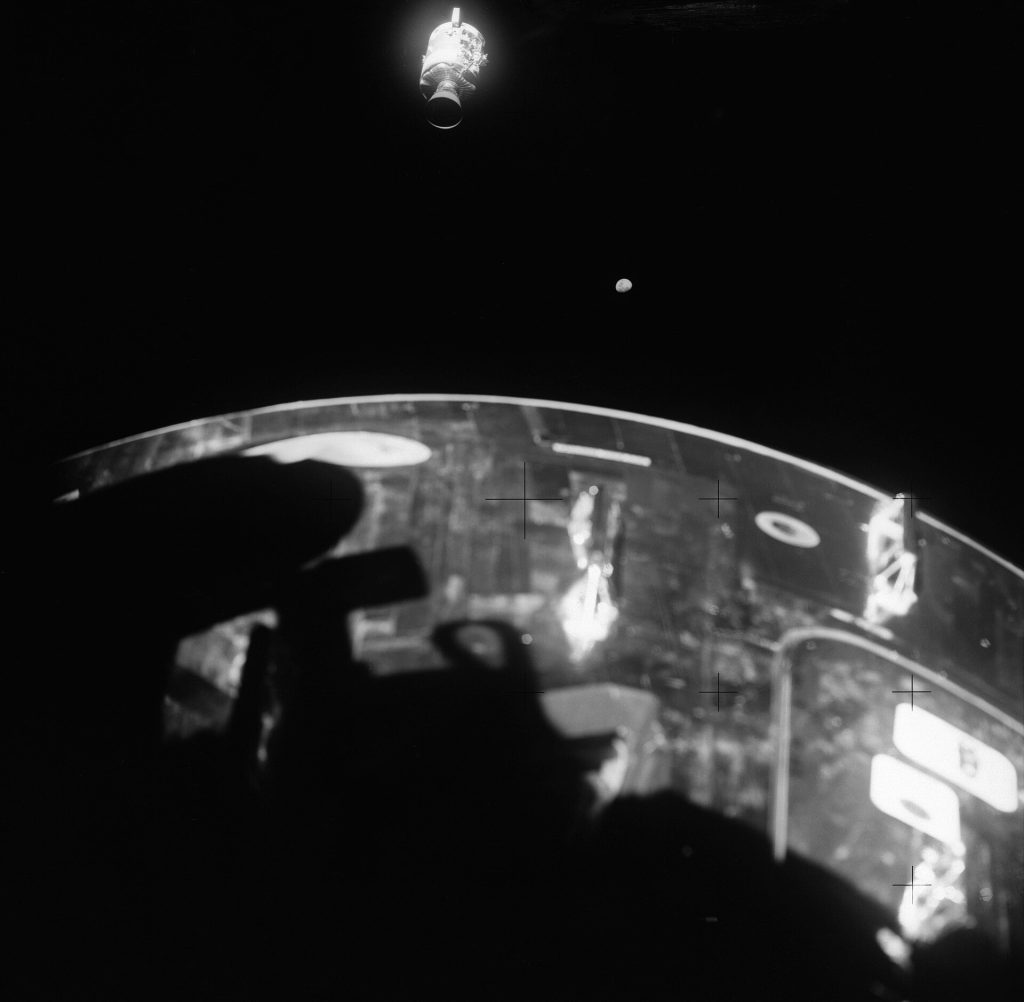
Skylab 2, with Pete Conrad, Paul Weitz and Joseph Kerwin, was delayed and became a rescue mission. After fly-around, Conrad reported solar wing 2 gone and wing 1 held down by the shield. Their first attempt to free it failed, and docking took nine tries after the capture latches failed eight times. Weitz said the workshop felt like a desert. They deployed a parasol through the scientific airlock, which covered only around two-thirds of the intended area, yet external temperature dropped 55° C over three days. On June 7, Conrad and Kerwin freed the wing with a cable cutter; it flung them away from the workshop as it released and then produced nearly 7 kW. The mission lasted 28 days, 49 minutes and 49 seconds, ending June 22, 1973.
Skylab 3 and 4
Skylab 3 (Alan Bean, Owen Garriott, Jack Lousma) lifted off July 28, 1973. Two reaction control thruster blocks leaked, and a rescue Apollo, modified to launch with two astronauts and return with five, was readied but never launched. All three crew suffered space adaptation syndrome. They performed a spacewalk of six and a half hours to install a twin-pole sun shade, and photographed a large solar flare and a prominence about three-quarters the size of the Sun. Two garden spiders, Arabella and Anita, spun webs with varying thickness. The mission lasted 60 days and 858 orbits, ending September 25, 1973.
Skylab 4 (Gerald Carr, Edward Gibson, William Pogue), all rookies, launched November 16, 1973. Pogue vomited and the crew chose not to tell the ground; an onboard tape recorder had captured it. Alan Shepard told them it was a fairly serious error in judgment, and Carr replied it was a dumb decision. Gibson later called his time "a 33-day fire drill". The alleged mutiny is a myth: Carr forgot to turn on his radio, leaving contact lost for exactly one orbit, roughly 90 minutes. After a frank discussion, the schedule was relaxed. The crew set a third duration record before undocking.
Reentry
Carr used the thrusters to raise the station to a 433 by 455 km orbit. Solar activity raised drag more than expected, and a shuttle reboost plan collapsed when the shuttle main engine failed tests in 1978. Skylab reentered at 1637 UTC on July 11, 1979, staying intact longer than predicted because of a 4% calculation error, and broke up about 300 miles east of Perth. The Shire of Esperance issued a $400 littering fine to NASA, never paid. Pieces landed on a home, whose resident collected the San Francisco Examiner's $10,000 prize.
Questions this video answers
When did Skylab launch?
Skylab lifted off at 1:30 p.m. on May 14, 1973, on the final Saturn V.
What went wrong at launch?
About a minute into ascent the micrometeoroid shield ripped off, jamming one primary solar array and exposing the station to the Sun's heat; the other array was torn off at stage separation.
How long was the first crewed mission?
Skylab 2 splashed down on June 22, 1973, after 28 days, 49 minutes and 49 seconds.
Was there a Skylab 4 mutiny?
The video calls it a myth: Gerald Carr forgot to turn on his radio, leaving the station out of contact for one orbit, roughly 90 minutes.
When did Skylab come down?
It re-entered at 1637 UTC on July 11, 1979, and broke apart about 300 miles east of Perth, Western Australia.