US Spacewalk 100: Installing the Seventh ISS Roll-Out Solar Array
The short version
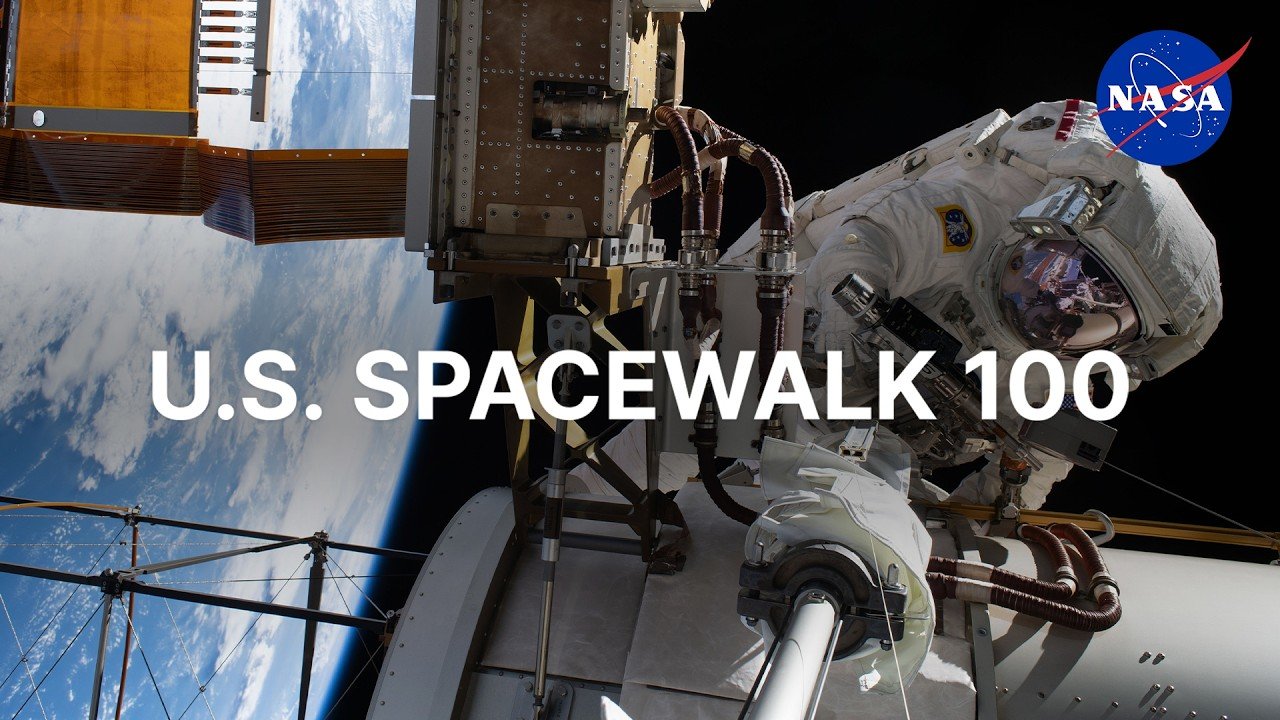
NASA's coverage follows Anil Menon and CSA astronaut Joshua Kutryk through US Spacewalk 100, the 285th ISS spacewalk for assembly, maintenance and upgrades. The footage covers suit-up, airlock depressurization and the first two hours of work freeing the seventh of eight IROSA solar arrays from its carrier. The crew was running ahead of the timeline, with a spacewalk of about 7 hours expected.
Full written account
NASA astronaut Anil Menon and Canadian Space Agency astronaut Joshua Kutryk left the Quest airlock of the International Space Station on a spacewalk billed as US Spacewalk 100: the 100th US spacewalk from Quest without a space shuttle present, and the 285th spacewalk overall in support of station assembly, maintenance and upgrades. Their job was to install a 750 lb ISS Roll-Out Solar Array, or IROSA, on the P4 (port four) truss. It was the seventh of eight such arrays. The official start was 7:57 a.m. Eastern (6:57 a.m. Central), when the two placed their suits on battery power.
The crew and the milestone
Menon was EV1, wearing the suit with red stripes, and Kutryk was EV2 in the unmarked suit. It was Menon's fourth spacewalk; his three earlier ones added up to 19 hours and 20 minutes. It was Kutryk's first. He is the fifth Canadian Space Agency astronaut to conduct a spacewalk and the first since David Saint-Jacques exited Quest on April 8, 2019. It was the eighth spacewalk out of the station in 2026 and the fifth for Expedition 75 crew members.
Inside, NASA astronauts Jessica Watkins and Luke Delaney helped with suit-up. Delaney was lead robotics operator for the Canadarm2, with Watkins as backup. In Houston, Greg Whitney was flight director for the day. Garrett Hayne would lead the following spacewalk. Nicole Stillwell was the intravehicular communicator, the spacewalk choreographer, and Jenny Gibbons of the CSA served as the other spacecraft communicator.
The numbering began with the first US spacewalk from Quest without a shuttle present, on February 20, 2002, during Expedition 4. NASA astronauts Carl Walz and Dan Bursch made it, and it lasted 5 hours 47 minutes.
Why the arrays matter
Each IROSA is about 60 ft long by 20 ft wide, roughly half the length of the station's original arrays, which stretch about 112 ft. They are lightweight, flexible carbon-fiber composite blankets that roll up for launch and unfurl on stored strain energy, like a tape measure, with no motors. They are mounted on brackets called mod kits and installed at an outward angle over the existing arrays, partly shading them while adding power. Each generates about 8 kilowatts, and the video states that each original array produced 19 kilowatts.
The earlier installations were:
- June 2021: the 2B and 4B channels, in a trio of spacewalks by Shane Kimbrough and ESA's Thomas Pesquet.
- December 2022: the 3A and 4A channels, by Josh Cassada and Frank Rubio.
- June 2023: the 1A and 1B channels, by Steve Bowen and Woody Hoberg.
Today's array was for the 2A channel. After the 2A array, the station was at about 200 kilowatts. The final array, for the 3B channel on the S6 truss, was due on US Spacewalk 101 a week later, on November 5th, and would bring the total to about 215 kilowatts, a figure that varies with visiting vehicles and other loads. Both arrays had been brought up in a SpaceX Cargo Dragon.
Preparation
The pair completed 10 cycles of in-suit light exercise as pre-breathe to clear nitrogen from the bloodstream and prevent decompression sickness. They carried SAFER backpacks for rescue in the unlikely event of becoming untethered. The crew lock was depressurized in two steps, pausing at 5 psi for suit leak checks and communications checks before going to vacuum. During the pause both crew members reported that their leak checks were complete. Ground teams verified less than 6 psi on the hatch gauge before the crew opened and stowed the EV hatch. Suit pressure read 4.3 for both. Before leaving, they read out their tether configurations and did buddy checks, in which a SAFER handle and a tab were caught. A reels check followed.
The plan
The animation narrated by lead spacewalk officer Miranda Nelson laid out the sequence. One crew member rides the robotic arm on a foot restraint (EV SSRMS), and the other works free-floating. They release the array from its pallet, install it temporarily on the mounting bracket, and bolt the two halves together at the hinge. Eight bolts secure it to the bracket. Y cables then connect the new array to the legacy system, so power can be drawn from both. Deployment takes about 12 minutes.
About three dozen bolts and a dozen electrical connectors were involved. The most critical connectors had to be mated during a night pass, so no stored energy would be on the 2A power channel. The spacewalk was expected to approach 7 hours.
Release from the carrier
Menon and Kutryk, using pistol grip tools, ran ahead of the timeline, by 10 to 15 minutes early on and about 20 to 30 minutes by the one-hour mark. A bolt on a bolt-block was released at 10 to 20 turns depending on the bolt, with some locking collars tighter than expected. A turn count and a torque light prompted a check on one anti-rotation device; Kutryk described a bolt block sitting about a millimeter and a half above the surface, and the ground judged the configuration good.
At about 1 hour 19 minutes, Menon found his pistol grip tool would not swing out. The ground saw its battery tucked against his SAFER tower. After a one-meter move of the arm and help from Kutryk, it came free.
There were 16 bolts to free the array from the carrier. Boom deployment system bolts were rotated 90 degrees, which should take at least 10 seconds. The final bolts were released around 1 hour 54 minutes. Around 1 hour 59 minutes the array was moved away from the carrier, with Kutryk watching clearance against the grapple fixture. Menon then rode it on the Canadarm2 toward the P4 truss. The array folded measures about 10 ft by 2 ft by 4 ft.
At 2 hours 29 minutes, Menon held the array at the integrated electronics assembly, next to the legacy arrays that were delivered on STS-115 in September 2006. Ground controllers cautioned about contact with the blanket boxes and a lateral load limit of 30 pounds on the mod kit.
Questions this video answers
Why is this spacewalk called US Spacewalk 100?
It is the 100th US spacewalk out of the Quest airlock without a space shuttle present, and the 285th spacewalk for ISS assembly, maintenance and upgrades.
Who performed the spacewalk?
NASA astronaut Anil Menon (EV1, red-striped suit) and CSA astronaut Joshua Kutryk (EV2, unmarked suit).
What was the task?
They are installing the seventh of eight ISS Roll-Out Solar Arrays (IROSA) on the P4 truss for the 2A power channel.
How big is an IROSA?
Each weighs about 750 pounds on Earth and unfurls to roughly 60 feet long by 20 feet wide, like a tape measure, with no motors.
What comes next?
Menon and Kutryk are to install the final IROSA on the S6 truss for the 3B power channel one week later, on November 5th, during US spacewalk 101.