Why the ISS Will Be Deorbited at Point Nemo and What Comes Next
The short version
The video explains why the International Space Station is due to be deorbited by SpaceX around 2030 and sent into the sea at Point Nemo. It traces the station's origins in the Cold War space station plans of the US and the Soviet Union, and lists the reasons for retirement: thermal fatigue, atomic oxygen, debris and orbital decay. It ends with the commercial stations competing to replace it.
Full written account
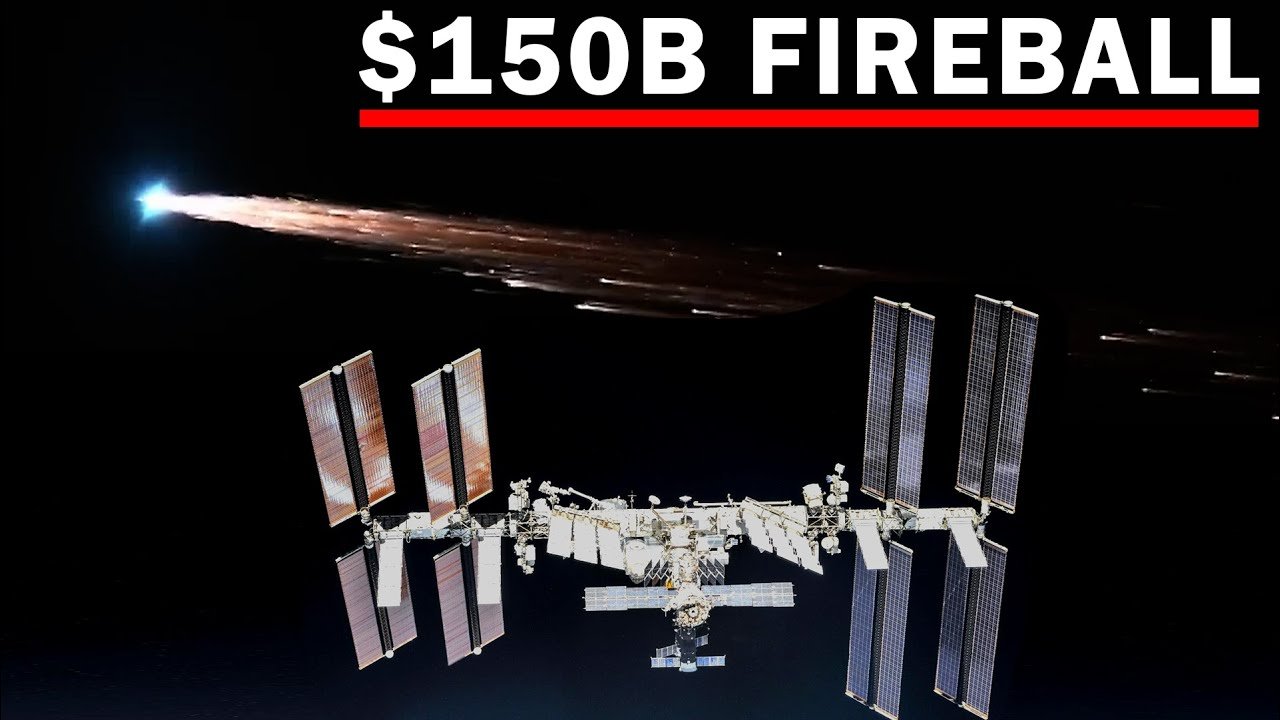
Around 2030, SpaceX is due to deorbit the International Space Station, and about $150 billion of hardware will burn up over the Pacific Ocean. What survives will fall into the sea at Point Nemo, between New Zealand and South America, the place on Earth considered farthest from any land mass.
An outpost born from rivalry
The station came out of Cold War tensions. In the 1970s both the US and the Soviet Union pursued space stations, and Wernher von Braun had pushed the idea earlier. He and Willy Ley proposed a rotating wheel 76 m (250 ft) across, with three decks turning at three revolutions per minute to give artificial gravity and room for a crew of up to 80. Konstantin Tsiolkovsky had explored the rotating wheel in 1903.
Skylab and the Soviet Salyut stations proved the concept, and the 1975 Apollo-Soyuz Test Project was the first docking of spacecraft from two different nations. An international Skylab, using the backup Skylab B, was imagined but never happened. The US later planned Freedom and the Soviets built Mir 2, but both programs struggled with politics and funding. In 1993 Vice President Al Gore and Prime Minister Viktor Chernomyrdin announced a joint station. Starting from the Russian Zarya module, the ISS now has 16 pressurized modules, weighs over 400 tons and is slightly larger than a football field.
Why it can't be kept going
The main problem is thermal. The ISS orbits every 90 minutes and swings 16 times a day between full sunlight at about 120 °C and full shade at minus 150 °C. Its aluminium structure is subject to metal fatigue, and joints, welds and stress points will gradually begin to fail. A fracture at a main structural point could endanger the crew and force an emergency evacuation. The station also grew in a halfhazard way, with nations developing modules separately, and its design life was always about 20 years.
Atomic oxygen is a second problem. Created in the upper atmosphere when the Sun's UV breaks down normal oxygen molecules, it is extremely reactive and causes oxidization, erosion and changes in material strength.
Debris is a third. Small holes have punctured the skin of the ISS, and orbital debris has cracked a window of the Cupola. The station flies low, where most rice-grain-sized debris is slowed by the high atmosphere and burns up. That same drag pulls the station down, so it must be boosted periodically. Raising it permanently would put it among larger debris of a centimeter or more, which could punch a hole through the station and its Kevlar protection.
Politics and what comes next
The head of Roscosmos said he would submit plans to President Putin to quit the ISS by 2025, but NASA had received no such notification, and Roscosmos most recently said it would probably carry on until 2028, when Boeing's maintenance contract is up for renewal. NASA and Roscosmos kept working together through the Ukraine conflict.
NASA wants to leave day-to-day station operation and concentrate on deep space research. It wants a private corporation to build, launch and run a new station, with a transition of about two years.
The contenders:
- Axiom: backed by a NASA Space Act Agreement and built while docked to the ISS; its first two modules have been manufactured.
- Orbital Reef: led by Blue Origin and Sierra Space, also NASA-backed, to launch on New Glenn and be serviced by Dream Chaser, neither of which had yet flown.
- Starlab: led by Nanoracks, Voyager Space and Lockheed Martin, built around an inflatable main module, due around 2028.
- Northrop Grumman: a three-module station based on the Cygnus craft, with stage one set for late 2028.
If NASA cannot deliver, China, with its existing space station, would be waiting to offer its services to the scientific world.
Questions this video answers
When will the ISS be deorbited?
Around the 2030 mark, when SpaceX will deorbit it so it burns up in the atmosphere.
Where will the remains of the ISS fall?
Into the sea at Point Nemo, between New Zealand and South America, the place on Earth considered farthest from any land mass.
Why can't the ISS simply be updated?
The video says its aluminium structure suffers metal fatigue from heating and cooling 16 times a day, and its design life was always about 20 years.
What could replace the ISS?
Candidates named are the Axiom space station, Orbital Reef from Blue Origin and Sierra Space, Starlab, and a Northrop Grumman station.