Challenger STS-51-L: The 73 Seconds From Liftoff to Breakup
The short version
A minute-by-minute account of Challenger mission STS-51-L, which launched on January 28, 1986 and broke apart 73 seconds after liftoff, killing all seven crew. It covers the crew, the O-ring seal failure in the right solid rocket booster, and the Rogers Commission findings.
Full written account
Challenger mission STS-51-L lifted off from Kennedy Space Center on January 28, 1986, at 11:38. Seventy-three seconds later the shuttle broke apart, and all seven people aboard died. It was the 25th space shuttle launch and the 10th Challenger mission.
The crew and the mission
The crew was commander Francis R. Scobee, pilot Michael J. Smith, mission specialists Judith A. Resnik, Ronald E. McNair and Ellison S. Onizuka, payload specialist Gregory B. Jarvis, and Christa McAuliffe, selected as the first teacher in space from 11,000 other applicants. She taught at Concord High School in New Hampshire. The shuttle carried a Tracking and Data Relay Satellite, TDRS-B, and the Spartan Halley spacecraft meant to study Halley's Comet.
Warnings before launch
The launch pad was covered in thick ice the night before. An engineer told a superior he was concerned about the reliability of the seals in the rockets. The video says engineers in the shuttle program had warned for over two years that the shuttles were being overused. The NASA official acknowledged the concern, and the launch went ahead as scheduled.
The ascent
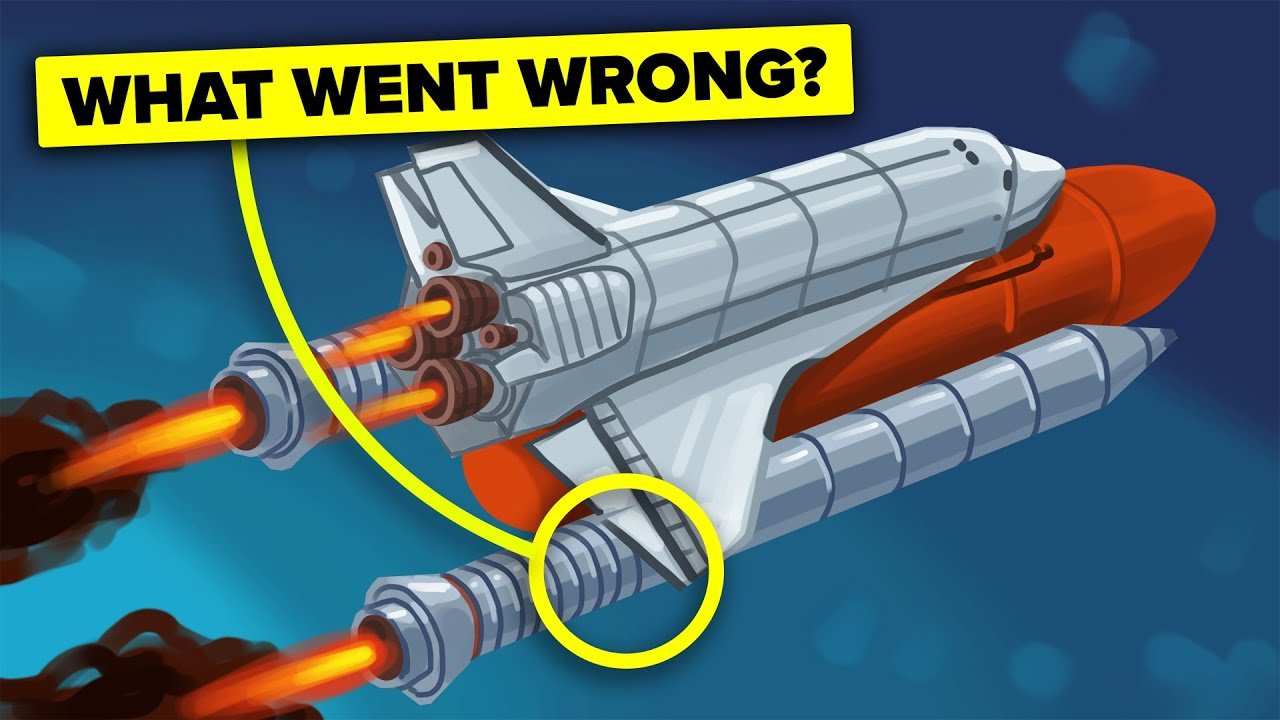
Abnormal black smoke was seen seeping from the right solid rocket booster near an O-ring joint at liftoff. At mission control a technician read the right booster's internal pressure as 11.8 pounds per square inch higher than normal. At 19 seconds the shuttle was shaken by wind; Smith said there was a lot of wind. At 28 seconds it passed 10,000 feet and Mach 0.5. Three bright flashes appeared near the right wing between 45 and 48 seconds, captured by a 70-millimeter tracking camera, and a fireball erupted from the right booster.
At 58 seconds Challenger was at 26,127 feet, going 1,539 miles per hour. An abnormal plume of smoke poured from the booster, and the crew had no cockpit sensors showing booster performance. At 60 seconds the booster's internal pressure began to drop. Mission control called "Throttle up, three at 104" at 66 seconds. Flames reached the external liquid hydrogen tank area and its pressure dropped.
Breakup
At 72 seconds the back end of the right booster tore away from the external tank when its strut failed. At 73 seconds Smith said "Uh oh…", the last words from the crew over the comms. The right booster was producing 100,000 pounds less thrust than the left and pushed into the liquid oxygen section of the tank. Leaking fuel ignited. The debris reached Mach 1.92 and 46,000 feet. The crew cabin arced out of the fireball, and the astronauts had not worn pressurized suits during liftoff. The cabin hit the Atlantic at about 200 miles per hour. Both boosters were destroyed by a self-destruct signal.
Investigation
Divers aboard USS Preserver located the front of the shuttle on March 7, 1986. The Rogers Commission, appointed by President Ronald Reagan, found that the two rubber O-rings were compromised by the severe cold of the night before launch. It also concluded that shuttles were being pushed too hard and engineers' concerns were ignored or overlooked. The report was given to the President on June 6. It determined Marshall Space Flight Center, Morton Thiokol Inc. and NASA as a whole were responsible. Discovery launched on September 29, 1988, the first mission after the disaster.
Questions this video answers
When did the Challenger disaster happen?
January 28, 1986, at 11:38 according to the video's timeline.
How many people died?
Seven people were aboard and all were lost.
What caused the disaster?
The Rogers Commission determined that the two rubber O-rings, which led to the fuel leak in the right booster, were compromised by the severe cold the night before launch.
Could the crew have known or escaped?
Everything was telemetry-nominal; the cockpit had no sensors displaying solid rocket booster performance, and the video says a high-speed separation would not have been survivable.
When did shuttles fly again?
Discovery launched on September 29, 1988, with five veteran astronauts on board.
Explore related missions
Connected by the topic: Space Shuttle