Columbia STS-107: How a Foam Strike and Missed Imagery Led to Loss
The short version
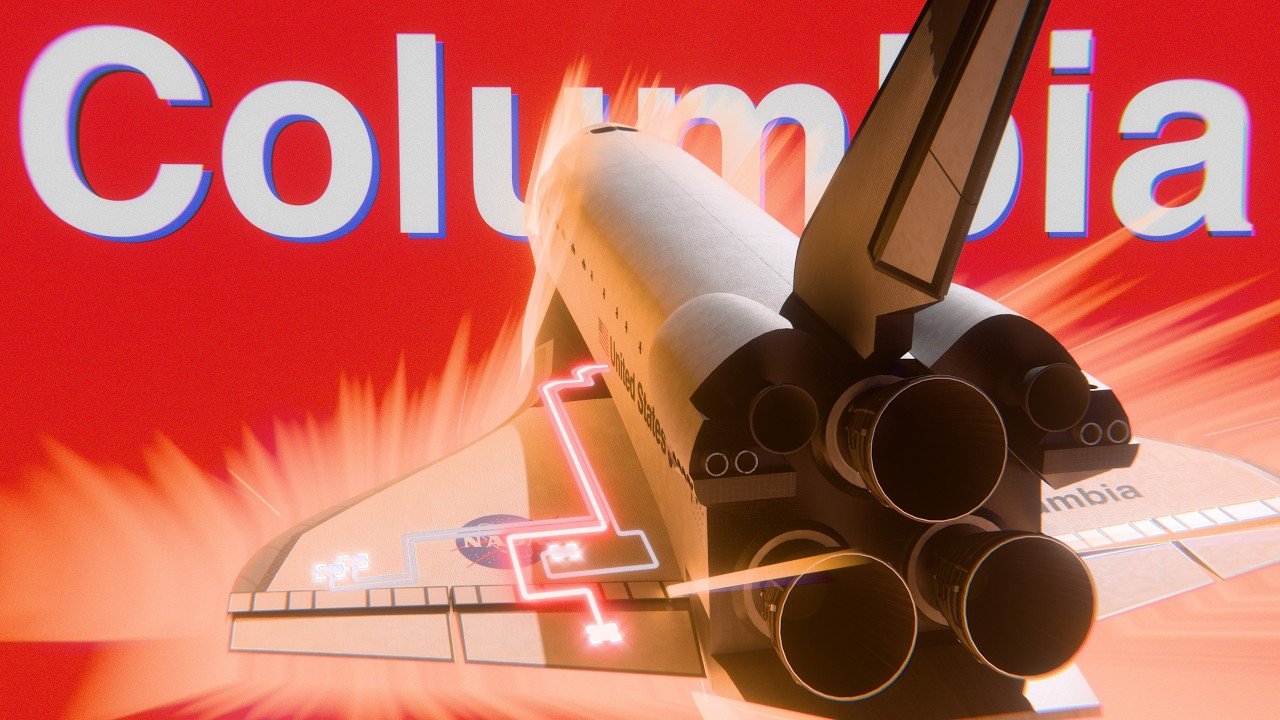
An animated documentary on the STS-107 mission of Space Shuttle Columbia, launched on January 16, 2003 for a planned 16-day science flight. It follows the launch, the foam strike noticed in launch footage, the Mission Management Team's handling of it, the re-entry breakup and the Columbia Accident Investigation Board's findings. It also covers the debris search, foam-impact tests, a possible rescue by Atlantis and the changes made to the shuttle program.
Full written account
All seven crew members died when Space Shuttle Columbia broke apart during re-entry at the end of STS-107, a 16-day international science mission that lifted off from Kennedy Space Center on January 16, 2003. The cause traced back to the launch: a piece of foam from the external tank's left bipod ramp struck the left wing 81.7 seconds after liftoff. Engineers saw the strike on launch footage on flight day 2, but the shuttle program's managers declined to seek images of the wing, and the crew was not asked to inspect the damage.
The mission and its crew
STS-107 was the 113th space shuttle flight and the 28th launch of Columbia. It was the first flight of the SPACEHAB Research Double Module, a laboratory that sat in the payload bay. The orbiter carried an extended duration orbiter pallet with extra oxygen and hydrogen tanks for the fuel cells, which made a 16-day flight possible. The planned orbit was 150 nautical miles high at a 39° inclination.
The crew split into a red team and a blue team so that experiments ran around the clock while the other team slept. The seven were:
- Rick Husband, commander, a US Air Force colonel who had flown on STS-96, the first shuttle mission to dock with the International Space Station
- William McCool, pilot, a US Navy commander and former test pilot, on his first flight
- Michael Anderson, payload commander, a US Air Force lieutenant colonel who had flown on STS-89
- David Brown, mission specialist, a US Navy captain and naval aviator, on his first flight
- Kalpana Chawla, mission specialist, who had flown on STS-87 as primary robotic arm operator
- Laurel Clark, mission specialist, a US Navy commander and naval flight surgeon, on her first flight
- Ilan Ramon, payload specialist, an Israeli Air Force colonel and fighter pilot, the Israeli space agency's first flying astronaut
The science covered biology, Earth and space science, physical science and technology development. Some experiments flew outside the SPACEHAB module on a Hitchhiker payload called Freestar. On orbit, the crew worked on the laminar soot process, bone-cell studies under the Biopack experiments, a bioreactor growing prostate cancer and bone cells, and a sand experiment on the mechanics of granular materials, among others.
Launch and the foam strike
The ascent was described by mission control as flawless. Marshall Space Flight Center teams then began their standard review of launch footage. That review found a particularly large piece of debris detaching from the left bipod of the external tank at 82 seconds and striking the orbiter. The other camera angles did not have the right angle or resolution to show the impact.
Analysis of the footage put the object at 21 to 27 inches long and 12 to 18 inches wide, rotating at least 18 times per second. Slowed by aerodynamic forces, it hit Columbia at a relative velocity of 625 to 840 feet per second. Debris was seen leaving from the underside of the wing, so the strike was assumed to be below the left wing's leading edge.
Engineers could not see the tiles, so they ran a program called Crater, which estimates the damage from a debris strike. Crater had been validated for objects of less than about 3 cubic inches, and the foam was about 400 times that size. It predicted damage deeper than the tiles' thickness, possibly exposing the wing's aluminum surface. The result was effectively ignored: Crater was known to overstate damage, it did not account for the densified layer under the tile surface, and it was being used far beyond its qualified range.
The mission management team
At the flight day 6 mission management team meeting, the strike was discussed. Participants recalled that a similar bipod foam loss had occurred on STS-112, and that STS-87 had shown significant damage between reinforced carbon-carbon panel 9 and the main landing gear door. The STS-112 foam loss had been treated as an action item rather than an in-flight anomaly at the flight readiness review for STS-113. The action's due date of December 5, 2002 was postponed until after STS-113 and STS-107, so both flew without an answer.
Mission management team chair Linda Ham later emailed that the external tank rationale for flight after STS-112 was "lousy."
A debris assessment team concluded that it needed better images. Ground telescopes lacked the resolution, so the only option was spy satellites, which meant a request through the Department of Defense. An email asking what it would take to obtain that imagery was interpreted as an information-gathering message rather than a formal request. Because it came from outside the official chain of command, Ham asked whether anyone knew of a requirement for imagery, and everyone she asked denied any. She also raised concerns that experiments would have to pause to orient the shuttle, and she believed nothing could be done even if damage were seen. The request was cancelled, and the whole exchange with the Department of Defense lasted about 90 minutes.
One engineer wrote an email calling the decision "wrong and bordering on irresponsible," but it was shared only among colleagues and was not passed up the chain, since it would have been seen as subverting a decision already made.
About a week after the strike, the crew was told, mainly in case a reporter asked during an interview. The email said the strike was "not even worth mentioning" and that there was "absolutely no concern for entry." At the final mission status briefing, entry flight director Leroy Cain said the engineers had found no concerns and that the entry would follow the nominal trajectory. Columbia was to land at Kennedy Space Center at 8:16 a.m. Central time.
Re-entry
Columbia fired its orbital maneuvering system engines for 2 minutes and 38 seconds to start the descent. Over the Pacific, sensors in the left wing began returning false readings and then failed. Mission control's Max reported losing four hydraulic return temperature transducers on the left side, serving the left inboard and outboard elevons, all within four or five seconds of each other. Tire pressure sensor readings then began rising unexpectedly before the landing gear tire pressure and temperature sensors went offline. Mission control lost the nose gear and right main gear down talkbacks and then all communication, and repeated calls to Columbia went unanswered. Cameras recording the re-entry captured the breakup.
Debris and recovery
Across Texas and Louisiana, 911 calls reporting debris reached 18 per minute. About $50,000 of property was damaged and nobody on the ground was injured. Searchers combed 2 miles on each side of the re-entry path, covering 25,000 square miles, in what became the largest search effort in US history.
Heavier pieces carried more momentum, so the debris field was sorted largely by mass. A heat shield tile was found furthest west, in Littlefield, Texas, and the main engine turbo pumps furthest east, in Fort Polk, Louisiana. Over three months about 38% of the orbiter's mass was recovered. Roundworm descendants from one experiment were found alive in their containers months later.
Columbia carried a unique data recorder, the OEX recorder, installed to study the effects of flight and re-entry. It was due to be removed after STS-107 to save weight. It was found 46 days after the accident near Hemp Hill, Texas, and its data was instrumental in piecing together the accident timeline.
What the investigation found
The Columbia Accident Investigation Board stated the physical cause: a breach in the thermal protection system on the leading edge of the left wing, caused by foam from the left bipod ramp that struck the lower half of reinforced carbon-carbon panel 8. During re-entry, superheated air penetrated the leading edge insulation and progressively melted the aluminum structure of the left wing, until aerodynamic forces caused loss of control, failure of the wing and breakup of the orbiter. The board said the breakup occurred in a flight regime in which the crew could not have survived, given the orbiter's design. It said the precise reason the ramp was lost may never be known, and that the hand-applied foam in the bipod region may have been a primary source of variability.
To test the strike, investigators built a compressed gas gun, adapted from a nitrogen gun used for bird-strike tests. It fired a 19 by 11.5 by 5.5 inch foam projectile weighing 1.67 pounds at reinforced carbon-carbon panels, with a fresh leading edge for each shot. Most shots left only a mark. In the final test, the projectile struck panel 8 at 777 feet per second and punched a 16 by 7 inch hole. The most credible scenario for loss of control was the loss of all hydraulic systems, which let the aerosurfaces float and caused an uncontrolled pitch-up.
The board also examined the crew's fate. Depressurization of the crew module began at or shortly after orbiter breakup, above 63,500 feet, and incapacitated the crew too quickly for them to lower their helmet visors. The board found the crew was not exposed to a cabin fire or thermal injury before depressurization, and that the acceleration levels the module experienced before its failure were not lethal. The board determined that the deaths resulted from blunt trauma and hypoxia.
The board's report went beyond the foam, stating that NASA's organizational culture "had as much to do with this accident as the foam." It cited schedule pressure, among other factors. NASA had set February 19, 2004 for the launch of Node 2 on STS-120, which would mark completion of the US core configuration of the International Space Station. Meeting it meant 10 flights in less than 16 months. The board noted that employees found a headquarters countdown screen saver amusing because the date could not be met. The report said managers required engineers to prove the strike was unsafe rather than prove it safe, an inversion of the burden of proof.
The board contrasted STS-107 with STS-27R in December 1988, when Atlantis was heavily damaged by a debris strike at about 85 seconds. On that mission the crew was directed to inspect the orbiter with a camera on the robotic arm, which Columbia did not carry. Atlantis had 707 dings, 298 of them larger than an inch in one dimension. A missing tile left the skin exposed at a thick aluminum plate that covered an antenna, and without that plate a burn-through may have occurred.
Aftermath
Questions this video answers
When did Columbia STS-107 launch?
On January 16, 2003, for a planned 16-day international science mission.
Who was aboard Columbia?
Rick Husband, William McCool, Michael Anderson, David Brown, Kalpana Chawla, Laurel Clark and Ilan Ramon. All seven died.
What was the physical cause of the loss?
The Columbia Accident Investigation Board found a breach in the thermal protection system on the leading edge of the left wing. It was caused by foam that separated from the left bipod ramp of the external tank 81.7 seconds after launch.
Did NASA request imagery of the wing in orbit?
A request to the Department of Defense for imagery was made and then cancelled within 90 minutes. Managers viewed it as a non-critical engineering desire.
Could the crew have been rescued?
The board's report outlined a scenario in which Atlantis, launched on flight day 26 with a crew of four, could have met Columbia and brought both crews home. It would have been very difficult, but not impossible.
Explore related missions
Connected by the topic: Space Shuttle