Challenger STS-51-L: The Night Engineers Said Don’t Launch
The short version
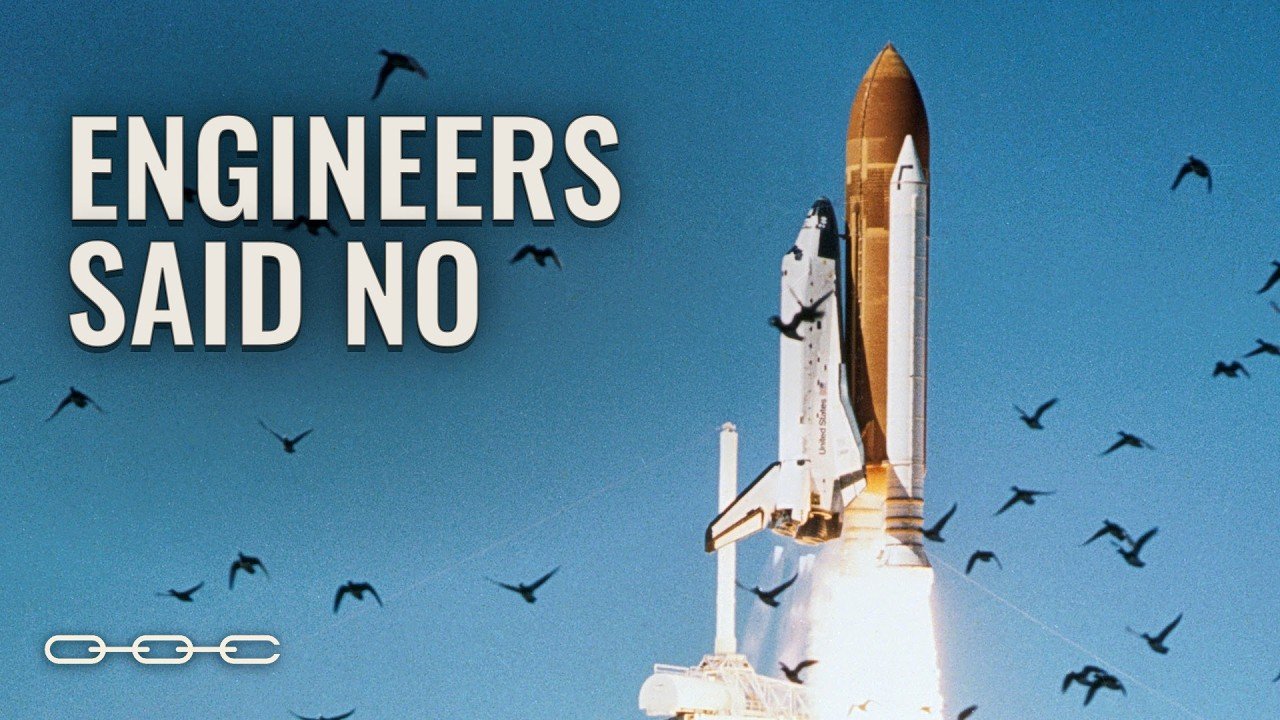
Built from the Rogers Commission report and sworn hearing testimony, this film follows the roughly 21 hours from the cold forecast reaching Morton Thiokol on Monday 27 January 1986 to 73 seconds after Challenger's liftoff. It covers the engineers' written recommendation not to launch below 53°, the managers' reversal, the ice on the pad, and the commission's findings on the booster joint and on decision-making. All seven crew died.
Full written account
Seven people died when Challenger broke apart 73 seconds after liftoff on 28 January 1986, and the night before, the engineers who built the shuttle's boosters had told NASA in writing not to launch. Their chart said not to fly until the seals were at 53°, the coldest any shuttle had flown. The forecast for launch time was 26°.
The warning
The forecast reached Morton Thiokol in Utah on Monday 27 January. An engineering manager there remembered the engineers as very adamant: "We were way below our database." At the launch site, Thiokol's senior man, Alan McDonald, said the decision should be an engineering decision, not a program management decision. On a first call with NASA, Thiokol's engineers said the launch should wait until noon or later.
A manager at Marshall, which ran the booster program, said that if Thiokol held its ground, they should not launch, and that shuttle program manager Arnold Aldrich should be told. That evening Marshall's director, William Lucas, was briefed in his motel room and said, "Fine, keep me informed."
The second call
Each booster seam is sealed with two rubber O-rings about as thick as a pencil. Roger Boisjoly's photographs came from the coldest earlier flight, with the seals at 53°, where hot gas had got past the first ring and burned the grease behind it black. That flight had carried Ellison Onizuka.
Larry Mulloy of Marshall pushed back, and George Hardy said he was appalled at how Thiokol read its data but would not recommend launch over the objections. Joe Kilminster asked for five minutes off the line. The break ran to thirty. In the Utah conference room, Boisjoly showed his photographs again, and Gerald Mason told his head of engineering, Bob Lund, to take off his engineering hat and put on his management hat. Only the four managers decided, agreeing to recommend launch. Boisjoly was not asked.
When the line reopened, nobody spoke up when asked if anyone disagreed. Kilminster's signed recommendation arrived by fax shortly before midnight.
The morning
Crews had left water running through the pad's pipes, which had never been done before; drains froze and overflowed. The ice team found ice from 95 ft up the tower to 215 ft, with icicles a foot long. Lucas was told only that a concern about the cold had been settled in favor of launch. An infrared reading near the bottom of the right booster was about 8°, and it was never reported.
At 9, Rockwell's representative told NASA's mission managers that Rockwell "cannot assure that it is safe to fly." They gave the ice another hour. The crew were not told anyone feared what the cold might do. The air at the pad was 36° at launch.
Liftoff
Less than a second after liftoff, gray smoke spurted from a joint near the bottom of the right booster. At 58 seconds a small flame appeared at the same joint. Six seconds later it had burned into the tank. At 73 seconds, nearly 9 miles up, the tank gave way. NASA's film analysts found no shock wave and no sign of a violent explosion. NASA's report on the crew said the cause of their deaths cannot be positively determined.
The commission's findings
Richard Feynman put the rubber in ice water and showed that at 32° it had no resilience. The commission found the joint's seal had failed and its design was unacceptably sensitive to cold. Counting every flight, of 20 flights with seals at 66° or warmer three had damage; of four at 63° or colder, all four did. It found Thiokol's managers reversed their position at the urging of Marshall, and that NASA appeared to be requiring a contractor to prove it was not safe to launch. Three senior NASA officials said they had not known of Thiokol's objections.
By June 1987 NASA reported the joint redesigned with a latch, a third rubber ring and a heater. The crew were buried together at Arlington National Cemetery on 20 May 1986.
Questions this video answers
When did Challenger launch?
On the morning of 28 January 1986, at 11:38 as the video gives it, after a Monday attempt was called off for crosswinds.
How many people died?
All seven aboard were lost.
What did the engineers recommend?
Morton Thiokol's engineers said not to launch until the seals in the boosters were at 53°; the forecast for launch time was 26°.
Who made the final recommendation at Thiokol?
Four managers took the decision to recommend launch; Roger Boisjoly was not asked.
What did the commission find about the joint?
It found the seal in the right booster joint had failed and that the joint's design was unacceptably sensitive to cold and to how it moved under load.
Did senior NASA officials know of the objections?
Three senior NASA officials, including Arnold Aldrich, said they had not known of Thiokol's objections.
Explore related missions
Connected by the topic: Space Shuttle