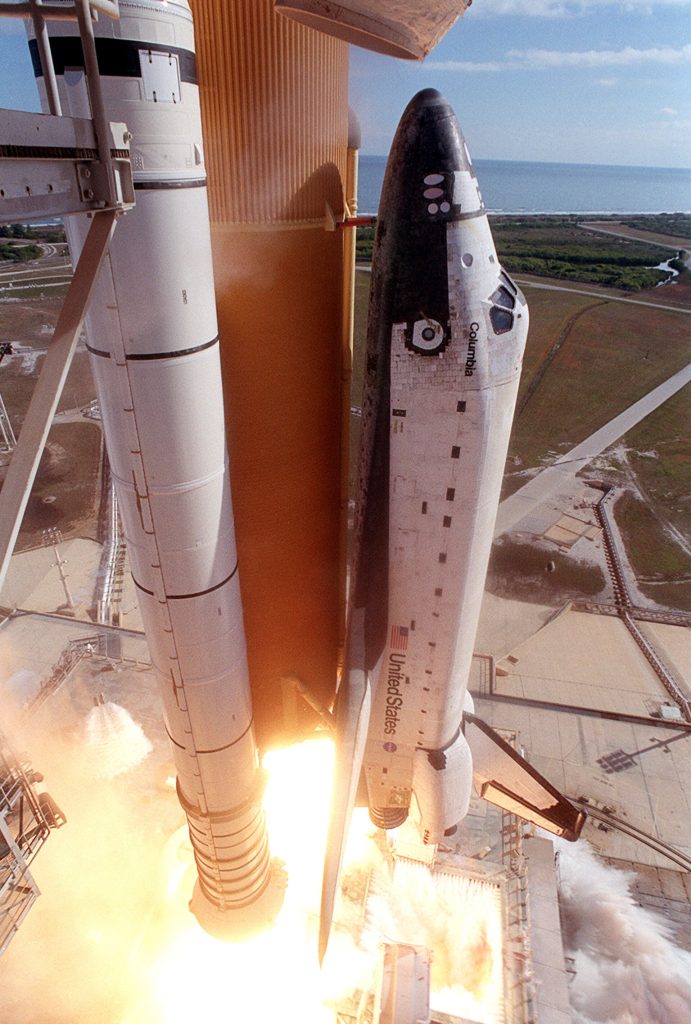
Challenger STS-51-L: The Cold O-Ring and the Launch Call
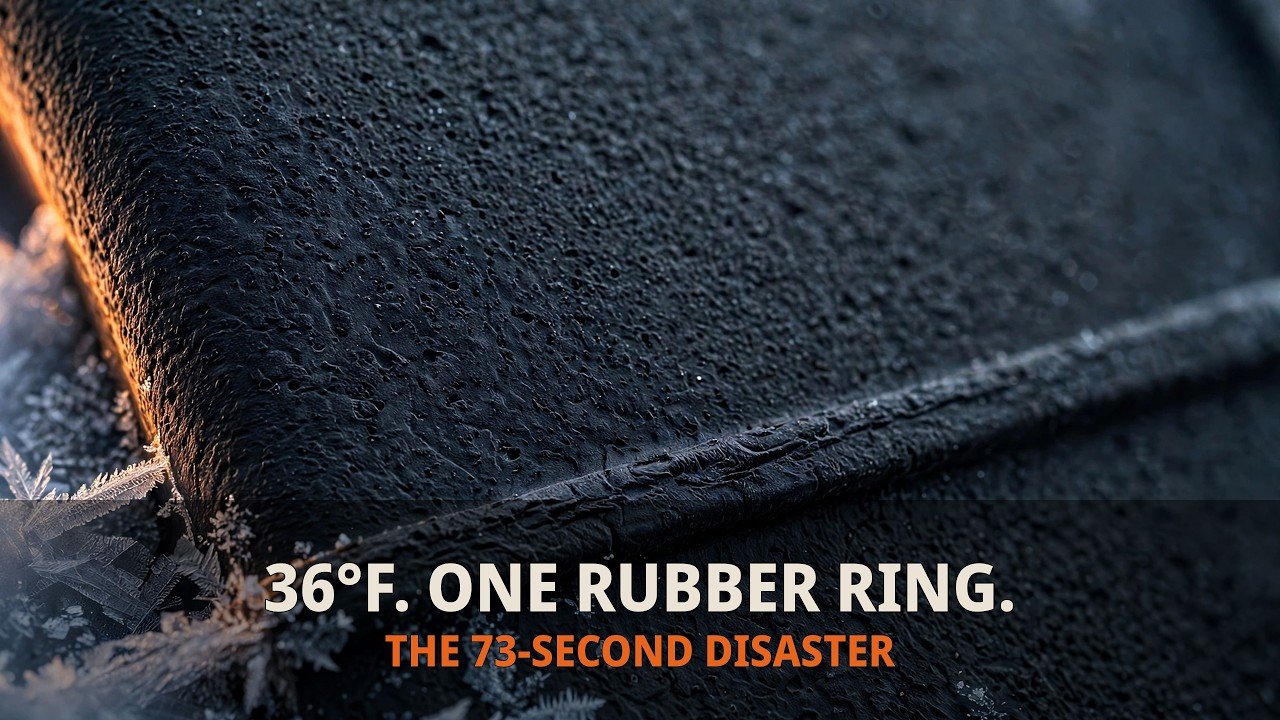
The short version
Challenger broke apart 73 seconds after launching from Kennedy Space Center on January 28, 1986, killing all seven crew. The video traces the failure of an O-ring seal in the right solid rocket booster's aft field joint back to a conference call the night before, in which Thiokol engineers recommended against launching in the cold and company management reversed that recommendation. It sets the cost of a scrub against the costs of the disaster and draws on the Rogers Commission report and Feynman's Appendix F.
Full written account
On the morning of January 28, 1986, Florida woke to 36°F, colder than any temperature the shuttle's rubber seals had been asked to survive. Space Shuttle Challenger left Launch Complex 39B at Kennedy Space Center at 11:38 a.m. Eastern. At 73 seconds, a tongue of flame appeared on the right solid rocket booster, the external tank failed and the orbiter broke apart. All seven crew members were killed. It was the 25th shuttle flight and Challenger's 10th, carrying a communication satellite and an instrument to watch Halley's comet on a planned six-day mission.
The call the night before
About 15 hours earlier, at roughly 8:45 p.m. Eastern, around 34 people joined a teleconference linking Morton Thiokol's plant in Utah, NASA's Marshall Space Flight Center in Alabama and Kennedy. Thiokol built the shuttle's solid rocket motors. Its engineers Roger Boisjoly and Arnie Thompson presented the case against launching, and vice president of engineering Bob Lund stated the recommendation: do not launch with the O-ring temperature below 53°F.
That figure was the lowest temperature of any previous flight, in January 1985 on STS-51C, whose boosters came back with the worst O-ring erosion recorded up to that point. Boisjoly's charts showed that the colder the launch, the deeper the erosion. The forecast called for 18°F overnight, rising to 26°F by launch time. The engineers acknowledged that there was no test data below 53°F, so they were arguing from the edge of the known.
Pressure and a reversal
Lawrence Mulloy, who managed the solid rocket booster program at Marshall, pushed back. As witnesses recalled, he said something like: "My God, Thiokol, when do you want me to launch, next April?" He cited earlier flights on which O-ring erosion had appeared and the vehicle had come home, and a safety factor of three. The burden of proof was reversed: instead of the contractor proving the vehicle safe, Thiokol was pressed to prove it unsafe.
Thiokol management asked for an offline caucus of about 30 minutes, with no NASA on the line and no minutes kept. According to testimony from Joe Kilminster and Boisjoly, senior vice president Jerald Mason told Lund to take off his engineering hat and put on his management hat. Lund reversed his position. Management's rationale was a margin of about three times over the worst erosion seen and confidence that the secondary O-ring would seal even if the primary did not.
NASA required the contractor's written approval to fly, an unprecedented step. Allan McDonald, on site at Kennedy, refused to sign; his boss in Utah supplied the signature.
The warning on record
On July 31, 1985, Boisjoly had written to his vice president of engineering after flight 51B in April, where the secondary O-ring had eroded, meaning the primary had never sealed. He called the erosion pattern a "jump ball" as to the success or failure of the joint and warned of a catastrophe of the highest order, loss of human life. In August an O-ring task force of 8 to 10 engineers was formed, and by October Boisjoly was writing that the team was being blocked.
After the 51B findings a launch constraint was placed on the field joint. Mulloy waived it for every flight after July 10, 1985, six consecutive waivers. Jesse Moore, who chaired the flight readiness review, and launch director Gene Thomas never knew the constraint existed.
How the seal failed
Each booster was built from segments joined in the field, with a tang slid into a clevis and pinned by 177 steel pins. Two O-rings, primary and secondary, sealed the joint, shielded by zinc chromate putty. A 1977 hydroburst test had revealed that at ignition the tang and clevis rotate apart, widening the gap. The O-rings were Viton, a rubber whose elasticity falls off sharply as temperature drops, each about 0.28 inch thick in cross-section and forming a circle 12 feet across. The commission measured that a compressed O-ring at 75°F is five times more resilient than one at 30°F. On February 11, 1986, Richard Feynman clamped a chilled sample of O-ring rubber and showed it failed to spring back.
The ledger and the findings
By later NASA accounting, a scrubbed launch cost about $1 million, or about $1.3 million once the external tank was loaded. Against that stand seven lives, a $680 million joint redesign, about $1.7 billion for the replacement orbiter Endeavour, a $10 million incentive fee Thiokol forfeited, and 32 months grounded until Discovery flew on September 29, 1988.
The Rogers Commission, created six days after the disaster by Executive Order 12546, interviewed 160 people. It found a serious flaw in the decision-making process, and that the engineers' concerns never reached the Level I flight readiness review. It also found no evidence that the White House pressured NASA to launch before the State of the Union address.
Questions this video answers
What caused the Challenger accident?
The Rogers Commission found the cause was the failure of a pressure seal in the aft field joint of the right solid rocket booster, due to a faulty design unacceptably sensitive to a number of factors, temperature among them.
What was the temperature at launch?
The air was 36°F, and the coldest point on the right aft field joint was estimated at 28°F, plus or minus 5.
What did the engineers recommend the night before?
Thiokol's vice president of engineering Bob Lund stated the recommendation not to launch with the O-ring temperature below 53°F, the lowest temperature of any previous flight.
Who refused to sign the launch authorization?
Allan McDonald, director of the solid rocket motor project at Kennedy, would not sign. His boss in Utah supplied the written signature.
How long was the shuttle fleet grounded?
32 months, 975 days, until Discovery returned to flight on September 29, 1988.
How many people died?
All seven crew members were killed.
Explore related missions
Connected by the topic: Space Shuttle