Challenger STS-51-L: O-Rings, Cold and the Overruled Warning
The short version
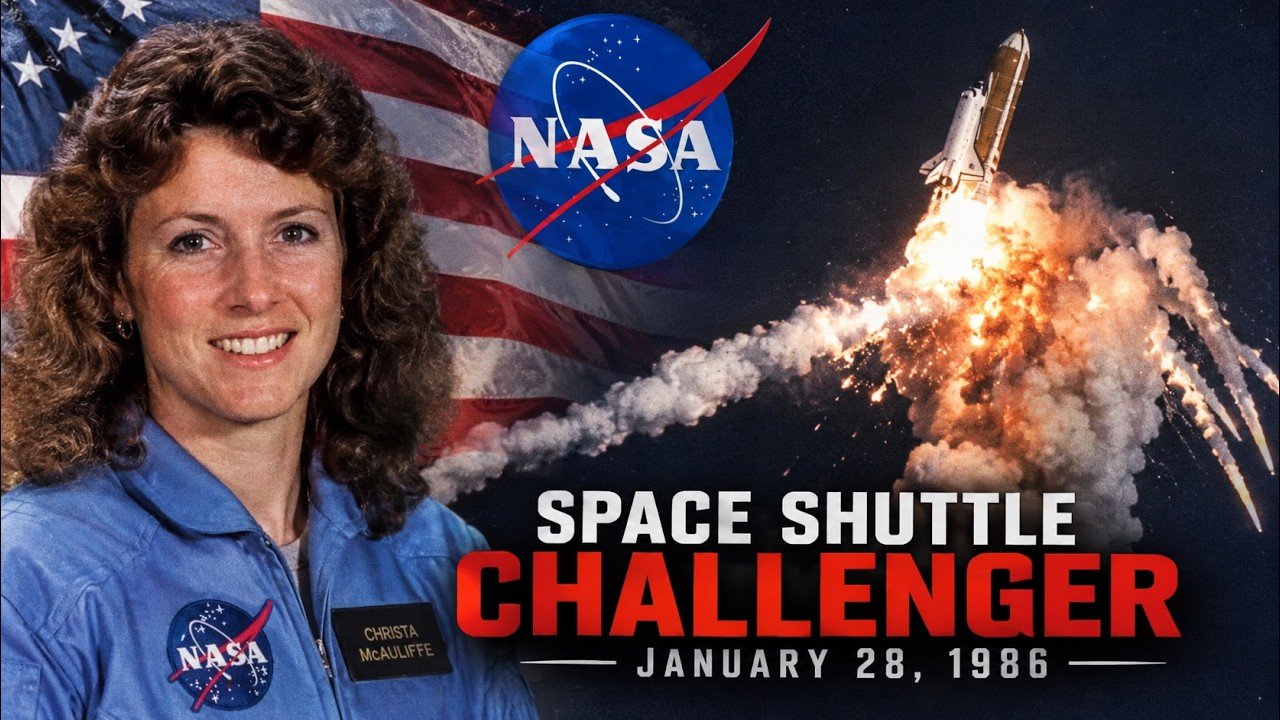
On January 28, 1986, Space Shuttle Challenger broke apart 73 seconds after liftoff on mission 51-L, and all seven crew members died. The video traces the booster joint O-ring flaw, the cold morning, the teleconference the night before in which engineers' concerns were overruled, the Rogers Commission findings and the changes that followed. It relies on official sources including the commission report.
Full written account
Seven people died when Space Shuttle Challenger broke apart 73 seconds after liftoff at 11:38 a.m. Eastern time on January 28, 1986. Among the crew on mission 51-L was Christa McAuliffe, a teacher who was to become the first private citizen to travel into space. Six months earlier, a Morton Thiokol engineer, Roger Boisjoly, had written a memo warning that an unsolved problem would result in "a catastrophe of the highest order with the loss of human life."
The joint flaw
The shuttle's two solid rocket boosters, built by Morton Thiokol in Utah, were made of stacked segments joined at sealed connections called field joints. Inside each joint, two rubber O-rings, a primary and a secondary backup, were meant to stop hot gases escaping. When the booster ignited, the joint flexed slightly and could briefly open a small gap, which the O-rings had to seal in a fraction of a second.
On some flights, engineers found hot gases had eaten into an O-ring and soot had slipped past the primary seal, called blow-by. Because the backup had never failed completely and every shuttle came home, the damage was treated as an acceptable flight risk. Engineers noticed it was worse in cold weather. In January 1985, Discovery launched with an O-ring temperature estimated at about 53° F, the coldest so far, and its boosters showed some of the worst blow-by yet seen.
The night before
The forecast for January 28 was for the low 20s overnight, while NASA's launch rules set a minimum of 31° F. On January 27, a teleconference connected Thiokol with NASA officials at Kennedy Space Center and Marshall Space Flight Center. Thiokol's engineers recommended, for the first time, not launching below an O-ring temperature of 53° F. NASA managers pushed back; George Hardy said he was appalled, and Larry Mulloy asked in effect whether Thiokol wanted NASA to wait until April.
Thiokol asked for a private break of about 30 minutes. According to later testimony, a senior executive told the vice president of engineering to take off his engineering hat and put on his management hat. When the call resumed, Thiokol supported the launch and sent the recommendation by fax. Allan McDonald, who ran Thiokol's booster program at the launch site, refused to sign it. According to the Rogers Commission, the engineers' concerns never reached the senior NASA officials who gave final approval.
Launch morning
Icicles hung from the launch tower. The air temperature was 36° F, and infrared readings later suggested the surface near the right booster's lower joint was around 28. The launch was pushed back about 2 hours. Film later showed puffs of dark gray smoke from the right booster's lower joint less than a second after liftoff. Burned fuel material plugged the gap. At about 37 seconds, Challenger flew through the strongest wind shear of any shuttle flight so far, and the commission concluded the stresses probably broke that seal open.
At 58 seconds a small flame appeared near the joint and grew into a jet of fire aimed at the external tank. At 68 seconds mission control said, "Challenger, go at throttle up," and Commander Scobee answered, "Roger, go at throttle up." At 72 seconds the right booster broke loose and swung into the tank; at 73 seconds the vehicle disappeared in a cloud of fire and vapor. The crew cabin separated largely intact and struck the Atlantic about 2 minutes and 45 seconds after the breakup. The commission could not determine when the crew lost consciousness or died.
The Rogers Commission
President Reagan created the commission within days. Chaired by William Rogers, it included Neil Armstrong, Sally Ride and Richard Feynman. At a televised hearing Feynman clamped a piece of O-ring rubber, dropped it in ice water, and showed it did not spring back. Allan McDonald told the commission about the teleconference; he was demoted and Boisjoly was placed on leave, but McDonald was later put in charge of redesigning the boosters.
In June 1986 the report concluded the accident was caused by a failure in the seal of a joint on the right solid rocket booster, a design flaw too easily affected by the low temperature. It also criticized the decision-making process. Sociologist Diane Vaughan named the pattern the normalization of deviance: each flight that survived with damage came to be seen as evidence the risk was manageable.
What changed
The fleet was grounded for about 32 months. NASA redesigned the joints, adding an extra O-ring and heaters, and the commission made nine recommendations covering boosters, management and safety. The Teacher in Space project ended and civilian passengers stopped flying. Discovery flew again in September 1988. The Columbia Accident Investigation Board later concluded that NASA had not fully learned the lessons of Challenger.
Questions this video answers
What caused the Challenger accident?
The Rogers Commission concluded it was caused by a failure in the seal of a joint on the right solid rocket booster, a design flaw too easily affected by the low temperature on the day of launch.
How long after liftoff did Challenger break apart?
73 seconds after liftoff.
Who was on board?
Dick Scobee, Michael Smith, Ellison Onizuka, Judith Resnik, Ronald McNair, Gregory Jarvis and Christa McAuliffe. All seven died.
What warning was given before the launch?
Thiokol engineers recommended not launching below an O-ring temperature of 53° F, but after a break, Thiokol reversed itself and supported the launch.
How long before shuttles flew again?
About 32 months passed before another shuttle flew; Discovery flew again in September 1988.
Explore related missions
Connected by the topic: Space Shuttle