Space Shuttle Story in a Card Box: Enterprise, Challenger, Columbia
The short version
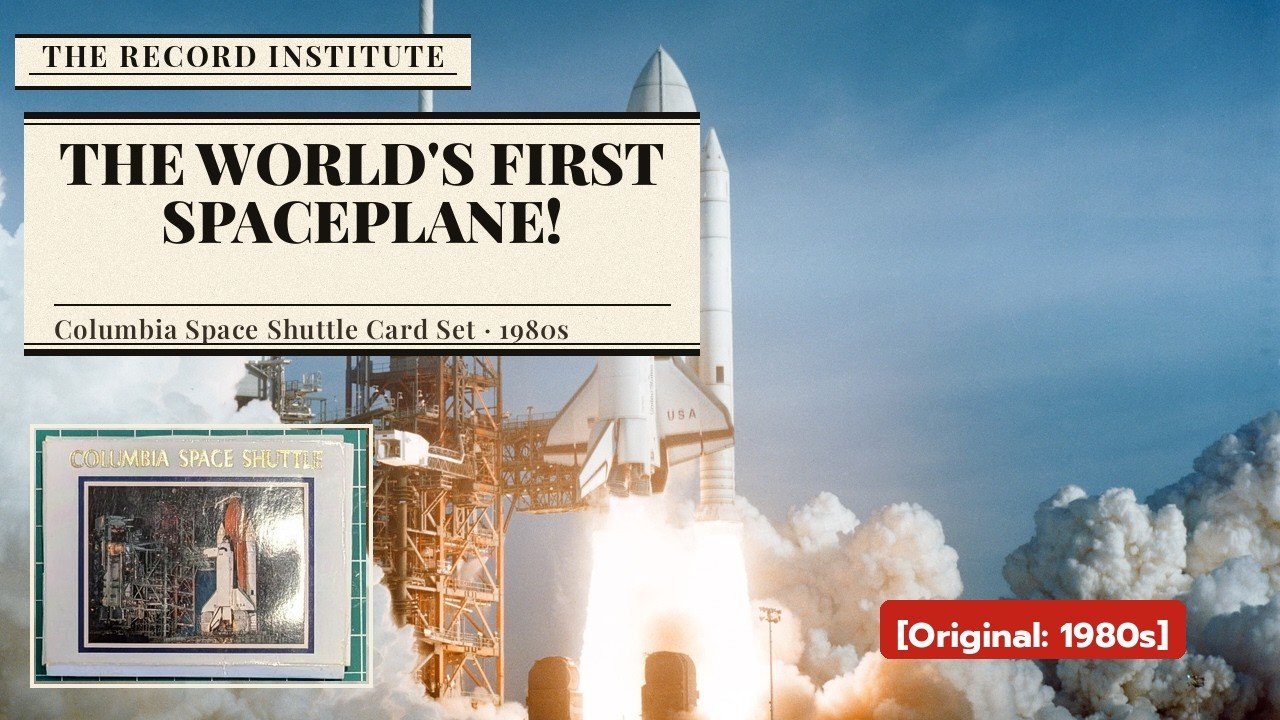
A souvenir box of thirteen NASA photograph cards, labelled "Columbia Space Shuttle", is used to tell the story of the shuttle era. It covers the 1977 Enterprise glide tests, the first Columbia flight on 12 April 1981, the Spacelab flight, and the losses of Challenger on STS-51L in 1986 and Columbia on STS-107 in 2003. The only card with printed words names the Challenger crew.
Full written account
A souvenir box printed in gold with the words "Columbia Space Shuttle" holds thirteen NASA photograph cards from the shuttle era, and the only card carrying printed words names the crew of Challenger. Seven people died on Challenger in 1986 and seven on Columbia in 2003, so one small box ends up touching both losses.
The box and its cards
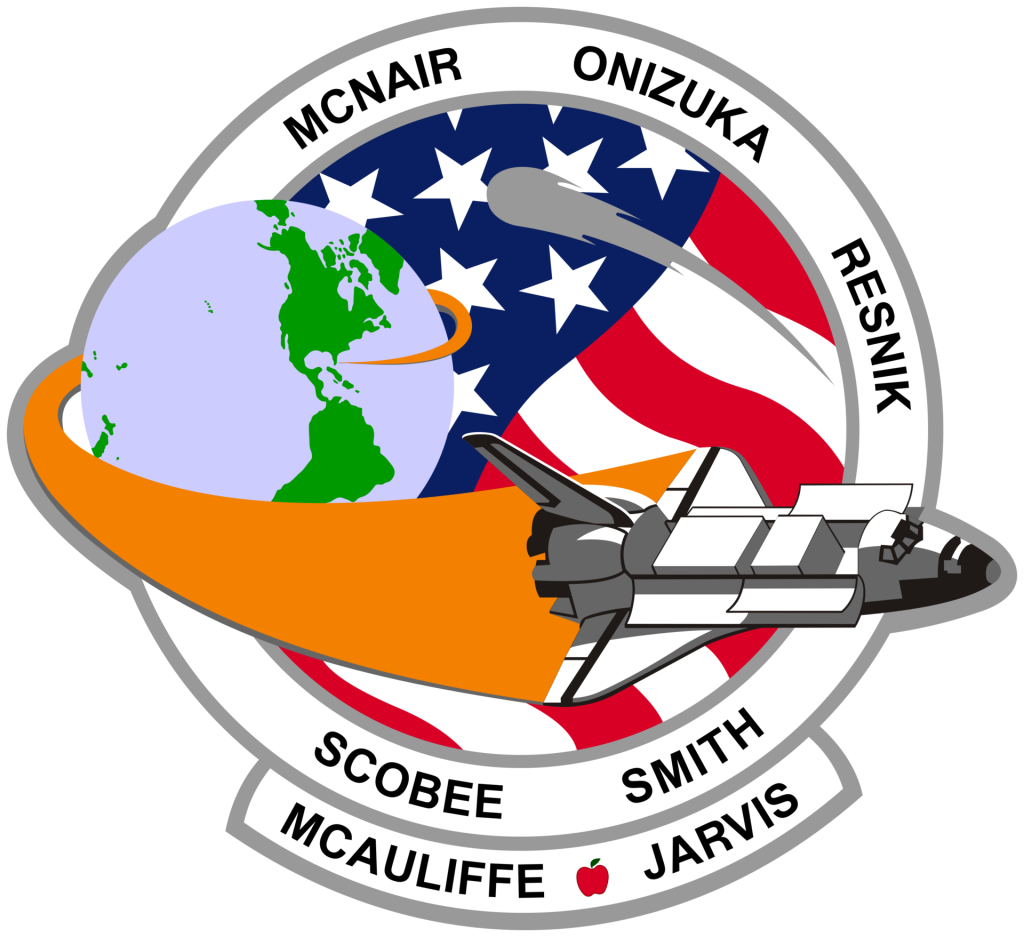
The cards date from 1977 to the late 1980s. Almost none has a caption. The exception is a group portrait of seven crew members in blue flight suits, listing "Onizuka, Smith, McAuliffe, Scobee, Jarvis, McNair, Resnik." The photographs carry clues to their own dates: a white external tank means 1981, an orange one means later, and a tail cone on the orbiter means 1977.
Enterprise, 1977
The oldest card shows a shuttle gliding with a cone over its tail. It is Enterprise, which never went to space. It was released in mid-air from the back of a Boeing 747 to glide and land unpowered. The first glide was on 12 August 1977, with Fred Haise and Gordon Fullerton at the controls. It lasted just over five minutes before a safe landing on a dry lakebed. There were five free-flight tests, and only the first three carried the tail cone. The final glide revealed a flaw in the flight control system, which NASA fixed before sending a real orbiter into space.
STS-1, 1981
Two cards show a launch and the pad at night, with a white external tank. Only the first two shuttle flights had the tank painted white; NASA then stopped painting it to save weight. Columbia lifted off from Florida on 12 April 1981, exactly twenty years after Yuri Gagarin's flight. John Young, who had walked on the Moon on Apollo 16, commanded, and Robert Crippen flew as pilot on his first spaceflight. It was the first time NASA flew a brand-new spacecraft with a crew on its first flight, with no uncrewed test before it. Columbia circled the Earth 36 times in just over two days and glided onto a dry lakebed in California. Post-landing inspection found some heat-shield tiles lost and others damaged by the shock of launch.
A working shuttle
Other cards show Columbia on the back of a modified Boeing 747, needed because shuttles landed in California but launched from Florida. NASA's main carrier aircraft had once been an American Airlines passenger jet, and it was the same aircraft that released Enterprise in 1977. There were 87 ferry flights across the programme. Another card looks into Columbia's payload bay with the Spacelab laboratory, built by the European Space Agency, which first flew in 1983 on a ten-day mission with some seventy experiments. John Young commanded it, flying to space for a record sixth time. The crew of six was the largest to that date and included Ulf Merbold, the first non-American to fly aboard an American spacecraft. A further card shows the belly covered with tens of thousands of heat-shield tiles.
Challenger, 1986
Challenger's STS-51L crew was commander Francis Scobee, pilot Michael Smith, and mission specialists Ellison Onizuka, Judith Resnik, Ronald McNair, Gregory Jarvis, an engineer from Hughes, and Christa McAuliffe, a New Hampshire teacher chosen from thousands of applicants to be the first teacher to teach lessons from space. The mission was also to deploy a communications satellite and observe Halley's comet. Challenger lifted off on 28 January 1986 from pad 39B, the first use of that pad. It was the 25th shuttle flight and ended 73 seconds after launch. The investigating commission concluded that a rubber O-ring seal in a solid rocket booster failed in the extreme cold. The shuttle programme stopped flying for 32 months. The card was printed and sold after that day.
Columbia, 2003
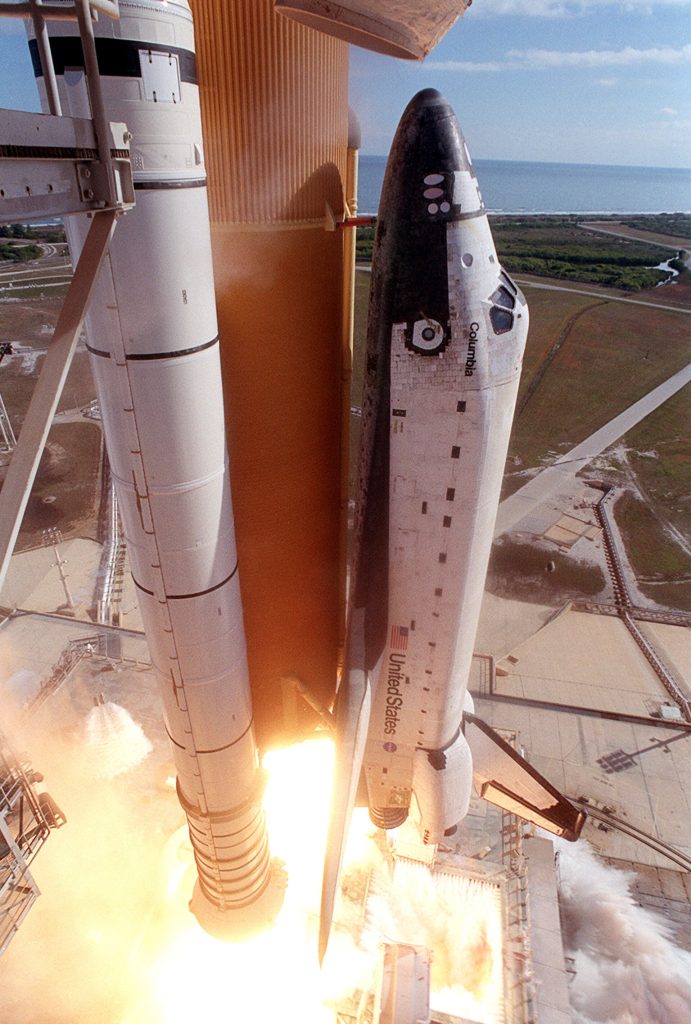
In her lifetime Columbia flew 28 missions, spent 300 days in space and circled the Earth 4,808 times. Her final mission, STS-107, was a sixteen-day science mission that departed on 16 January 2003. During launch a piece of insulating foam broke away from the external tank and struck the leading edge of her left wing; no one could see the damage from the ground. On 1 February 2003, as Columbia re-entered over Texas roughly sixteen minutes before she was due to land, the orbiter broke apart. All seven crew members died: commander Rick Husband, pilot William McCool, and mission specialists Michael Anderson, David Brown, Kalpana Chawla, Laurel Clark and Ilan Ramon, the first astronaut of Israel.
At the Kennedy Space Center, an exhibition called Forever Remembered honours both crews together.
Why the cards exist
NASA's photographs have been public domain from the beginning, so souvenir shops along Florida's Space Coast printed them onto small cards for tourists who came to watch launches. Complete, clean sets are not often found now. It is also reported that in 1990 one shuttle card set gave a share of its profits to help fund the astronauts' memorial at the Kennedy Space Center.
Questions this video answers
What is the card box in the video?
A souvenir box printed "Columbia Space Shuttle" in gold letters, holding thirteen NASA photograph cards from the shuttle era, roughly 1977 to the late 1980s.
Which crew does the only captioned card name?
Challenger's STS-51L crew: Onizuka, Smith, McAuliffe, Scobee, Jarvis, McNair and Resnik.
When did Columbia first fly?
On 12 April 1981, on STS-1, crewed by John Young and Robert Crippen.
How did the Enterprise glide tests go?
The first glide was on 12 August 1977, flown by Fred Haise and Gordon Fullerton, lasting just over five minutes. There were five free-flight tests, and the last revealed a flight control flaw that NASA fixed before an orbiter flew in space.
What happened to Challenger?
It lifted off on 28 January 1986 and the flight ended 73 seconds after launch. The investigating commission concluded that a rubber O-ring seal in a solid rocket booster failed in the extreme cold.
What happened to Columbia on STS-107?
Foam broke off the external tank at launch and struck the leading edge of the left wing. On 1 February 2003 the orbiter broke apart over Texas during re-entry, roughly sixteen minutes before it was due to land.
Explore related missions
Connected by the topic: Space Shuttle