Challenger STS-51L: How Cold O-Rings Led to the 1986 Disaster

The short version
Challenger STS-51L, carrying seven crew including teacher Christa McAuliffe, began to disintegrate 73 seconds after liftoff on January 28, 1986, killing all seven. NASA determined that cold-affected rubber O-rings in the right-hand solid rocket booster joint caused the breach. The Rogers Commission found NASA had at times violated its own safety rules and ignored engineers' warnings, and the shuttle program paused for 32 months.
Full written account
Seven crew members died on January 28, 1986, when the Space Shuttle Challenger began to disintegrate 73 seconds after liftoff from Cape Canaveral, Florida. Among them was Christa McAuliffe, a 37-year-old high school social studies teacher from Concord, New Hampshire, the only school teacher who got the chance to go to space.
The Teacher in Space project
In 1984, President Ronald Reagan announced the Teacher in Space project, a NASA program meant to honor teachers and get students more excited about STEM and space. Around 11,000 teachers applied, and NASA accepted just two: McAuliffe, and Barbara Morgan, an elementary school teacher from Idaho, who would serve as McAuliffe's backup. NASA required McAuliffe to make up lesson plans to present aboard the shuttle.
The mission
STS-51L was the 25th mission of the Space Shuttle program. It was mostly a routine mission meant to launch a satellite, and the crew was also to check out Halley's Comet for 6 days. The commander was Dick Scobee, the pilot Michael J. Smith, the mission specialists Ellison Onizuka, Judith Resnik and Ronald McNair, and the payload specialists Gregory Jarvis and McAuliffe.
Launch day
The morning was cold and icy, and liftoff was delayed because of ice on the launchpad. Around 17% of all Americans were watching live on television. At 11:38 a.m. local time, mission control told Scobee, "Challenger, go with throttle up." Seventy-three seconds after liftoff, at around 46,000 ft (14,000 m), Challenger began to disintegrate and all communication was lost. The shuttle had no escape system.
The fuel tank exploded, but the crew compartment remained intact and reached as high as 12 mi (19 km). It fell back and, less than 3 minutes later, hit the water at approximately 207 mph (333 km/h). All seven crew members died on impact.
Cause and investigation
NASA determined the cause was two rubber O-rings sealing the joint between the two lower parts of the right-hand solid rocket booster. The cold had caused them not to seal properly, and the breach let burning gas reach the external fuel tank.
NASA recovered the remaining fragments of Challenger from the ocean floor, and the crew's remains were flown to Dover Air Force Base in Delaware on April 30 and turned over to their families. The families later helped establish the Challenger Center for Space Science Education.
The Rogers Commission concluded that NASA had at times violated its own safety rules and ignored engineers' warnings about launching in the cold. NASA put the shuttle program on hold for 32 months.
Aftermath
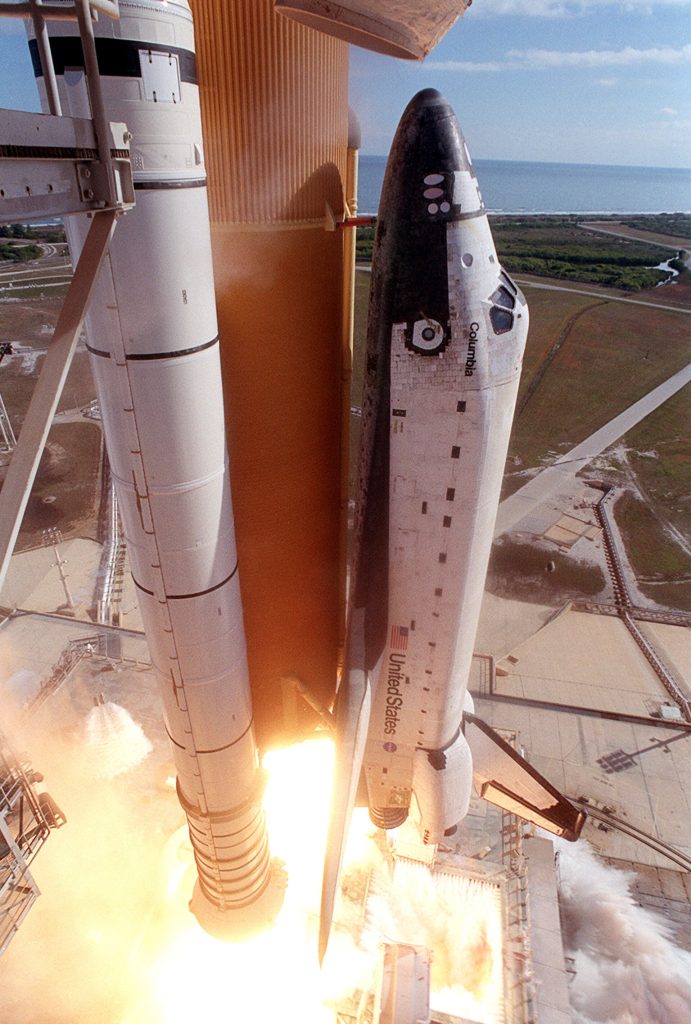
The disaster halted NASA's sending of civilians to space. Seventeen years later, Columbia disintegrated on reentry, also killing all seven crew members aboard.
Questions this video answers
When did the Challenger disaster happen?
January 28, 1986.
How many people died?
All seven crew members died.
How long after liftoff did Challenger break apart?
Challenger began to disintegrate 73 seconds after liftoff, at around 46,000 ft (14,000 m).
What caused the disaster?
NASA determined the cause was two rubber O-rings that sealed a joint in the right-hand solid rocket booster; the cold had caused them not to seal properly.
How long was the shuttle program paused?
NASA put the space shuttle program on hold for 32 months.
What did the Rogers Commission conclude?
The Rogers Commission concluded NASA had at times violated its own safety rules and ignored engineers' warnings about launching in the cold.
Explore related missions
Connected by the topic: Space Shuttle