Challenger: How Thiokol’s Engineers Were Overruled the Night Before
The short version
A documentary on the Challenger launch decision of 28 January 1986, which ended with the breakup of the vehicle 73 seconds after liftoff and the deaths of all seven on board. It follows Roger Boisjoly's July 1985 memo, the 27 January teleconference and the managers' vote that excluded the engineers, citing the Presidential Commission. It then compares the organisational causes with the loss of Columbia 17 years later.
Full written account
On 28 January 1986, with ice on the launch tower at Cape Canaveral and the overnight temperature down to 18° Fahrenheit, Challenger lifted off at 11:38. It broke apart 73 seconds later, and all seven people on board were killed. The seals in its rocket boosters had never flown colder than 53°, and the engineers who designed those boosters had told NASA the night before not to launch.
The mechanical cause
Each of Challenger's two solid rocket boosters was built in segments, joined at field joints and sealed with rubber O-rings. In the cold, the rings in the right booster's aft joint lost their flexibility and failed to seal. Launch film shows puffs of black smoke from that joint less than a second after ignition. About 59 seconds into the flight a flame appeared there, hot gas burned through and reached the external tank, and the vehicle broke apart.
The warnings
NASA's own engineers at Marshall had flagged problems with this joint design as early as the late 1970s. In July 1985 Morton Thiokol seal engineer Roger Boisjoly wrote to his vice president of engineering, Bob Lund, that rings on earlier flights had shown erosion and that on one joint the primary seal had never sealed at all. He wrote that a failure would be a catastrophe of the highest order, with loss of human life. Thiokol set up a team to work on the seal, but the joint was never fixed and the shuttle kept flying.
NASA had scheduled a record 15 shuttle flights for 1986, and this one had already been delayed several times. The forecast for launch morning, issued on 27 January, was well below freezing. The coldest launch so far, a year earlier, had produced some of the worst seal damage on record.
The teleconference
At 8:45 that evening Thiokol's engineers joined a teleconference with NASA managers at Marshall Space Flight Center in Alabama and Kennedy Space Center in Florida. Their recommendation was not to launch below 53°. NASA managers pushed back on the data and on adding a new launch rule the night before a flight. Boisjoly later testified that the usual rule had been turned upside down: instead of proving it was safe to fly, the engineers were being asked to prove it was not. Their data was thin and incomplete. They could not prove the cold would cause a failure, but nothing in it showed the joint was safe below freezing.
Marshall's booster project manager, Lawrence Mulloy, was quoted at the commission's hearings: "My God, Thiokol, when do you want me to launch? Next April."
Thiokol asked to go off the line. The caucus lasted about 30 minutes, with Boisjoly and his colleague Arnie Thompson continuing to argue against launching. The decision then went to four senior managers without the engineers. According to the commission, senior vice president Gerald Mason asked Lund to take off his engineering hat and put on his management hat. Lund changed his vote.
Around 11:00 Thiokol came back on the line and recommended launch, then sent it in writing. At Kennedy, Thiokol's senior representative, Allan McDonald, refused to sign it; another Thiokol manager did. The commission later found that Thiokol's managers reversed their position to accommodate a major customer, and that the people at the top who gave the final go were never told of the engineers' objections.
Groupthink and the commission
The documentary offers groupthink, a term from psychologist Irving Janis in 1972, as an interpretation rather than a finding of the commission. Several of its warning signs are visible in the record: pressure on dissenters, a false sense of safety because earlier erosion was treated as acceptable, an illusion of unanimity in a vote that excluded the engineers, and warnings that never reached the top. Sociologist Diane Vaughan described the normalization of deviance: nobody had to break the rules, because the rules had slowly learned to accept the danger.
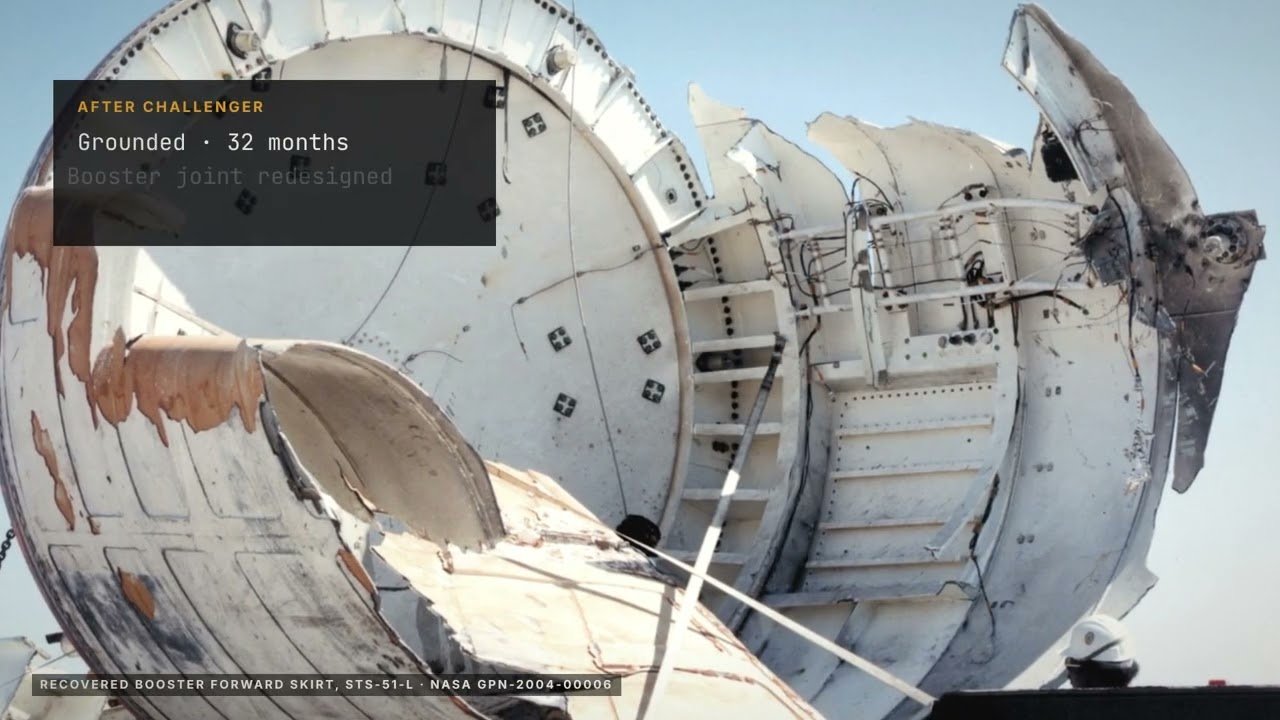
President Reagan appointed a commission led by William Rogers. At a public hearing physicist Richard Feynman dropped O-ring rubber into ice water and showed it no longer sprang back. The commission concluded that the decision to launch was flawed. The shuttle did not fly again for 32 months; the joint was redesigned and NASA set up a new independent safety office. Boisjoly testified, was shunned by many colleagues, left the company and spent years teaching engineers about ethics. He died in 2012.
The crew were Dick Scobee, Michael Smith, Judith Resnik, Ellison Onizuka, Ronald McNair, Gregory Jarvis, and Christa McAuliffe, a high school teacher from New Hampshire.
Columbia
Questions this video answers
What was the temperature on launch morning?
Overnight the temperature had fallen to 18 degrees Fahrenheit, and the booster seals had never flown colder than 53.
What did Thiokol's engineers recommend?
They recommended not launching below 53 degrees.
Who made the final recommendation at Thiokol?
The decision went to four senior managers without the engineers. Senior vice president Gerald Mason asked Bob Lund to take off his engineering hat and put on his management hat, and Lund changed his vote.
What did the commission find?
It found that Thiokol's managers reversed their position to accommodate a major customer, that those giving the final go were not told of the engineers' objections, and that the decision to launch was flawed.
How long did the shuttle stay grounded?
The shuttle did not fly again for 32 months.
Explore related missions
Connected by the topic: Space Shuttle