Challenger STS-51-L: The O-Ring Warning and the 73-Second Flight

The short version
Space Shuttle Challenger, on mission 51-L, lifted off at 11:38 a.m. on January 28, 1986 and broke apart 73 seconds later, killing all seven crew. The night before, Morton Thiokol engineers had recommended no launch below 53°, but their managers overruled them. A presidential commission found the cause was a failed seal in the right booster's aft joint and a flawed decision process at NASA.
Full written account
Seven crew members died when Space Shuttle Challenger broke apart 73 seconds after liftoff on January 28, 1986. The night before, engineers at Morton Thiokol, the company that built the solid rocket boosters, had warned NASA that it was too cold to launch. At launch time it was 36°, 15° colder than on any earlier shuttle flight.
Why was the cold a problem?
Each solid rocket booster was built in segments sealed at the joints by rubber O-rings. The engineers knew the rings stiffened in the cold. On earlier flights hot gas had already eaten into them, and a launch at 53° a year before had produced the worst damage yet. Engineer Roger Boisjoly had warned in a memo that a failure could bring a catastrophe of the highest order, loss of human life.
The teleconference
Mission 51-L was Challenger's 10th flight, and the launch had already slipped six times. After a scrub on January 27, the forecast warned of overnight temperatures in the low 20s. In a teleconference with NASA, Thiokol recommended no launch below 53°. NASA managers pushed back, and one asked when Thiokol wanted them to launch next April. Thiokol's managers went offline, where one told a colleague to take off his engineering hat and put on his management hat. They overruled their own engineers and recommended launch. Alan McDonald, Thiokol's man at the Cape, refused to sign the approval.
Overnight the temperature fell to 18°, and icicles hung from the launch tower by morning.
The flight
The crew was commander Dick Scobee, pilot Michael Smith, mission specialists Judith Resnik, Ellison Onizuka and Ronald McNair, payload specialist Gregory Jarvis, and Christa McAuliffe, a New Hampshire social studies teacher picked from more than 11,000 applicants for NASA's Teacher in Space program. She planned two lessons from orbit.
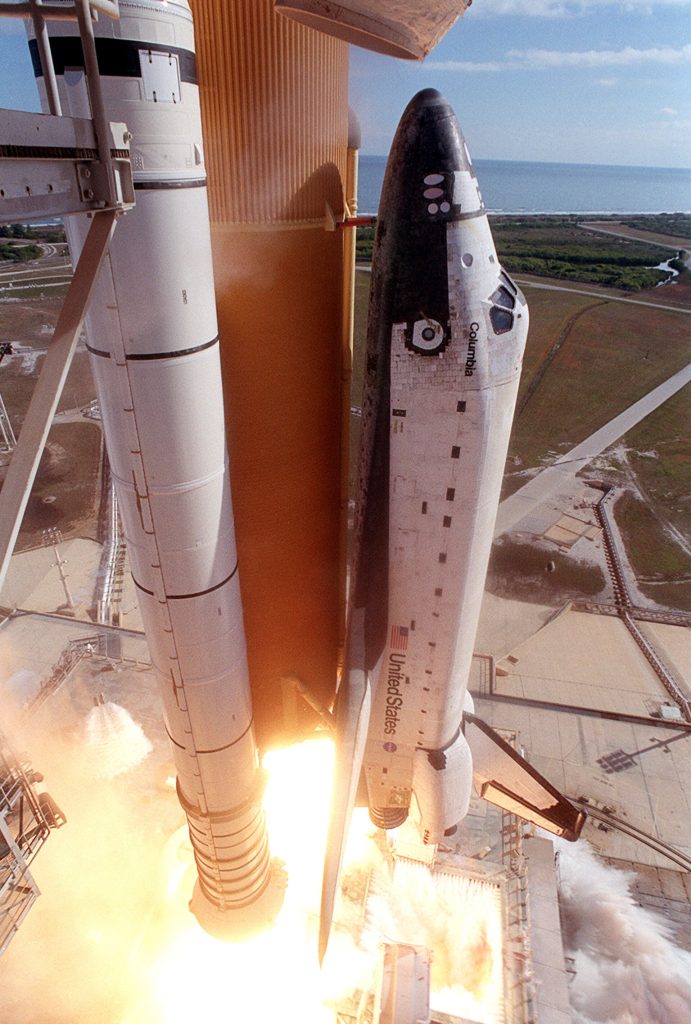
At 11:38 a.m. the engines roared and the boosters ignited. Just over half a second after ignition, black smoke spurted from a joint on the right booster, where the cold O-rings had failed to seal. Burned aluminum briefly plugged the gap. Mission control saw nothing wrong as the shuttle throttled down through high winds and back up. At 58 seconds a flame appeared at the leaking joint and played across the external fuel tank. At 68 seconds mission control radioed "go at throttle up", and Scobee acknowledged; these were the last words heard from the crew. At 73 seconds the fuel tank came apart, 9 miles above the Atlantic. The range safety officer destroyed the out-of-control boosters.
The crew cabin survived the breakup, and some of the crew likely lived until it struck the sea at more than 200 mph nearly 3 minutes later.
Investigation and return to flight
Navy ships and submarines searched the seabed for months in one of the largest salvage operations in history. A presidential commission led by William Rogers investigated. Physicist Richard Feynman dropped a piece of O-ring rubber into ice water and showed it lost its springiness. The commission found the cause was the failed seal in the right booster's aft joint and a flawed decision process at NASA.
The shuttle stayed grounded for 32 months. The booster joints were redesigned with a third O-ring and heaters, and Discovery returned to flight in September 1988.
Questions this video answers
When did Challenger launch and when did it break apart?
It launched at 11:38 a.m. on January 28, 1986, and the fuel tank came apart 73 seconds later.
How many people died?
All seven crew members died.
What warning was given before launch?
Morton Thiokol engineers warned that the rubber O-rings in the booster joints stiffened in the cold and recommended no launch below 53°.
What did the Rogers Commission find?
The cause was the failed seal in the right booster's aft joint and a flawed decision process at NASA.
How long was the shuttle fleet grounded?
The shuttle stayed grounded for 32 months; Discovery returned to flight in September 1988.
Explore related missions
Connected by the topic: Space Shuttle