Challenger STS-51-L: The Seals, the Cold and 73 Seconds
The short version
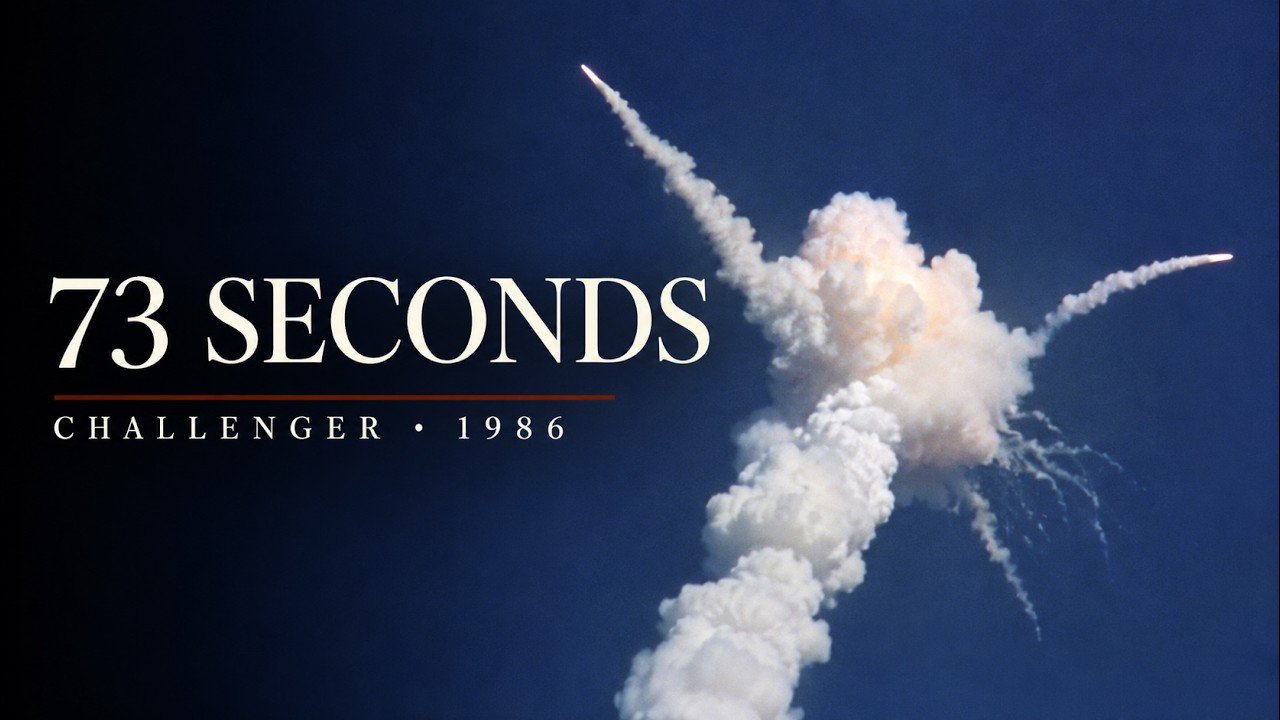
A documentary on the Challenger mission 51-L, which lifted off at 11:38 on 28 January 1986 and broke apart 73 seconds later. It profiles the seven crew members, the engineers' warnings about the booster seals in the cold, the launch as recorded in NASA's own footage and audio, and the commission's findings. It ends with the return to flight in September 1988.
Full written account
All seven crew members died when the space shuttle Challenger broke apart 73 seconds after liftoff at 11:38 on 28 January 1986. Among them was Christa McAuliffe, a New Hampshire teacher chosen to be the first teacher in space. The mission, 51-L, was Challenger's tenth flight. The warning had been written down six months earlier by a Thiokol engineer, Roger Boisjoly, who told his managers that a failure of the booster seals would be a "catastrophe of the highest order, loss of human life."
The crew and the mission
The crew was Francis R. Scobee, Michael J. Smith, Judith A. Resnik, Ellison S. Onizuka, Ronald E. McNair, Gregory B. Jarvis and Christa McAuliffe. Four had already flown in space. Scobee, the commander, had piloted Challenger in April 1984 on a mission to capture and repair a satellite. Smith, the pilot, had been selected by NASA in 1980 and was still waiting for his first flight. Resnik had flown on Discovery's first voyage in 1984, and Onizuka had flown a classified military mission in January 1985. McNair had played his saxophone in orbit in 1984 and planned to record a solo for the French composer Jean-Michel Jarre.
Jarvis was a Hughes Aircraft satellite engineer whose seat had twice been given to someone else, first to a senator and then to a congressman. Challenger was his third assignment. More than 11,000 teachers had applied for the teacher-in-space role that McAuliffe won. The crew was to release a satellite and study Halley's Comet, and McAuliffe planned to teach two lessons from orbit.
The launch delays
The launch, planned for 22 January, slipped repeatedly. On 27 January the crew was strapped in, but a problem with a hatch handle and strong winds at the emergency landing runway ended the attempt. That night the temperature began to fall.
The night before
NASA's launch managers expected clear skies and temperatures in the low 20s Fahrenheit for about 11 hours. They discussed water drains, safety showers and heaters, but no one raised the booster seals.
Each booster was built in four segments. Each joint was sealed by two rubber rings, barely a quarter of an inch thick, which had to spring back after the joint flexed at ignition. Cold rubber is stiff and slow to spring back. Every flight with seals estimated at 63° or colder had come back with signs of heat damage. In January 1985, Discovery flew with seals estimated at 53°, and hot gas got past a primary ring for the first time.
At about a quarter to nine that evening, Thiokol's vice president of engineering, Bob Lund, recommended against launching unless the seals were at least 53 degrees. NASA's Lawrence Mulloy challenged the data and the new temperature rule, saying that with it "they might not launch until April." George Hardy said he was appalled but would not launch against the contractor's advice. A requested five-minute break lasted half an hour. Thiokol's senior manager, Jerry Mason, asked Lund to take off his engineering hat and put on his management hat. Four Thiokol managers made the final recommendation, and the engineers were not asked.
At about 11:00 Thiokol came back on the line, called the data inconclusive and recommended launch. No one on the line disagreed, and a signed recommendation was faxed to Florida just before midnight. Allan McDonald, Thiokol's representative at the Cape, kept arguing for delay, but none of it reached the officials at the top of the launch decision.
Morning of the launch
Overnight water left trickling in the pad's lines froze, and at half past 1:00 an ice team found icicles across more than 100 feet of the tower. Their handheld instrument later read about 25° on the surface of the left booster and about 8° near the base of the right. There was no rule for booster temperatures, and the readings were not reported. Rockwell said it could not assure that it was safe to fly, but NASA judged that the ice would fall clear and held the launch to let it melt. By late morning the air at the pad was 36°, still 15° colder than any previous shuttle launch. Parts of the booster joints were later calculated to have been as cold as 28°.
The flight
Questions this video answers
When did Challenger launch and how long did the flight last?
Challenger lifted off at 11:38 on 28 January 1986 and broke apart 73 seconds later.
Who was on board?
Francis R. Scobee, Michael J. Smith, Judith A. Resnik, Ellison S. Onizuka, Ronald E. McNair, Gregory B. Jarvis and S. Christa McAuliffe. All seven died.
What caused the accident?
The commission's report said the joint failed because of a faulty design and that the decision to launch had been flawed. The failed joint was in the right solid rocket booster.
What did engineers warn about before launch?
Roger Boisjoly had warned in writing that the booster seals could fail. On the eve of launch, Thiokol's engineers first recommended against launching unless the seals were at least 53 degrees.
Was the crew told about the booster concerns?
No. The weather briefing that morning discussed the cold and ice, but the concerns about the boosters were not discussed and no one told the crew.
When did the shuttle fly again?
Discovery lifted off from the same launch pad on 29 September 1988, after almost three years on the ground.
Explore related missions
Connected by the topic: Space Shuttle