Columbia STS-107: How a Foam Strike Led to Breakup on Re-entry
The short version
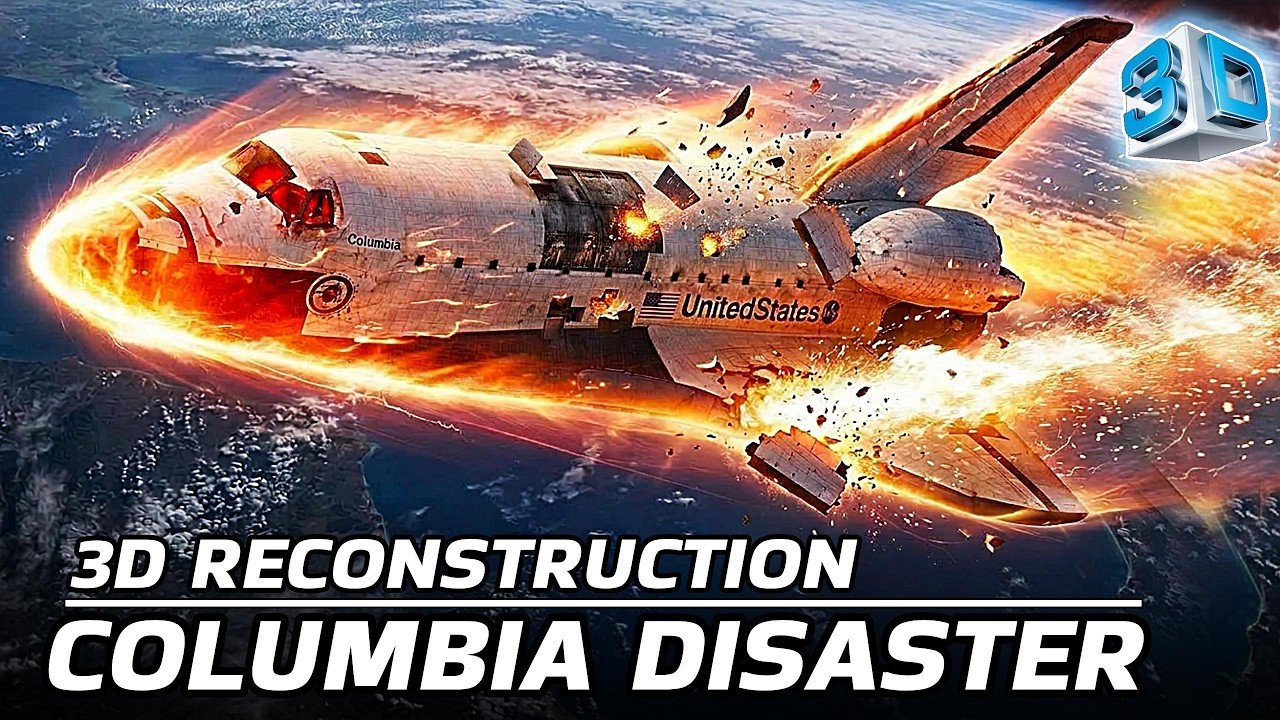
Space Shuttle Columbia launched on January 16, 2003 from Kennedy Space Center on the 17-day STS-107 science mission. A piece of insulating foam struck the left wing's reinforced carbon leading edge 81 seconds after liftoff. On February 1, 2003 the orbiter broke apart during re-entry, killing all seven crew members. The video presents a 3D reconstruction and analysis of the sequence, and the investigation's conclusions about risk normalization and communication.
Full written account
Columbia broke apart during re-entry on February 1, 2003, killing all seven crew members of STS-107. The origin of the failure traces back to launch, when a piece of insulating foam broke off the external tank 81 seconds into flight. The foam was not particularly heavy, but the orbiter effectively ran into the fragment at an estimated 600 to 800 feet per second.
A strike on the left wing
Columbia launched on January 16, 2003 from Kennedy Space Center for a 17-day scientific mission. The crew were commander Rick Husband, pilot William McCool, payload commander Michael Anderson, biologist Laurel Clark, scientist David Brown, flight engineer Kalpana Chawla and payload specialist Ilan Ramon.
The foam hit the leading edge of the left wing. That area is not covered by standard thermal tiles but by reinforced carbon panels, known as RCC, which were designed to withstand extreme re-entry temperatures but not high-energy impacts. Launch cameras captured the strike, but their resolution and the initial analysis made it hard to judge how severe it was.
A risk treated as normal
Foam strikes were not uncommon at NASA and had occurred on multiple earlier missions without catastrophic consequences, which led to what the video calls a dangerous normalization of risk. In orbit, Columbia operated normally and the crew carried out experiments without detecting structural anomalies.
On the ground, some engineers raised concerns. A request was made for high-resolution imagery of the left wing using Department of Defense assets, but mission leadership ultimately denied it. The impact had created a breach in one RCC panel, in the area of panel eight on the left wing. The shuttle's thermal protection system lacked redundancy there, with no secondary protective barrier.
Re-entry
The deorbit maneuver was carried out normally. Columbia entered the atmosphere at over Mach 20, with external temperatures that could surpass 1,500°C. Air compressed ahead of the vehicle turned into superheated plasma, which entered through the breach in the damaged panel.
Sensors on the left wing began to register abnormal temperatures. The heat eroded the wing's aluminum internal structure and weakened the main wing spar, and the problem became structural rather than thermal. The flight control system compensated for the resulting imbalance with the elevons and the reaction control system, and for several minutes the vehicle stayed within acceptable parameters.
The plasma also destroyed internal components, including hydraulic lines needed to move the control surfaces. Telemetry showed a cascade of failures: sensors that stopped transmitting, inconsistent readings and loss of hydraulic pressure. Ground observers noticed debris shedding from the vehicle. Eventually the control system no longer had enough authority to correct the flight path, and Columbia entered an uncontrolled rotation as aerodynamic loads far exceeded the structural limits of what remained. The loss of signal occurred at 8:59, approximately 16 minutes before the planned landing sequence.
What the investigation concluded
The subsequent investigation concluded that the agency had developed a tendency to treat foam impacts as an acceptable risk, based on earlier incidents without serious consequences. Engineers who raised concerns were unable to have their warnings properly escalated through the decision-making chain. There was also pressure to maintain the mission schedule, as the shuttle program operated under budget constraints and demanding operational requirements, particularly those related to construction of the International Space Station.
Questions this video answers
When did Columbia STS-107 launch and from where?
It launched on January 16, 2003 from Kennedy Space Center on a 17-day scientific mission.
Who was on board?
Rick Husband, William McCool, Michael Anderson, Laurel Clark, David Brown, Kalpana Chawla and Ilan Ramon. All seven died.
What damaged the shuttle?
At 81 seconds into flight a piece of insulating foam broke off the external tank and struck the leading edge of the left wing, which was protected by reinforced carbon (RCC) panels.
What happened during re-entry?
Superheated plasma entered a breach in the damaged RCC panel, weakened the wing structure and hydraulic lines, and the vehicle went into uncontrolled rotation and broke up.
When was the signal lost?
At 8:59, approximately 16 minutes before the planned landing sequence.
What did the investigation conclude?
It concluded the agency had a tendency to treat foam impacts as an acceptable risk, that engineers' warnings were not properly escalated, and that there was pressure to maintain the schedule.
Explore related missions
Connected by the topic: Space Shuttle