Columbia STS-107: How a Foam Strike Led to the Breakup
The short version
A NOVA documentary on the loss of Space Shuttle Columbia, which broke apart over Texas on re-entry in 2003 and killed all seven crew. It traces the shuttle's design compromises, the foam strike 81 seconds after launch, the decisions of mission managers, the investigation board's foam-gun test and the changes that followed.
Full written account
Space Shuttle Columbia broke apart over Texas on February 1, 2003, during re-entry at the end of mission STS-107, killing all seven crew members. The mission had launched from Cape Canaveral on January 16, 2003. Eighty-one seconds after liftoff, a piece of foam insulation had come off the external tank and hit the orbiter's left wing. Engineers saw the impact on film on the second day of the flight, and mission managers decided it did not pose a safety problem.
The crew and the shuttle
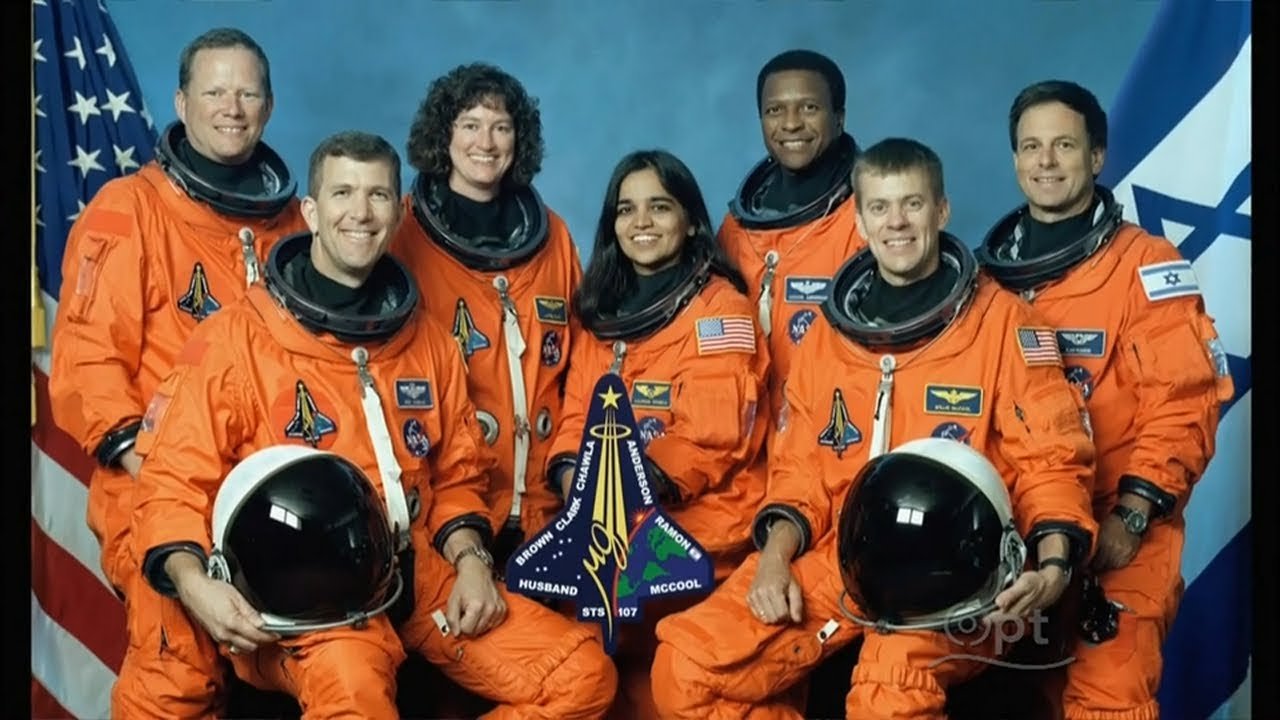
The commander was Rick Husband, who had flown one previous mission. Pilot Willie McCool, mission specialists Dave Brown and Ilan Ramon (the first Israeli in space), payload commander Michael Anderson, flight engineer Kalpana Chawla and Navy officer Dr. Laurel Clark completed the crew. Columbia was the oldest shuttle in the fleet and the only one not designed to dock with the International Space Station. Eight minutes after launch it was in orbit, on a mission dedicated to science.
The shuttle had been shaped by compromise. After Apollo, NASA's plans for large space stations were cut back, and the shuttle had to justify itself as a cost-effective vehicle for military and scientific satellites as well as people. Contributors describe conflicting design requirements. They also say the shuttle needed months of refitting between flights, and that per-flight costs ran from half a billion to over a billion dollars. The Challenger accident in 1986 was blamed on a cold-weather O-ring failure, and the board that investigated it learned that engineers who objected to the launch had been ignored.
A familiar problem
Foam was a known issue. On the first shuttle flight in 1981, engineers noticed hundreds of fragments hitting the underside of the orbiter, and found about 50 gouges. Over time, as shuttles kept landing safely, the concern faded. One contributor says that when you see something abnormal often enough, you begin to think it is normal. Three months before Columbia's launch, foam had gouged a crater in a booster rocket on Atlantis, missing an electronics box by inches. NASA ordered an investigation, but it was delayed, and Columbia's launch did not wait.
Decisions during the flight
Rodney Rocha, division chief engineer for the Columbia flight, wanted additional images to check for damage. He asked for outside agency help, writing that the engineers were highly uncertain and that some possibilities were very bad. On the fifth day, the debris assessment team made an initial estimate that the foam fragment was several hundred times larger than average. Nobody knew where it had hit: the carbon panels at the front of the wing, the tiles underneath or the landing gear door.
On the eighth day, the crew was told of the strike in a routine email saying there was "absolutely no concern for entry." Rocha's requests for images were denied. At the mission management meeting on day nine, managers concluded they saw no safety-of-flight issue. The investigation later did simple arithmetic: with a transit time of about 0.16 seconds, the foam would have struck with roughly three thousand pounds of force. NASA management had compared it to a styrofoam cooler hitting a windshield.
Re-entry
Families and reporters gathered at the Kennedy Space Center landing strip on February 1. Less than a minute after Columbia crossed the California coast, a flight controller reported losing four temperature transducers on the left side of the vehicle within four or five seconds of each other. Left tire pressure messages followed, and these were the last message Columbia transmitted. Mission control then lost communication, and the tracking station did not pick up the orbiter when expected. Flight director Leroy Cain asked the controllers to lock the doors and secure all data.
Superheated gas had penetrated the left wing through the hole made by the foam and slowly began to destroy the vessel from the inside. The autopilot fired thrusters to compensate for drag on the damaged wing, but Columbia broke apart over Texas, 16 minutes before it was expected to land in Florida.
Investigation
The Columbia Accident Investigation Board was headed by retired Navy admiral Hal Gehman, with Scott Hubbard as the NASA representative. About 20,000 people searched for debris spread over an area 200 miles long and about 10 miles wide, from west Louisiana to Dallas. Only about 40 percent of the orbiter was recovered, but the condition and location of pieces led investigators to the wing hit by foam.
To settle the question, the board built a life-size model of the wing and fired foam at it at different speeds and angles. The test, held in San Antonio, produced a giant hole in the wing leading edge. Some NASA engineers had expected the foam to bounce off. A tape from the camera Laurel Clark used during re-entry was found beside a Texas road, and shows the crew on the flight deck before it ends.
The board found that a rescue scenario, in which Atlantis would be launched and the astronauts transferred one at a time, had low odds of success but might have worked. It criticized what it called NASA's broken safety culture, saying management operated outside the rules while holding engineers to a stifling protocol. Its report also asked why NASA was flying humans at all, and a contributor believes this led to the Vision for Space Exploration announced by President Bush in January 2004, which mandated the shuttle's retirement. The shuttle returned to flight on July 26, 2005, with STS-114 aboard Discovery.
Questions this video answers
When did Columbia STS-107 launch?
On January 16, 2003, from Cape Canaveral.
How many people died?
All seven crew members died when Columbia broke apart over Texas during re-entry.
What hit Columbia's wing?
A large piece of foam insulation broke off the external tank 81 seconds after liftoff and struck the orbiter's left wing.
How big was the foam?
It was described as probably the size of a small briefcase and probably weighing about two pounds.
How was the foam theory tested?
The investigation board built a life-size model of the wing and fired foam at it; the impact made a giant hole in the wing leading edge.
How much of the orbiter was recovered?
Only about 40 percent, spread over an area about 200 miles long and 10 miles wide.
When did the shuttle fly again?
On July 26, 2005, with STS-114 aboard Discovery, commanded by Eileen Collins.
Explore related missions
Connected by the topic: Space Shuttle