Columbia’s Last Mission: Foam Strike to Breakup Over Texas
The short version
Space Shuttle Columbia launched from Kennedy Space Center on January 16, 2003. At 81.7 seconds after liftoff a piece of insulating foam from the External Tank struck the leading edge of the left wing. Engineers reviewed the footage during the mission and concluded there was 'no concern' for the heat shield. On February 1, during re-entry, telemetry from the left wing began to fail and Columbia broke apart over Texas, killing all seven crew members.
Full written account
Space Shuttle Columbia broke apart over Texas on February 1, 2003, during re-entry after 16 days in orbit, killing all seven crew members. The sequence began at launch on January 16, when a piece of insulating foam broke from the External Tank 81.7 seconds after liftoff and struck the leading edge of the left wing.
The launch and the foam strike
The crew went to Launch Complex 39-A at Kennedy Space Center on the morning of January 16. Rick Husband was commander, William McCool pilot, Michael Anderson payload commander, and Kalpana Chawla, David Brown and Laurel Clark were mission specialists. Ilan Ramon was payload specialist and the first astronaut from Israel. Columbia lifted off at 10:39 a.m.
Fifty-seven seconds into flight the shuttle met a wind shear, and liquid oxygen sloshing in the External Tank caused an oscillation. Three seconds later the shuttle tilted slightly, putting extra stress on the forward bipod, the structural link between the orbiter and the tank. All measurements stayed within limits.
At 81.7 seconds, foam broke from the left bipod. The main fragment was estimated at 21 to 27 inches long and 12 to 18 inches wide, and two smaller pieces followed. It hit the reinforced carbon panels of the left wing's leading edge at over 400 miles per hour. Tracking cameras recorded it, but its significance was not immediately clear, and Columbia reached orbit at 11:39 a.m.
What engineers decided
On Flight Day 8, January 23, engineers went back to the launch footage and studied the moment 81 seconds after liftoff frame by frame. The impact was clear to them. Foam shedding had been seen on earlier missions without significant problems, and that history shaped how they read the footage.
Mission Control emailed Husband and McCool the video and a formal assessment. It confirmed that foam had struck the orbiter and, based on past missions, said there was 'no concern' for damage to the heat shield. The crew watched the footage and accepted the explanation.
On Flight Day 13, January 28, the crew held a moment of silence for those lost in the Apollo 1 fire and the Challenger disaster.
Re-entry
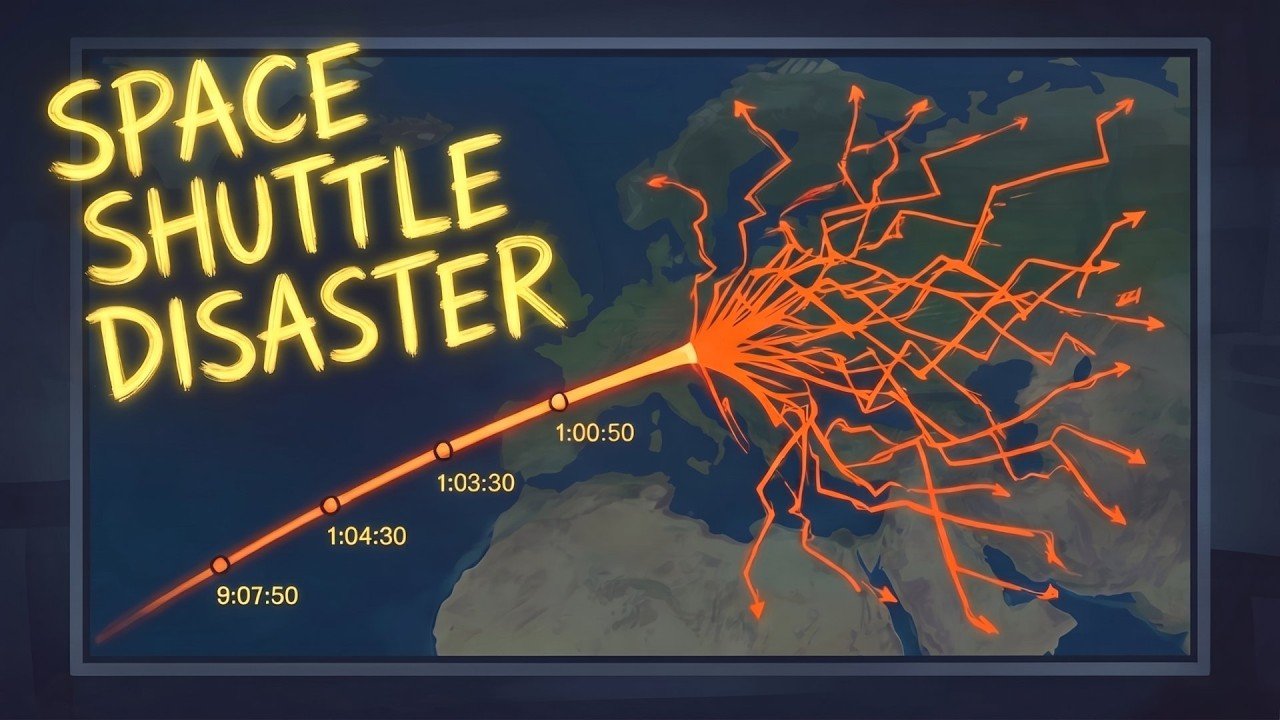
At 8:15:30 a.m. on February 1, Columbia fired its orbital maneuvering system engines for the deorbit burn. At 8:44:09 a.m. it crossed Entry Interface at 400,000 feet above the Pacific Ocean. Some 270 seconds later, a sensor in the left wing's leading edge recorded higher strain than on past flights. That reading came from the Modular Auxiliary Data System, which is meant for post-flight analysis and is not transmitted to the ground, so neither the crew nor Mission Control saw it.
At 577 seconds, observers on the ground saw five bursts of light from the shuttle's streak across the sky. Aboard, no alarms sounded.
At 613 seconds, the Maintenance, Mechanical, and Crew Systems (MMACS) officer told the flight director that four hydraulic sensor readings in the left wing were 'off-scale low.' At 727 seconds, temperatures rose in the left wheel well along the hydraulic lines. Two sensors monitoring left main landing gear tire pressure first trended upward, then dropped off-scale low. At 834 seconds the orbiter rolled sharply and unplanned, and shortly afterward pressure readings from both left main gear tires disappeared from telemetry.
The loss of Columbia
At 8:59:32 a.m., Husband answered Mission Control: 'Roger, ah, bu–.' The transmission cut off mid-sentence, and it was the last communication received from the crew. At 927 seconds a Reaction Control System jet began firing continuously to correct the shuttle's orientation. Superheated plasma had burned through all four hydraulic lines in the left wheel well, and the orbiter began to pitch upward.
At 9:00:18 a.m. the orbiter began to break apart. Mission Control recorded it as 'Vehicle Main Body Breakup,' and all data stopped. About 1,000 seconds into re-entry the crew module, with the pressurized compartment and outer forebody, separated from the rest of the orbiter. At 9:00:53 a.m. the crew module catastrophically depressurized. Columbia had completed 27 previous missions.
At 9:16 a.m., the time set for landing, Entry Flight Director LeRoy Cain gave the call 'Lock the doors.' A spaceflight contingency was declared and the Recovery Control Center at Kennedy Space Center was activated. Debris fell across parts of Texas and Louisiana, scattered over hundreds of miles.
Aftermath
At 1:15 p.m. NASA Administrator Sean O'Keefe addressed the nation and announced the Columbia Accident Investigation Board. More than 80,000 pieces of debris were recovered, including crew remains identified through DNA. NASA later confirmed that the astronauts likely survived the initial breakup but lost consciousness within seconds as the crew cabin depressurized.
Questions this video answers
How many people died in the Columbia disaster?
All seven crew members: Rick Husband, William McCool, Michael Anderson, Kalpana Chawla, David Brown, Laurel Clark and Ilan Ramon.
When did Columbia launch and where from?
It launched on January 16, 2003, from Launch Complex 39-A at NASA's Kennedy Space Center.
What struck Columbia during launch?
A piece of insulating foam from the External Tank broke away 81.7 seconds after liftoff and hit the leading edge of the left wing at over 400 miles per hour.
Did NASA know about the foam strike during the mission?
Yes. Engineers reviewed the launch footage frame by frame on Flight Day 8 and sent the crew an email saying they had 'no concern' for damage to the heat shield.
What was the last communication from Columbia?
At 8:59:32 a.m. on February 1, Commander Rick Husband responded to Mission Control with 'Roger, ah, bu–' before the transmission cut off.
What followed the disaster?
NASA Administrator Sean O'Keefe announced the Columbia Accident Investigation Board. Over 80,000 pieces of debris were recovered.
Explore related missions
Connected by the topic: Space Shuttle