Hubble Servicing Mission: How Endeavour’s Crew Fixed the Mirror

The short version
A documentary on the first Hubble servicing mission, flown on Space Shuttle Endeavour, which set out to correct the telescope's flawed mirror and replace failing hardware. It covers the training, the fight to get Endeavour and five days of spacewalks, the repairs, and the sharper images that followed. The video also describes a spare mirror made by a rival manufacturer that sat in storage for about 10 years.
Full written account
To be on the safe side, NASA had commissioned a spare mirror for the Hubble Space Telescope from a rival manufacturer. It was delivered to the prime contractor and held under lock and key, hidden in its box, for some 10 years. Had it been fitted in the first place, the documentary notes, the lost years of astronomy could have been avoided. Instead the telescope flew with a mirror ground to the wrong prescription, and it took a shuttle mission to restore its sight.
A mirror made to the wrong prescription
Soon after launch NASA admitted a significant spherical aberration appeared to be present in the optics. Ten years earlier, a simple mistake with a measuring instrument had led to the mirror being ground wrongly. Light striking the outer edge focused in one place and light from the inner edge in a completely different one, so a star appeared as a fuzzy blob around a sharp central point.
NASA had insisted on designing the telescope to be serviced by astronauts, and almost anything except the mirror could be replaced. A shuttle visit had been planned about three years after launch, to swap the original Wide Field Planetary Camera for a newer one.
Fixing five instruments' worth of problem
New mirrors inside a replacement camera could restore near perfect vision for that camera only. The telescope carries five scientific instruments, including the European Space Agency's Faint Object Camera, so an international strategy panel looked for a wider answer. Its best solution was to fold the light path into each instrument, at the price of sacrificing one existing instrument to make room for a box of mirrors correcting the other three. That box was COSTAR, the corrective optics space telescope axial replacement. The moving parts had to fit a package no bigger than a shoe box and deploy to within a 200th of the thickness of a human hair. It reached the clean room within two years.
Other faults piled up. A gyro failed in the fall of 1990 and a second about six months later, and a flight computer lost memory. Solar panels warped and shook the telescope, and the magnetometers also needed new units, bolted over the old ones.
Why Endeavour
The astronauts' work grew past the three spacewalk days first envisioned. There was pressure to split the repair into two missions, and the NASA administrator himself asked hard questions about it. One participant pushed to commit to Endeavour, whose extra tanks for oxygen, hydrogen, electrical power and airlock repressurisation allowed five days of spacewalks. The crew trained in a large water tank, on an air-bearing floor and with the Air and Space Museum's full-scale model for the magnetometer work.
Five days of spacewalks
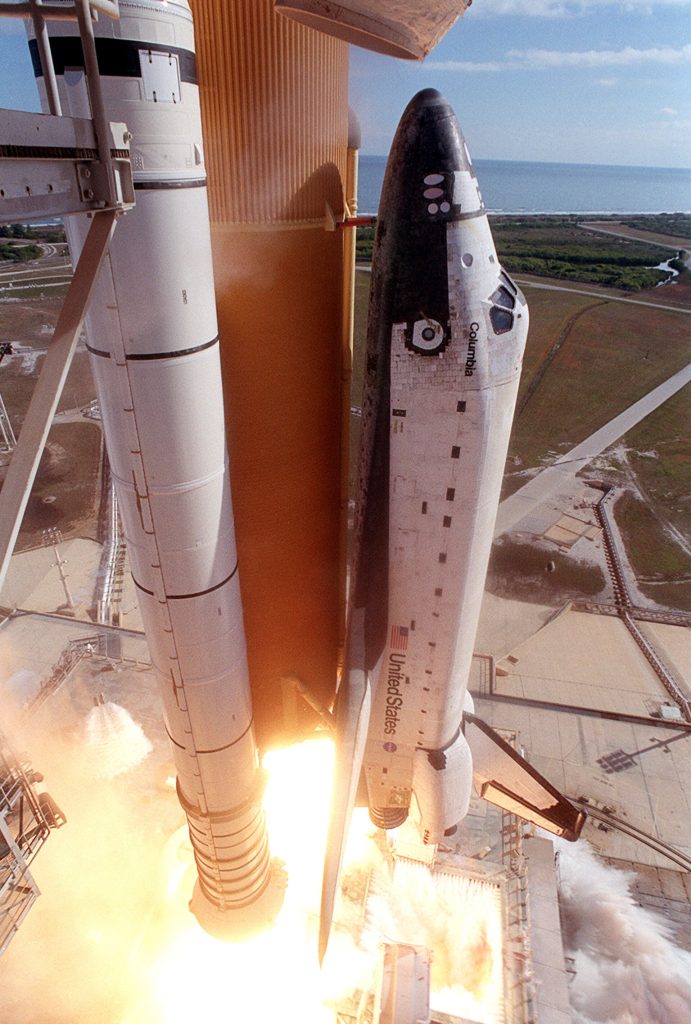
Dick Covey, Endeavour's commander, brought the shuttle beneath the telescope, and Claude Nicollier captured it with the robot arm after sunset left his arm camera nearly blind. Spacewalkers went out in pairs, and Story Musgrave and Jeff Hoffman took the first, third and fifth days.
On day one they installed two rate sensor units for the gyros. Misaligned equipment doors would not close until Musgrave got a heavy duty tool he called a come along, and within five minutes the doors were shut. Thomas Akers and Kathy Thornton handled a solar array whose support was badly bent. It could not be rolled up, so it was disconnected in orbital night and released. It stayed rock solid, then flapped as Ken Bowersox moved the orbiter away with its jets. The new array they fitted had a mass of 330 pounds.
On day three Musgrave and Hoffman replaced the Wide Field Planetary Camera, and Hoffman found insulation peeling on a magnetometer. On day four Akers and Thornton removed the High Speed Photometer to make room for COSTAR, an almost exact rerun of their training, then fitted a 386 based co-processor. Day five was the solar array drive electronics, which had not been designed to be replaced in orbit. A screw drifted off and Hoffman caught it before it reached the cargo bay. Musgrave then described standing above the telescope with a view of the west coast of Australia.
The pictures
All scheduled repairs were done within five days, and Hubble was released. Two weeks later, first light from the wide field camera showed much improved images, though further tuning of the mirrors was needed. Corrected star images from the Faint Object Camera followed just after Christmas. Five weeks after the fix, the senator who had once called the telescope a techno turkey visited NASA's Goddard Space Flight Center.
Questions this video answers
What was wrong with Hubble's mirror?
The mirror had been ground to the wrong prescription because of a simple mistake with a measuring instrument, causing spherical aberration.
How did the mission correct the blurred vision?
The corrective optics COSTAR, a box of mirrors, was installed to fix three instruments including the Faint Object Camera, and a new Wide Field Planetary Camera was fitted.
Which shuttle flew the mission and why?
Endeavour. It carried extra tanks for oxygen, hydrogen and electrical power and for repressurising the airlock, giving more days in orbit.
How many spacewalks were made?
Five days of spacewalks, with the crew going out in pairs.
What happened to the old solar array?
One array had a badly bent support; it was disconnected, then released by Thornton and left behind to burn up in the atmosphere eventually.
Was there a spare mirror?
Yes. NASA commissioned a spare from a rival manufacturer, and it was held under lock and key for about 10 years.
Explore related missions
Connected by the topic: Space Shuttle