Inside the ISS: How the Station Is Built, Powered and Lived In
The short version
A documentary tour of the International Space Station, described as covering 9,700 m² and about 400 tons. It explains how the station was built, how crews arrive on Soyuz, live, exercise, make oxygen and recycle water, and how they handle a 2010 cooling-pump failure, fire, radiation and debris risks. Astronauts narrate their own experiences throughout.
Full written account
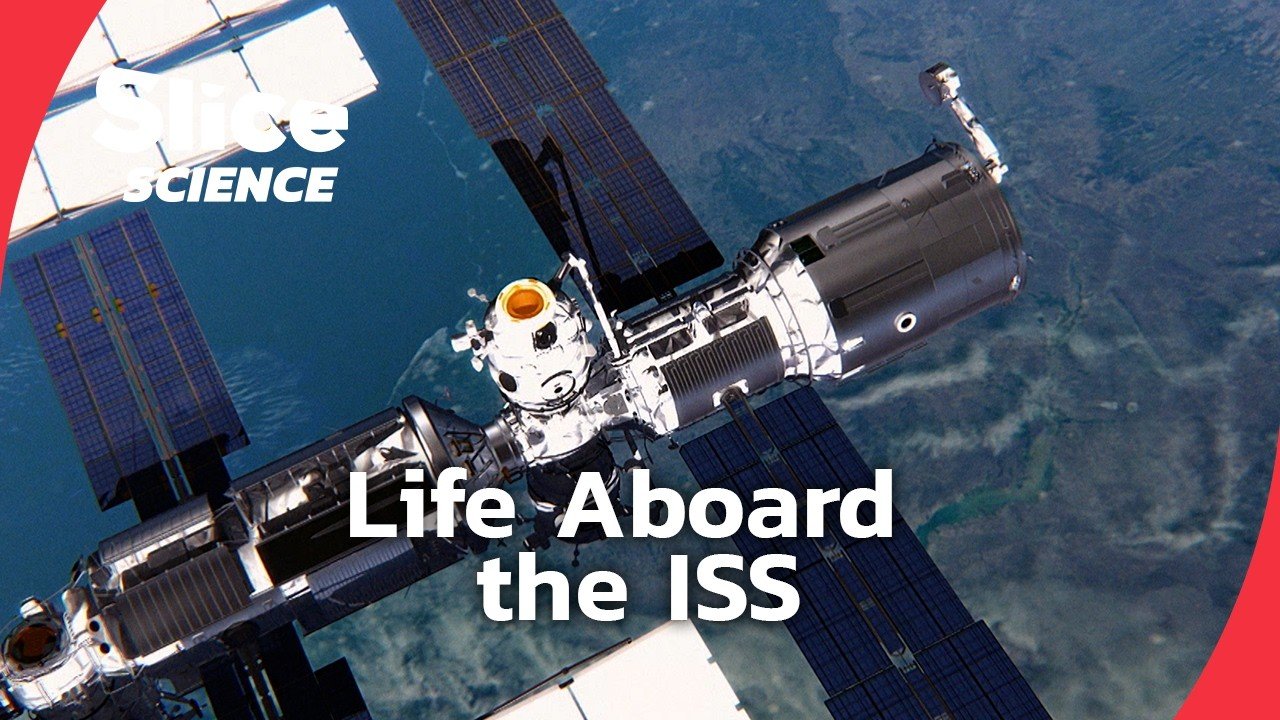
The International Space Station travels around the Earth at 28,000 km an hour, about 400 km above the planet, and completes 16 orbits a day. Roughly 108 m long and 73 m wide, it was assembled over 10 years from modules built on Earth by American, Russian, European, Canadian and Japanese space agencies. A documentary tour with astronauts explains how it is built, powered, supplied and kept safe.
Building the station
The idea of a space station goes back to Konstantin Tsiolkovsky in the 1920s. The Russians launched Salyut 1 in 1971, and the Americans answered two years later with Skylab. In 1975 a joint Apollo-Soyuz mission showed cooperation was possible. Later the Americans planned their own station, but the size and cost of the task brought in the Europeans, Canadians and Japanese, and after the collapse of the Soviet bloc, Russia.
The plan was to build 15 modules on Earth and assemble them in space. The first American module was anchored to the first Russian one in 1998. On November 2nd 2000, Cosmonaut Sergey Krikalev officially became the station's first resident. He recalls that the first job was to turn the lights on and find a cable hidden behind a panel to establish the link with Earth. The crew then plugged in the service module systems and started the unit that purifies carbon dioxide and supplies oxygen. Had it not worked, they could not have stayed long, because the reserves in the Soyuz were very low.
Building the station took 115 launches. Canada supplied a 17 m robotic arm used to move modules, supplies and astronauts. Many components were never tested together on Earth. The project is described as costing some $150 billion.
Arriving and living aboard
Crews travel on Russian Soyuz spacecraft. The trip takes 48 hours, and the vessel is within 400 m of the station after that flight. The station's total volume is comparable to a five-room house, and it was designed for seven astronauts, each staying an average of six months.
Weightlessness shifts blood towards the chest and head, giving astronauts puffy faces, nasal stuffiness and sometimes a dull headache that can last a few weeks. One astronaut recalls stopping in the service module because he did not recognise his surroundings; a more experienced colleague told him he was standing on the ceiling. Astronauts' bodies can lengthen by 2 to 7 cm, and the vision of 75% of astronauts is altered by long stays, with a flattening of the retina causing up to about a diopter of shift towards nearsightedness. The cause is not fully settled; theories include intracranial pressure and higher CO2 levels.
Astronauts sleep in small crew quarters in sleeping bags fixed to the wall, wake between 6:00 and 6:30, and must exercise at least two hours daily.
Science
Astronauts have carried out over 1,700 experiments, using the Kibo, Destiny and Columbus laboratories supplied by Japan, the US and Europe. Examples include the Veggie experiment growing lettuce, robotics work with force-feedback joysticks, and Danish astronaut Andreas Mogensen filming red sprites and a pulsating blue jet from the Cupola, which he says was the first time such a blue jet was captured on video like this.
The Cupola, at the end of the Tranquility module, has seven reinforced windows and always points towards the Earth. This is because the station holds a local vertical, local horizon orientation, steered by four gyroscopes.
Power, air and water
Each solar array is 73 m long and made of more than 32,000 solar panels. The arrays turn at 4° per minute to follow the Sun, and together could supply electricity for around 40 houses. Batteries supply power on the night side of the orbit.
Oxygen is made by electrolysis, splitting water into hydrogen and oxygen, in the Oxygen Generation Assembly and in the Russian service module. Ventilators keep air moving, because without them pockets of CO2 could form around a sleeper's mouth. About 70% of the water on board is recycled, including urine and moisture from towels condensed by the air conditioning.
Reboosts, repairs and dangers
The station's altitude decays by about 2 km per month because of a very thin atmosphere, so a supply vessel fires its motors roughly every six months to raise it. Emptied cargo vehicles are filled with rubbish and burn up on re-entry.
During Tim Peake's first flight, a Soyuz thruster problem about 17 m from the station forced commander Yuri Malenchenko to dock manually, with low sun glare making the periscope view difficult. He eventually docked successfully.
In July 2010, Tracy Caldwell Dyson was doing routine checks when alarms revealed a fault in the thermal control system. A defective ammonia pump had to be replaced. She and Doug Wheelock did spacewalks, Wheelock on the robotic arm, to swap it for one of four spare pumps. Four spacewalks totalling 29 hours were needed.
The documentary names three main dangers: fire, radiation and space debris. Against radiation, the Russian segment's batteries and the Zvezda and Destiny modules are cited as good shelter. More than 100,000 pieces of debris lie in the station's path, and layers of aluminium, ceramic and Kevlar protect the modules. If debris is missed by radar, the crew must close the airlocks and shelter in their Soyuz. The station's life was originally to end in 2020 and has been extended to 2024 or even 2028.
Questions this video answers
How big is the ISS?
The documentary describes it as about 108 m long and 73 m wide, around 400 tons, comparable in size to a football field.
How fast does the ISS travel?
About 28,000 km an hour, circling the Earth 16 times a day.
How long do astronauts stay aboard?
On average about 6 months each.
How long did it take to build the station?
It took 10 years to assemble and 115 launches to bring up modules and crews.
How much water is recycled?
About 70% of the water on board is recycled.
How was the 2010 cooling failure fixed?
Tracy Dyson and Doug Wheelock replaced the defective ammonia pump during four spacewalks totalling 29 hours.