Progress 96 Docks to Poisk After a 3-Day, 49-Orbit Chase
The short version
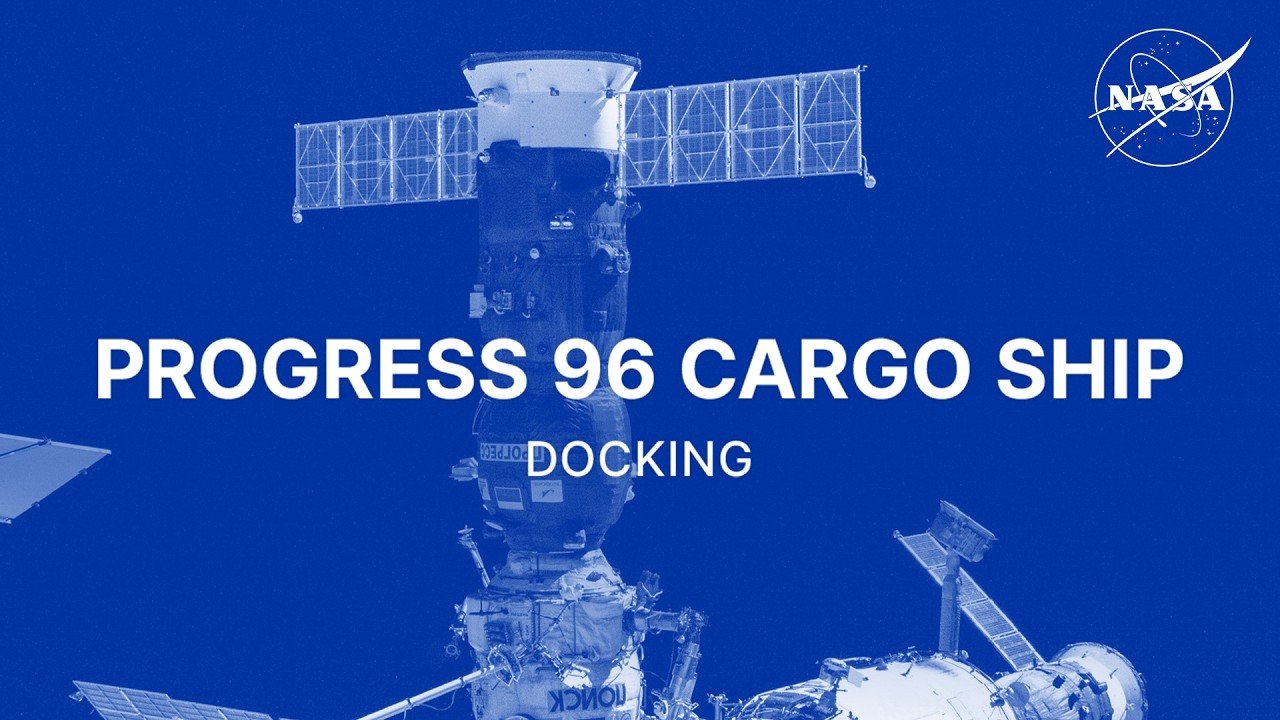
NASA's live coverage follows the unpiloted Roscosmos Progress 96 cargo ship through its final approach and automated docking to the Poisk module of the International Space Station. Launched on a Soyuz 2.1b from Baikonur on Sept. 16, it carried 2.8 tons of food, fuel and supplies for the Expedition 75 crew. Docking was confirmed at 9:44 a.m. EDT, two minutes ahead of schedule, followed by hook closure and a hard mate.
Full written account
Progress 96, an unpiloted Roscosmos cargo ship carrying 2.8 tons of food, fuel and supplies for the Expedition 75 crew, docked to the Poisk module of the International Space Station at 8:44 a.m. Central Time (9:44 a.m. Eastern), two minutes ahead of the scheduled 9:46 a.m. Eastern. The station and the ship were flying 260 miles over the Black Sea at the moment of contact and capture.
A three-day rendezvous
Progress 96 lifted off on a Soyuz 2.1b from the Baikonur Cosmodrome in Kazakhstan on Wednesday, Sept. 16, with engine ignition at 9:33 a.m. Eastern, 6:33 p.m. local time and 23 minutes before sunset. The booster delivered the ship to its preliminary orbit 9 minutes 11 seconds later. Solar arrays and navigational antennas then deployed as planned.
The trip took three days, or 49 orbits. Progress typically flies a 2-day, 34-orbit profile; the orbital mechanics for a September 16 launch date drove the longer one, which was described as uncommon but not unprecedented. Pre-programmed burns first raised the ship's altitude to match the station's, and a series of mid-course corrections followed, including the impulse burns, small final engine tweaks that fine-tuned the approach. One of these, a burn of about 17 seconds, came at a range of about 2 km.
Kurs and the TORU backup
The approach ran on the Kurs automated rendezvous system, which supplies range and rate-of-closure data to the Progress's onboard computers. Kurs was checked out before the approach and operated without problems throughout.
The backup was TORU, the tele-robotically operated rendezvous unit, to be used only in the unlikely event of a Kurs failure. Cosmonaut Pyotr Dubrov would fly it with a joystick from a workstation in the Zvezda service module, with Anna Kikina also named for the checkout. Before the final approach, Dubrov tested TORU's rotational and translational hand controllers with Russian flight controllers at Korolyov. He confirmed the rotational hand control worked nominally and the translational hand control assist test completed successfully.
Fly-around and final approach
At a range of about 400 m, Progress began an automated fly-around of the station to align its forward docking probe with the Poisk port, which sits on the space-facing side of the Russian segment. Poisk is also known as MRM-2, mini research module 2, and serves as the airlock for Russian-based spacewalks. During the fly-around Dubrov reported that the crosshairs sat slightly off the docking target, by fractions of a degree, and ranges from the ruler and the course data matched closely.
Progress then paused in a brief period of station keeping at roughly 150 to 200 m so Russian controllers could check its systems and alignment one more time. They were satisfied and final approach began. Closing speed fell step by step: under 100 m at 0.4 m/s, 30 m at a range rate of 0.14, and about 0.1 m/s through the last metres, the planned contact speed meant to minimise loads on Poisk. Before docking, Houston's flight director Diane Dailey polled her flight controllers for a go for docking.
Capture and hard mate
Contact was confirmed, followed by capture. The forward docking probe retracted, the hooks then closed, and the hard mate between Progress and the station was confirmed about six minutes after docking. Dubrov and Kikina were to run leak checks at the docking interface and open the hatches about three hours after docking to begin unloading. Progress 96 is to stay docked for about five months before departing to reenter and dispose of trash loaded by the station crew. Progress 95 remained docked to the aft port of Zvezda.
The crew aboard
Seven people were aboard: NASA astronauts Jessica Meir (station commander), Jack Hathaway and Anil Menon, ESA's Sophie Adenot, and cosmonauts Dubrov, Kikina and Andrey Fedyaev. Meir, Hathaway, Fedyaev and Adenot were preparing to return aboard Crew Dragon Freedom after a 7-month mission as Crew 12. Menon, Dubrov and Kikina, launched on a Soyuz in July, were to stay on an 8-month mission. Crew 13, made up of Jessica Watkins, Luke Delaney, Joshua Kutryk of the Canadian Space Agency and cosmonaut Sergey Teteryatnikov, was due to launch from Cape Canaveral Space Force Station in early October for a 6-month stay. Fyodor Yurchikhin was to take command from Meir in a few weeks.
Questions this video answers
When did Progress 96 dock with the space station?
Contact and capture were confirmed at 8:44 a.m. Central, 9:44 a.m. Eastern, about two minutes ahead of the scheduled 9:46 a.m. EDT.
Which port did Progress 96 use?
The Poisk module on the space-facing port of the Russian segment.
How much cargo did it carry?
2.8 tons of food, fuel and supplies for the Expedition 75 crew.
How long was the flight to the station?
Three days, a 49-orbit rendezvous profile, instead of the more typical two-day, 34-orbit profile.
What is the TORU system?
The telerobotically operated rendezvous unit, a backup operated by joystick from the Zvezda service module in case the Kurs automated system fails.